The Supreme Court in the Sabitri Dey @ Swasthi Dey vs Union of India case set aside a Gauhati High Court judgment, ruling that determining citizenship or foreigner status requires a fair, lawful, and reasonable process through Foreigners Tribunals.
Citizenship adjudication is the formal legal and quasi-judicial mechanism through which the State determines an individual's legal identity, nationality, and right to belong to the political community.
Background
India's citizenship framework, rooted in colonial anxieties under the Foreigners Act of 1946, originally controlled wartime migrants.
In Assam, demographic politics heavily shapes this process, leading to the National Register of Citizens (NRC) and tribunal rulings.
Parliament's Immigration and Foreigners Act, 2025, centralizes digital surveillance while retaining a strict reverse burden of proof.
Objectives
Detects and prevents unauthorized foreign nationals from illegally obtaining Indian citizenship through deceit or manipulation.
Protects genuine citizens' fundamental rights against wrongful exclusion or statelessness caused by administrative negligence.
Citizenship is the Gateway to Constitutional Rights
Citizenship functions as the fundamental "right to have rights," acting as the primary link that connects an individual to the protective constitutional, civil, and political machinery of the State.
Protects Individuals Against Arbitrary Deprivation of Rights
The Supreme Court rules that arbitrary State action under statutory guise lacks legal protection. Fair process shields vulnerable populations from "civil death"—the complete loss of political participation, welfare access, and freedom.
Upholds Principles of Natural Justice
Citizenship determination demands strict adherence to audi alteram partem (the right to be heard). Despite Section 9 of the Foreigners Act placing the burden of proof on the accused, tribunals must uphold objective consideration and natural justice.
Strengthens Democratic Legitimacy
Fair internal processes legitimize a constitutional democracy. Transparent adjudication prevents citizen dehumanization and builds essential public trust in quasi-judicial institutions.
Reinforces Rule of Law and Due Process
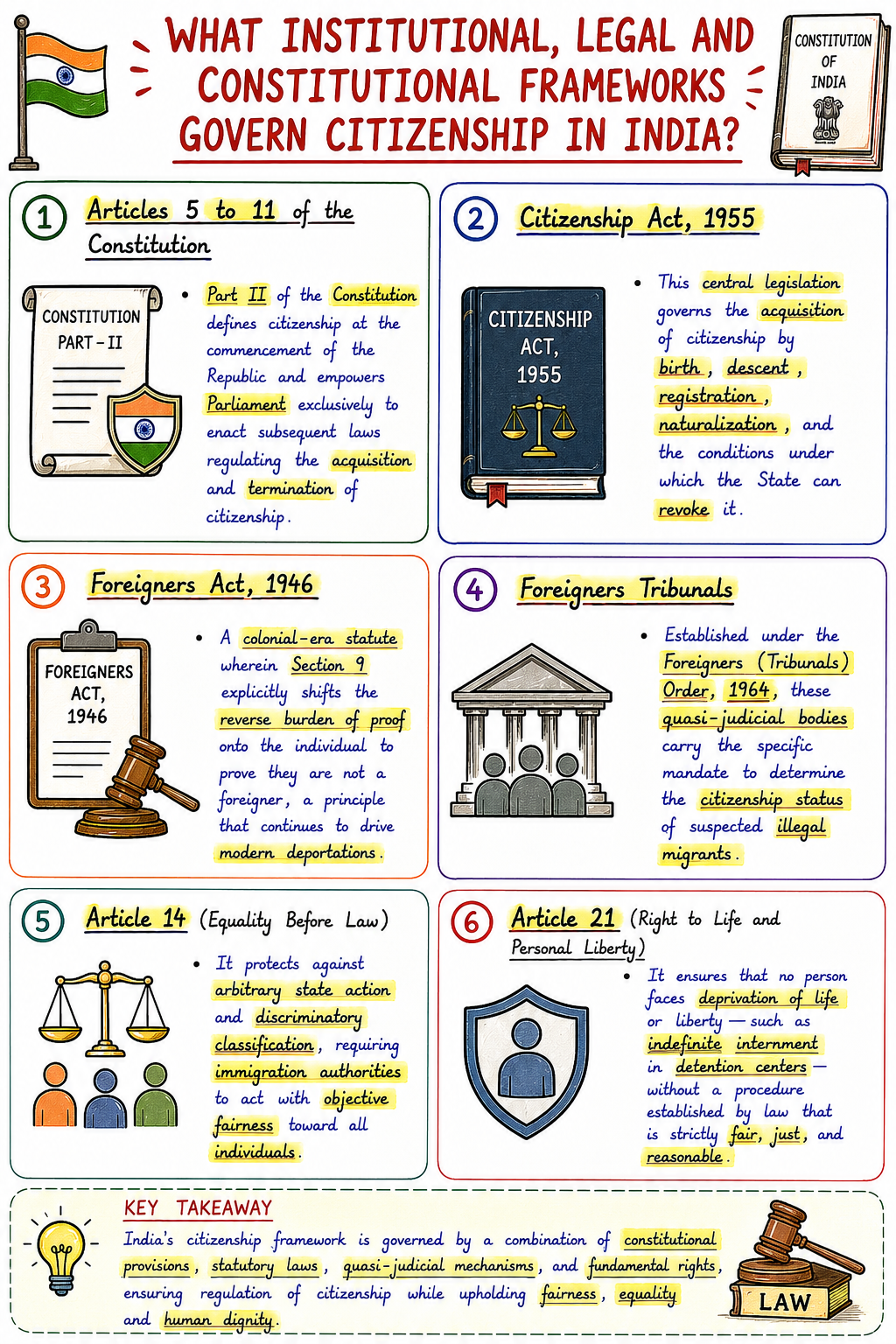
Article 21 (Life and Personal Liberty) protects citizens and foreigners alike. Judicial oversight ensures "fair, just, and reasonable" procedures, blocking arbitrary or oppressive executive deportation orders.
Right to Notice
Authorities must duly serve legal notices to the accused, clearly disclosing the "main grounds" of the allegation before initiating any quasi-judicial proceedings.
Right to Be Heard
Even in ex-parte proceedings, tribunals must evaluate the merits of the case actively; they cannot pass a guilty verdict simply because the accused failed to appear.
Reasoned and Speaking Orders
Adjudicators must draft transparent, reasoned decisions that demonstrate a thorough application of mind, rather than mechanically endorsing police or executive references.
Access to Evidence and Documentation
Tribunals must objectively assess historical lineage documents, such as pre-1971 legacy data and electoral rolls, rather than discarding genuine claims over minor typographical discrepancies.
Opportunity to Present Defence
The State must provide individuals adequate time, support, and a non-coercive environment to procure complex historical documents necessary to discharge their burden of proof.
Judicial Review and Appeal Mechanisms
The Supreme Court maintains that the severe consequences of foreigner declarations demand judicial oversight, ensuring administrative actions comply with statutory and constitutional standards.
Protection of Fundamental Rights
It securely anchors the protections under Article 14 (Equality Before the Law) and Article 21 (Right to Life), ensuring the State treats every individual with inherent human dignity.
Prevention of Wrongful Exclusion
Robust procedural checks stop innocent citizens from permanent statelessness, unlawful detention in holding camps, and forced deportations.
Enhanced Public Confidence in Institutions
When tribunals operate transparently and issue objective rulings, it mitigates societal panic and fosters deep trust in the judiciary and administrative frameworks.
Greater Administrative Accountability
Mandating reasoned orders forces investigating agencies and Foreigners Tribunals to elevate their evidentiary standards, eliminating arbitrary policing and reliance on unverified hearsay.
Strengthening Constitutional Governance
By synchronizing national security imperatives with individual liberties, a fair process aligns India's domestic actions with customary international law and democratic ideals.
Documentation Deficiencies
Historical record-keeping lacked penetration; until the year 2000, India registered only 56% of births, making it nearly impossible for older generations to produce formal legacy data.
Socio-Economic Vulnerabilities of Affected Persons
Illiterate laborers and marginalized groups living in fluctuating geographies, like Assam's river islands (chars), possess fragile, miswritten records, making them highly susceptible to clerical erasure.
Procedural Delays
The systemic backlog and mechanical disposal of cases force individuals into decades of agonizing legal limbo, draining their financial and mental resources.
Risk of Arbitrary Decisions
Unstructured discretionary powers granted to authorities often lead to subjective, biased evaluations where minor errors (like an age mismatch) trigger permanent foreigner declarations.
Access to Legal Assistance
Marginalized people/groups lack the financial capacity to secure legal representation, undermining their ability to defend themselves in complex tribunal hearings.
Balancing National Security and Individual Rights
The State constantly struggles to secure porous borders against illegal migration without weaponizing the law to strip vulnerable, undocumented citizens of their rightful status.
Ensuring Procedural Due Process
Courts must monitor tribunals to guarantee proper notice issuance, independent hearings, and the outright elimination of mechanical, unreasoned ex-parte orders.
Strengthening Legal Aid Mechanisms
The government should expand frameworks like the Tele-Law service to provide mandatory, high-quality, free legal representation to marginalized individuals facing citizenship challenges.
Improving Documentation and Record Systems
Administrators must adopt humane evidentiary standards that accommodate historical documentation gaps and pardon minor clerical anomalies in land and voter records.
Capacity Building of Adjudicatory Bodies
The State must replace temporary contract-based tribunal members with permanent, specialized judicial officers equipped with mandatory training in constitutional and human rights.
Enhancing Transparency and Accountability
Creating a robust, independent appellate tribunal system will provide an accessible layer of scrutiny over Foreigners Tribunal verdicts, curbing executive overreach.
Promoting Citizen Awareness of Legal Rights
Civil society and government bodies must proactively conduct legal literacy campaigns in border districts, empowering vulnerable citizens to understand their documentation and constitutional rights.
The Supreme Court's mandate for fair procedure in citizenship adjudication reinforces that constitutional guarantees of natural justice cannot be subverted by administrative technicalities, ensuring that individual liberty and human dignity remain paramount.
Source: TIMESOFINDIA
|
PRACTICE QUESTION Q. Citizenship determination is not merely an administrative exercise but a constitutional process that must adhere to principles of fairness, natural justice and due process." Discuss. (250 Words, 15 Marks) |
Section 9 enforces a "reverse burden of proof," legally obligating the accused individual—rather than the State—to prove that they are an Indian citizen.
These are specialized quasi-judicial bodies established under the Foreigners (Tribunals) Order, 1964, specifically tasked with adjudicating whether an individual living in India is an illegal migrant.
The Supreme Court continuously holds that Article 21 (Right to Life and Personal Liberty) applies to all persons. Consequently, any tribunal procedure that deprives someone of their liberty must be strictly fair and non-arbitrary.
The 2025 Act consolidates several colonial-era immigration laws into a modern digital framework. However, it retains the controversial reverse burden of proof and expands the State's biometric and surveillance capabilities over foreigners.
© 2026 iasgyan. All right reserved