Adopting agriphotovoltaics (Agri-PV) enables India to achieve clean energy self-reliance and reduce power subsidies by transforming agricultural land into dual-purpose energy and food production sites.
Energy security represents the uninterrupted availability of energy sources at an affordable price, ensuring reliable, sustainable, and modern energy services to meet national needs.
 India’s Energy Dependence Challenge
Import Vulnerability: India imports approximately 85% of its crude oil requirements, triggering massive foreign exchange outflows and exposing the economy to global geopolitical shocks.
Structural Risk: Fossil fuel disruptions directly constrain fertilizer supplies, transmitting energy shocks straight into India’s agricultural economy.
Agriculture as a Source of Renewable Energy
Initiatives like the PM-KUSUM scheme transform farmers from food providers (Annadata) to energy producers (Urjadata) through decentralized solar generation on farmlands. Solarizing feeders and irrigation pumps reduces reliance on imported diesel and the electrical grid.
Biomass Availability in India
India produces approximately 350 million tonnes of agricultural waste yearly, offering a potential 18,000 MW of power. 750 million tons of non-edible biomass are utilized annually to supplement coal and save foreign exchange.
Crop Residues as Energy Resources
By converting crop residues like stalks and straw into compressed biogas (CBG), ethanol, and biomass pellets instead of burning them, you advance a waste-to-wealth model. This produces bioenergy alongside nutrient-rich organic fertilizers that improve soil health.
|
India’s Agricultural Biomass Potential Rice Straw: India collects surplus rice straw to produce Second Generation (2G) biofuels, reducing stubble burning and lowering greenhouse gas emissions by 60-90%. Sugarcane Residues: Bagasse, a high-yield byproduct, supports a potential of 3,500 MW in cogeneration power projects. Maize and Corn: Maize emerges as a primary feedstock for ethanol, with domestic production growing at an 8.77% CAGR from FY22 to FY25. Animal Waste: India deploys vast quantities of livestock dung to produce biogas and bio-CNG, ensuring safe disposal and clean rural energy. |
Biofuels and Energy Security
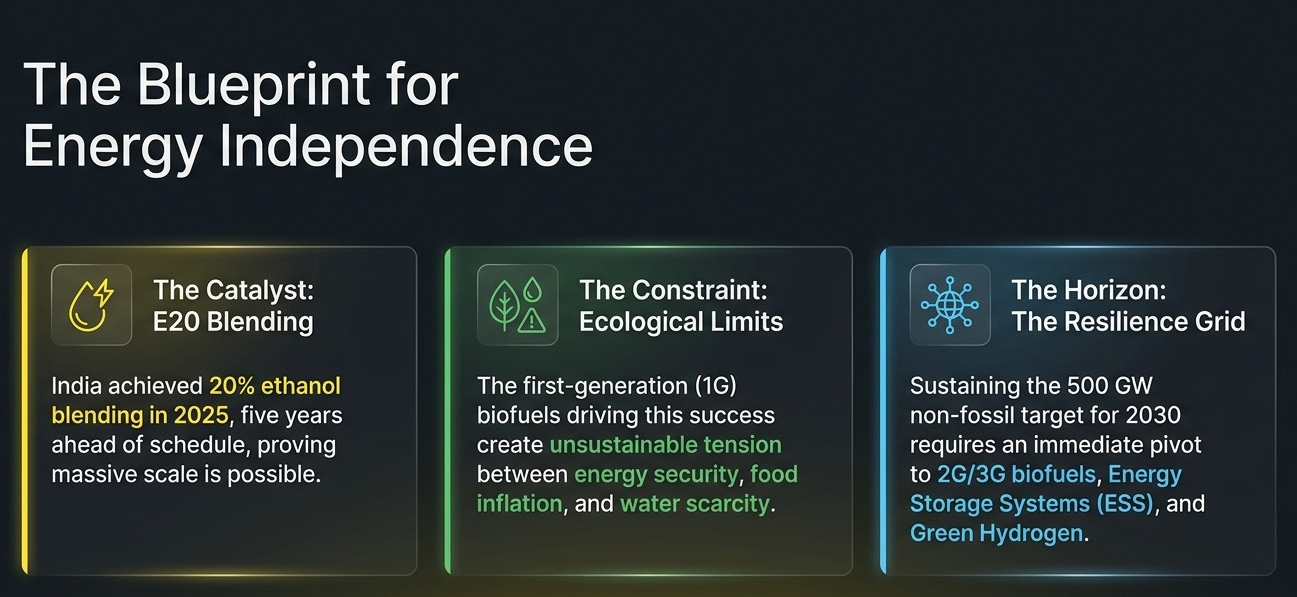
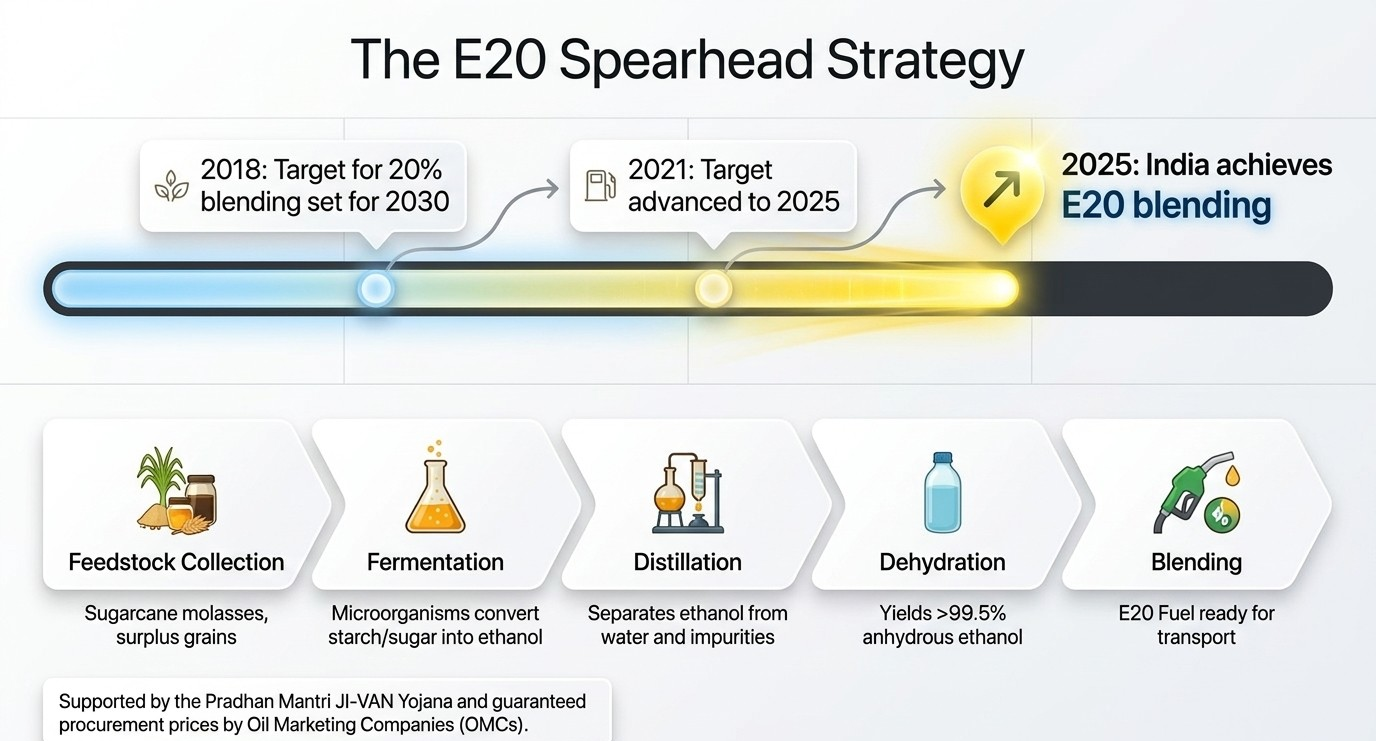
Ethanol Blending Programme (EBP): India achieved the 20% ethanol blending (E20) target five years ahead of schedule, projecting annual savings of $10 billion in crude imports.
Compressed Biogas (CBG): India extracts methane from agricultural residues and municipal solid waste to substitute natural gas in transport and domestic sectors.
Sustainable Aviation Fuel (SAF): The government strategically channels 2G ethanol and CBG extracted from paddy straw to capture the 2030 SAF market.
Biodiesel: India extracts biodiesel from non-edible oils, Used Cooking Oil (UCO), and waste animal fats to provide an alternative market for oilseed crops.
 Key Government Initiatives
National Biofuel Policy
Reduce crude oil imports, lower greenhouse gas emissions, and boost the rural economy by promoting domestic biofuel production.
SATAT Scheme
The SATAT (Sustainable Alternative Towards Affordable Transportation) scheme promote the production and usage of Compressed Bio-Gas (CBG) as a green, cost-effective alternative to traditional automotive and industrial fossil fuels
Gobar-Dhan Scheme
GOBARdhan (Galvanizing Organic Bio-Agro Resources Dhan) initiative turning bio-waste into biogas and bio-slurry. By converting cattle dung, crop residues, and food waste into clean energy and organic manure, the scheme drives a rural circular economy, improves village sanitation, and reduces greenhouse gas emissions.
PM-JI-VAN Yojana
The Pradhan Mantri JI-VAN Yojana (Jaiv Indhan-Vatavaran Anukool fasal awashesh Nivaran) promotes the commercial production of 2G (Second-Generation) bioethanol from agricultural residue and biomass. It aims to reduce carbon emissions, lower crude oil imports, and provide extra income for farmers.
Production Process: Microorganisms anaerobically break down farm and municipal waste, capturing methane to produce commercial-grade CBG
Rural Employment: Decentralized CBG plants boost local industry, creating thousands of rural green jobs and preventing forced urban migration.
Import Substitution: CBG directly substitutes imported Liquefied Natural Gas (LNG) and crude oil, strengthening national energy sovereignty.
Circular Economy: Fermented organic manure—a byproduct of CBG—replaces synthetic fertilizers, completing the waste-to-wealth loop.
|
Ethanol Economy and Rural Prosperity Sugarcane Yields: B-heavy molasses and sugarcane juice yield up to 70 litres of ethanol per ton, offering farmers the highest fixed ex-mill prices. Maize Incentives: The government incentivizes maize-based ethanol, ensuring guaranteed offtake by Oil Marketing Companies. Income Injection: Assured demand from the biofuel sector injects an estimated ₹40,000 crore annually into the rural economy. Foreign Exchange Savings: India substituted 245 lakh metric tonnes of crude oil through the ethanol program, saving ₹1.44 lakh crore in foreign exchange reserves. |
Biomass Collection and Logistics
Massive supply chain bottlenecks because agricultural residue is only available for a few months annually, requiring huge land parcels for storage.
Seasonal Availability of Feedstock
Fluctuations in monsoons and crop yields directly disrupt the continuous supply of feedstock needed to keep biofuel plants operational year-round.
High Initial Investment
Advanced 2G ethanol technology and commercial CBG plants demand steep capital expenditure (₹150-200 Cr for large units), heavily deterring rapid scaling.
Technology Adoption Gaps
Older vehicles face severe material compatibility issues, fuel pump corrosion, and increased maintenance costs up to ₹10,000 when using E20 petrol.
Water-Energy-Food Trade-offs
Producing one litre of ethanol from rice consumes over 10,000 litres of water, severely aggravating groundwater depletion in states like Maharashtra.
Food vs Fuel Dilemma
Diverting edible crops like maize and rice to distilleries causes supply shortages for poultry feed, triggering severe food inflation.
Land-Use Conflicts
Expanding large-scale utility solar projects frequently encroaches on valuable agricultural land, actively displacing food crops and threatening local ecological balances.
Ecological Impact of Monocropping
Deplete soil nutrients and increase vulnerability to pests by monocropping water-guzzling sugarcane and rice specifically for biofuel.
Integrating Agriculture and Energy Policies
Establish an apex Just Energy Transition Authority to harmonize food security mandates with ambitious clean energy targets.
Scaling Up Biofuel Infrastructure
Mandate multi-grade flex-fuel pumps and construct dedicated ethanol storage corridors to permanently resolve supply chain bottlenecks.
Supporting Farmer Producer Organisations (FPOs)
Empower FPOs with direct access to the Agriculture Infrastructure Fund to manage massive biomass aggregation and sorting hubs.
Promoting Decentralised Renewable Energy Systems
Deploy standalone solar agriculture pumps to drastically slash DISCOM subsidies and ease peak daytime grid pressure.
Incentivising Biomass-Based Industries
Provide Viability Gap Funding (VGF) and generation-based incentives to make advanced 2G ethanol and CBG plants commercially viable.
Promoting 2G & 3G Biofuels
Invest in commercializing lignocellulosic (2G) and algae-based (3G) fuels to resolve the fierce food vs. fuel conflict.
Water-Smart Ethanol Production
Enforce mandatory water audits for all distilleries and strongly promote drought-tolerant feedstocks to safeguard rapidly depleting groundwater reserves.
Transforming Indian farms into sustainable energy hubs perfectly aligns agricultural prosperity with national energy security, driving India's resilient transition toward a net-zero future.
Source: INDIANEXPRESS
|
PRACTICE QUESTION Q. Analyze the concept of 'Just Energy Transition' in India. How can integrating agriculture into the renewable energy matrix through schemes like PM-KUSUM protect small and marginal farmers? 150 words |
Agriculture strengthens energy security by supplying massive volumes of biomass feedstock—such as sugarcane, maize, and crop residues—that rural bio-refineries convert into domestic biofuels and decentralized biopower, effectively insulating the grid from volatile global energy shocks.
Biofuels directly slash crude oil imports by serving as high-blend components in commercial petroleum products, with initiatives like India's 20% ethanol blending target displacing millions of barrels of imported fossil fuels and saving billions in foreign exchange reserves annually.
The primary bottlenecks include highly fragmented and seasonal supply chains, high logistics and compaction costs for transporting bulky crop wastes, a lack of specialized local harvesting machinery like balers, and the competitive need to retain residues for maintaining soil organic carbon.
Farm-based energy drives global climate targets by creating a closed-loop circular carbon economy that permanently displaces high-emission fossil fuels, intercepts toxic open-field stubble burning to improve air quality, and generates organic biochar for long-term geological carbon sequestration.
© 2026 iasgyan. All right reserved