

The rising compliance costs of Non-Tariff Measures (NTMs), such as the EU's Carbon Border Adjustment Mechanism (CBAM), emphasize a global shift where regulatory standards now outpace traditional tariffs as the primary barriers to international trade.
What Are Trade Barriers?
Trade barriers is a strategic government policy designed to restrict international trade and deliberately shield domestic businesses from foreign competition.
They manifest as either direct tariff barriers (taxes) or complex Non-Tariff Measures (NTMs) that obstruct free market access.
Job Protection: Governments use barriers to sustain unorganized sectors and prevent unemployment.
Infant Industry Support: Developing nations subsidize new manufacturers to build global competitiveness through economies of scale.
National Security: Nations limit foreign reliance in critical sectors like aerospace and food to ensure autonomy during crises.
Consumer Safety: Strict health standards are mandated to block hazardous imports.
Historically, trade protectionism utilized mercantilist tariffs, but the 21st century has shifted toward invisible regulatory hurdles.
Since the WTO's 1995 inception, global tariffs halved, leading protectionism to migrate to NTMs, which now affect 90% of global trade volume. (Source: World Bank)
|
What Are Tariffs? Tariffs function as direct border taxes imposed on imported goods, inflating foreign product prices to make domestic alternatives financially competitive. Types include Ad Valorem (percentage of value), Specific (fixed fee per unit), and Tariff Rate Quotas (TRQs) which allow a certain volume at a low rate before imposing massive duties. |
Global Decline in Average Tariff Rates
Expansion of Global Value Chains
Rise of Regulatory and Technical Standards
NTMs comprise all policy measures excluding standard customs tariffs that influence trade volume, costs, and competition. These include technical regulations, sanitary controls, import licensing, and conformity assessments.
The WTO permits NTMs via the TBT (Technical Barriers to Trade) and SPS (Sanitary and Phytosanitary) Agreements, mandating that member states justify health and safety barriers using verifiable scientific evidence.
Unlike transparent tariffs, NTMs act as opaque behind-the-border filters. They currently create higher export costs than tariffs for 88% of nations due to heavy compliance burdens. (Source: UNCTAD)
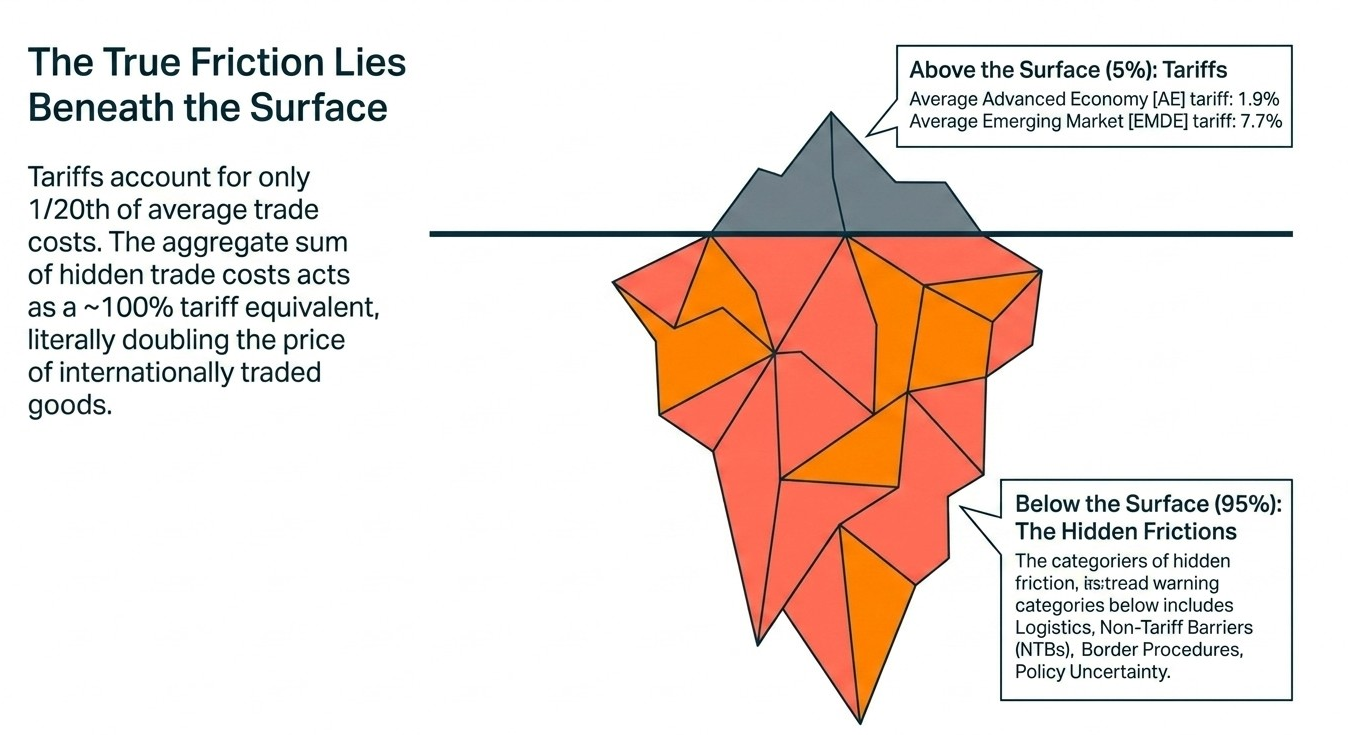 Major Types of Non-Tariff Barriers
Sanitary and Phytosanitary (SPS) Measures
Governments use SPS rules to protect health from contaminants. Case Study: In 2024, the EU's Rapid Alert System for Food and Feed (RASFF) blocked 217+ Indian agricultural products citing severe health risks.
Technical Barriers to Trade (TBT)
TBTs mandate specific packaging and quality. Developed nations often reject international standards, causing 5-7 year approval delays.
Licensing Requirements
Onerous paperwork and arbitrary approvals bottleneck imports. Example: Indian standards require a six-month certification for Pakistan cement, stalling a three-week procedure.
Quotas and Import Restrictions
Volume limits are enforced to protect domestic market share.
Rules of Origin
It Prevent trade deflection. Complex Product-Specific Rules limit sourcing options, acting as potent barriers.
Subsidies and Domestic Support
State funding lowers domestic costs. Rich nations provide $360 billion annually in farm subsidies, undermining developing world competitiveness.
Carbon Border Adjustment Mechanism (CBAM)
The EU weaponized climate policy by introducing CBAM, a border carbon tax penalizing imports from high-emission developing economies.
Environmental Standards
Regulations like the EU Deforestation Regulation demand exhaustive geographical traceability, transforming ecological compliance into a major structural roadblock.
Labour and Human Rights Standards
Western nations deploy humanitarian clauses to unilaterally block goods suspected of exploiting forced or child labor.
Digital Trade Regulations
Nations mandate strict data governance rules that systematically block cross-border data flows, crippling the massive global digital services sector.
Data Localisation Requirements
Governments mandate foreign digital companies to store citizen data strictly within local geographic borders and meet mandatory local content quotas (e.g., EU demanding 20% local content on Netflix).
ESG Compliance Norms
Environmental, Social, and Governance (ESG) reporting metrics strictly dictate trade financing; failure to conform triggers credit denial or inflated borrowing costs.
Developing nations suffer "double burden": escalating domestic tariffs combined with the exorbitant financial costs of conforming to western technical certifications.
Hidden transparency failures and non-notification of rules inflict trade costs equivalent to a massive 28% ad valorem tariff on emerging economies (Source: UNCTAD).
Exporters desperately lack accredited domestic laboratories, forcing them to absurdly route testing through third-party countries just to secure legal EU or U.S. market access.
Due to the inability to match ultra-strict technical standards, Least Developed Countries (LDCs) permanently lose an estimated 10% of their total exports to G20 markets. (Source: UNCTAD)
The weaponization of non-tariff regulations systematically locks smaller nations out; LDCs account for a microscopic 1.1% of world exports in 2024, far behind the UN target of 2%. (Source: UNCTAD)
Micro, Small, and Medium Enterprises (MSMEs) lack the financial and legal stamina to decipher the 20,000+ distinct technical requirements demanded by foreign FTA partners.
Despite zero-tariff promises, Indian agricultural and processed foods violently hit the wall of EU SPS standards; agricultural trade costs remain four-fifths higher than manufacturing costs. (Source: World Bank)
Indian pharmaceutical and textile utilization of the ASEAN and Japan FTAs sits miserably below 50% due to hostile Indonesian registrations and unyielding Japanese lab approvals.
The EU's CBAM represents an existential threat to India's iron, steel, and aluminium sectors, which currently pump nearly 25% and 14% of their respective exports directly into European markets.
India's overall FTA utilization rate painfully hovers around 25%, starkly underperforming against the 70-80% utilization rate enjoyed by advanced economies.
Faulty tariff structures and unaddressed partner NTBs historically cause India's imports to surge faster than its exports post-FTA implementation, widening the national trade deficit.
New Delhi counter-attacks by actively multiplying its own mandatory Quality Control Orders (QCOs) across electronics, machinery, and chemicals to legally block sub-standard imports.
India rapidly modernizes logistics by integrating customs frameworks via the National Trade Facilitation Action Plan, slashing horrific border wait times to boost global rankings.
Indian negotiators now prioritize Sector-Specific Mutual Recognition Agreements (MRAs) in pharmaceuticals and gems to instantly eliminate the financial hemorrhage of duplicate testing.
India shifts its strategic methodology; the landmark UAE CEPA guarantees automatic approval for Indian medicines previously cleared by major global regulators.
The historic 2025 India-EFTA TEPA introduces a radical shift, installing permanent, legally binding sub-committees dedicated to continuously dismantling NTBs.
Rather than battling border barriers, the government pushes Outward Foreign Direct Investment (OFDI), encouraging Indian giants to construct physical production hubs directly within friendly allied territories.
To eliminate Western pretexts for rejecting exports, India must align its domestic industrial quality with international (ISO/EU) standards.
India can access carbon-tax-protected Western markets by accelerating its domestic green transition and decarbonizing heavy industry.
India is pursuing trade deals with the Central Asia, Middle East to penetrate untapped markets and end its dependence on stagnant Western economies.
Trade policy must shift from seeking simple market access to securing strategic production partnerships in electronics, defense, and pharmaceuticals.
India should leverage its digital and IT service advantage, focusing on sectors that bypass physical tariffs and shipping disruptions.
India has a unique chance to absorb the multinational manufacturing shift away from high-risk zones, establishing itself as the primary "China Plus One" anchor.
Fragmentation of Trade Rules: The proliferation of overlapping bilateral treaties creates a "noodle bowl" of conflicting regulations, undermining the WTO’s uniform governance.
Compliance Burdens: Opaque regulatory requirements act as a hidden tax, inflating the cost of exports from developing nations by over 20% due to redundant customs compliance.
Protectionist Regulations: Advanced economies deploy pseudo-ethical environmental and human rights regulations as legal fortresses to block competition from developing-world exporters.
Asymmetric Negotiating Capacity: Developing nations lack the extensive legal and scientific resources required to contest the relentless barrage of Non-Tariff Barriers (NTBs).
Logistics Vulnerabilities: The World Bank identifies that shipping monopolies and maritime bottlenecks expose the Global South to volatile trade costs that can instantly double the price of physical goods.
Urge partners to sign binding Mutual Recognition Agreements (MRAs) for automatic global acceptance of Indian exports
Fund world-class domestic laboratories to end reliance on third-party countries for product clearances.
Provide targeted financial and technical aid to help MSMEs navigate complex Rules of Origin.
India should lead the Global South in demanding WTO transparency reforms that legally require advanced economies to scientifically justify and quantify all new non-tariff barriers.
All future FTAs must include permanent, fast-track Regulatory Sub-Committees to neutralize emerging NTBs and protect trade flows.
Adopt AI, blockchain, and automated "Single Window" clearances to eliminate bureaucratic bottlenecks and reduce international logistics costs.
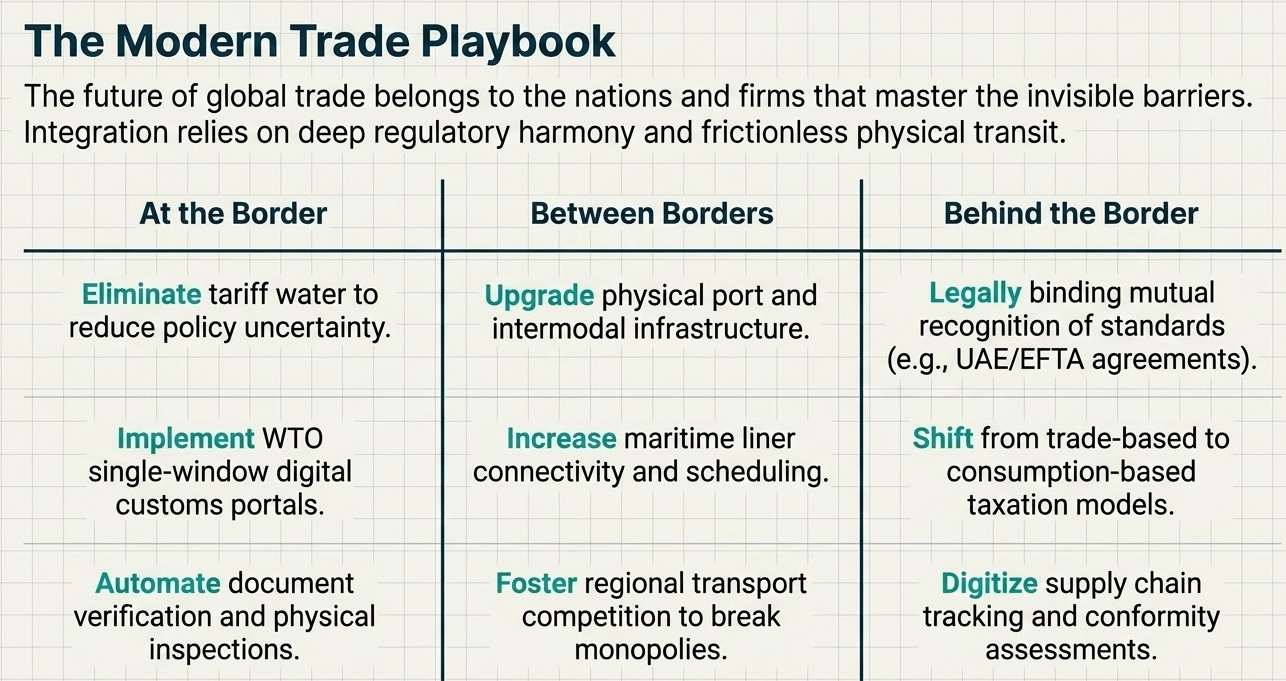 onclusion
Future economic growth requires nations to move past simple tariff cuts and address the complex Non-Tariff Measures and regulatory standards currently governing global market access.
Source: THEHINDU
|
PRACTICE QUESTION Q. Analyze the impact of emerging environmental trade barriers, such as the European Union's Carbon Border Adjustment Mechanism (CBAM), on the export competitiveness of developing nations like India. 250 words |
Non-tariff barriers (NTBs) are restrictive government policies, regulations, and administrative procedures—such as quotas, import bans, and complex quality certifications—that restrict or penalise international trade without the imposition of a direct tax at the customs border.
Tariffs operate as explicit, highly transparent border taxes that directly increase the price of imported goods, whereas non-tariff measures act as implicit, complex regulatory frameworks that control trade volume, raise compliance costs, or introduce administrative delays.
Indian exporters face severe bottlenecks including stringent Sanitary and Phytosanitary (SPS) safety checks on agricultural goods, costly Technical Barriers to Trade (TBT) such as mandatory quality marks, and green protectionist policies like the European Union's Carbon Border Adjustment Mechanism (CBAM).
India can boost its global export edge by upgrading domestic laboratory and certification infrastructure to match international standards, leveraging the Export Promotion Mission (EPM) to help MSMEs with regulatory compliance, and aggressively negotiating mutual recognition agreements within Free Trade Agreements.
© 2026 iasgyan. All right reserved