

Copyright infringement not intended
Picture Courtesy: INDIAN EXPRESS
The debate over criminalising marital rape has intensified as the Supreme Court is set to hear a batch of petitions challenging the constitutional validity of the marital rape exception.
|
Read all about: MARITAL RAPE STATUS IN INDIA l AGE OF CONSENT: MEANING, CHALLENGES, WAY FORWARD |
Marital rape is non-consensual sexual relations between spouses, defined by the lack of consent. It is a severe domestic violence, violating trust and bodily autonomy.
Current Legal Status in India
Legal Provision: Sexual intercourse by a man with his own wife is not considered rape under Section 63, Exception 2 of Bharatiya Nyaya Sanhita (BNS), provided the wife is over 18.
Judicial Intervention: In the Independent Thought vs Union of India (2017) case, the Supreme Court criminalized the rape of a minor wife by raising the age of consent within marriage from 15 to 18 years, though this protection was not granted to adult married women.
Civil vs Criminal Remedy: Marital rape, a form of sexual abuse under the Protection of Women from Domestic Violence Act, 2005, is grounds for divorce but is only a civil remedy, not leading to criminal prosecution.
Conflict with Constitutional Values
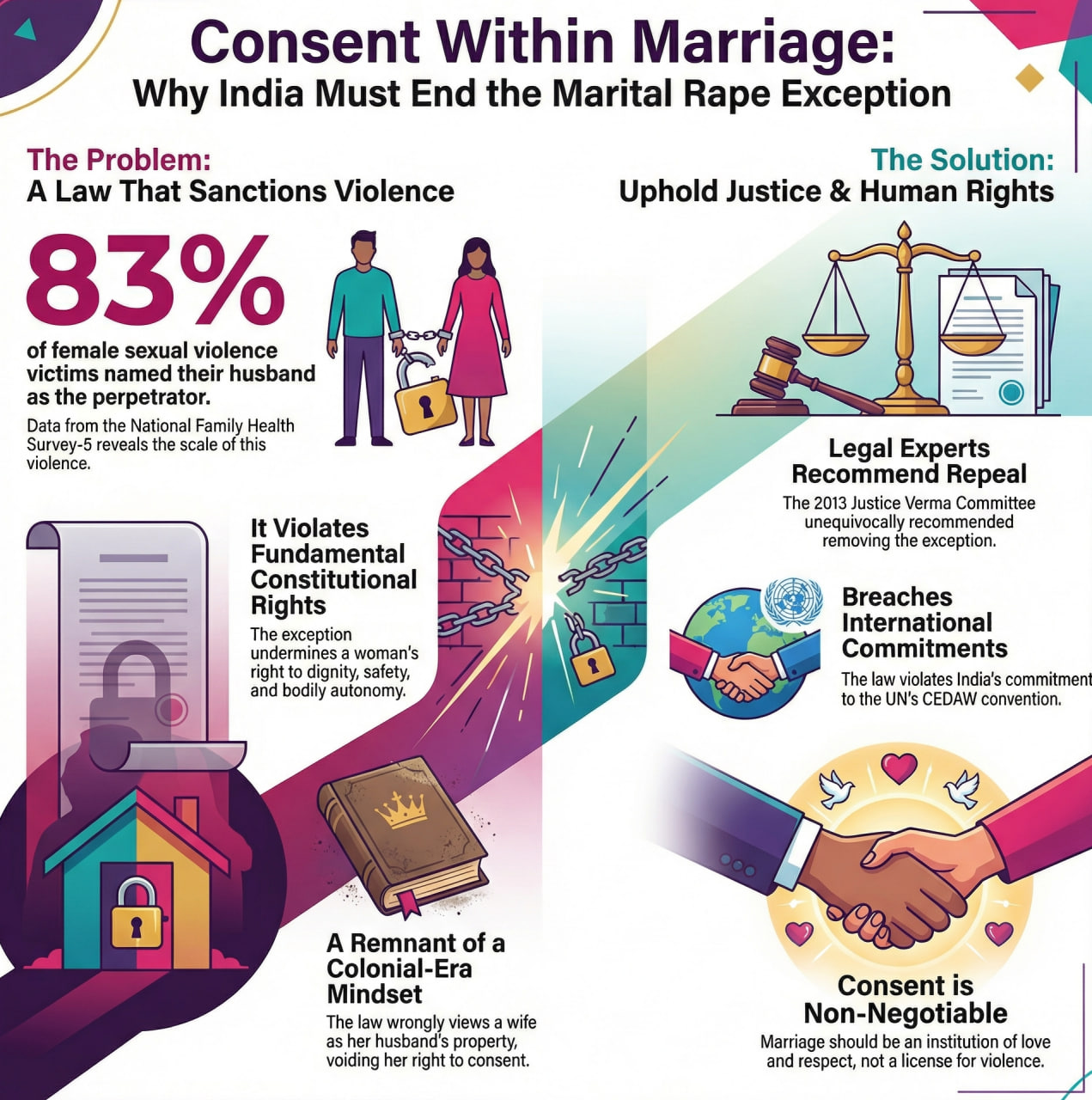
The marital rape exception directly violates the fundamental rights guaranteed by the Constitution.
|
Constitutional Article |
Core Principle |
How the Marital Rape Exception Violates It |
|
Article 14 |
Right to Equality |
It creates an arbitrary classification between married and unmarried women. It denies married women the equal protection of the law against the same act of sexual violence. |
|
Article 15 |
Prohibition of Discrimination |
It discriminates against women based on their marital status, reinforcing patriarchal ideas that a wife's legal identity is subordinate to her husband's. |
|
Article 21 |
Right to Life and Personal Liberty |
The Supreme Court has interpreted this to include the right to dignity, privacy, and bodily autonomy. Forced sexual relations are a gross violation of these rights. The Justice K.S. Puttaswamy vs. Union of India (2017) judgment affirmed that the right to make intimate personal choices is central to the right to life. |
Social and Psychological Impact
The legal immunity for marital rape normalizes sexual violence within families and has severe consequences:
Scale of the Problem: NFHS-5 Data
The prevalence of spousal violence in India is alarmingly high, with sexual violence being underreported.
Government opposes the criminalization of marital rape, arguing it would destabilize the "institution of marriage" and is "excessively harsh" for husbands.
Argument 1: Threat to the Institution of Marriage. The government has argued that criminalization could "destabilize" marriages.
Argument 2: Potential for Misuse. The fear of false cases being filed to harass husbands is a major concern.
Expert Recommendation: The Justice J.S. Verma Committee (2013), formed after the Nirbhaya case, recommended the deletion of the marital rape exception, asserting that marriage is not an irrevocable consent to sexual acts.
 International Practices
Over 150 countries worldwide have criminalized marital rape, including the UK, USA, Canada, South Africa, and Australia.
International conventions, such as the UN Convention on the Elimination of All Forms of Discrimination Against Women (CEDAW), to which India is a signatory, call nations to take all appropriate measures to eliminate violence against women, which includes marital rape.
The UN Declaration on the Elimination of Violence against Women also recognizes marital rape as a violation of human rights.
Legislative Reform: Amend the BNS and remove the marital rape exception, aligning Indian law with constitutional principles and global standards.
Introduce Safeguards: To address concerns about misuse, clear safeguards, robust evidentiary standards, and thorough judicial scrutiny can be implemented.
Strengthen Support Systems: Enhance civil remedies and create accessible support systems like shelters, counseling services, and legal aid for victims.
Sensitization and Training: Conduct sensitization programs for police, judiciary, and medical professionals to handle such cases with empathy and professionalism.
Public Awareness: Launch nationwide campaigns to raise awareness about the importance of consent within marriage and challenge patriarchal mindsets.
Criminalizing marital rape is not about interfering in the private sphere of marriage but about upholding the state's duty to protect every citizen's fundamental rights.
Source: INDIAN EXPRESS
|
PRACTICE QUESTION Q. The marital rape exception presents a direct conflict between the patriarchal notion of the 'institution of marriage' and the constitutional principles of equality and individual autonomy. Critically analyze. 250 words |
The marital rape exception, found under Exception 2 to Section 375 of the IPC and now Section 63 of the Bharatiya Nyaya Sanhita (BNS), states that sexual intercourse by a man with his own wife is not considered rape, provided the wife is over 18 years of age.
It is challenged on the grounds that it violates fundamental rights. It violates Article 14 (Right to Equality) by discriminating between married and unmarried women, and Article 21 (Right to Life and Personal Liberty) by infringing upon a married woman's bodily autonomy, dignity, and privacy.
The Union Government has opposed the removal of the exception. It argues that criminalising marital rape could destabilise the institution of marriage, be misused to harass husbands, and that alternative legal remedies like Section 498A (cruelty) and the Domestic Violence Act are already available.
© 2026 iasgyan. All right reserved