Copyright infringement not intended
Picture Courtesy: livelaw
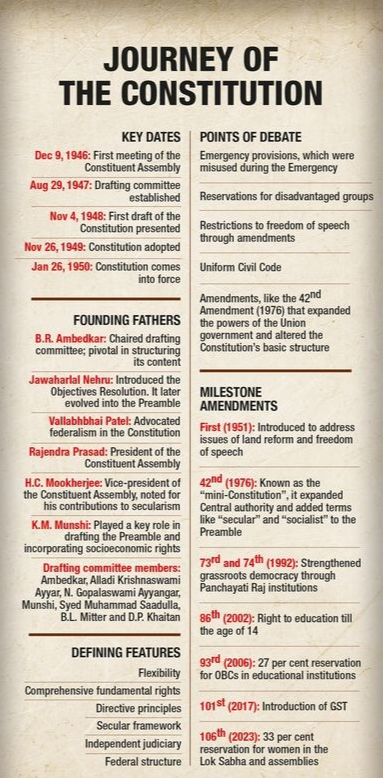
India celebrates Constitution Day, or 'Samvidhan Divas', on November 26th annually to commemorate the adoption of the Constitution by the Constituent Assembly in 1949.
A Constitution is the foundational set of principles, laws, and precedents that forms the legal basis and structure of a state's governance, defines governmental powers and limits, often guarantees citizen rights, and is the supreme law of a country.
Establishes Government Structure: It creates the different branches of government (e.g., legislative, executive, judicial) and defines their respective roles and powers.
Defines Powers and Limits: It outlines what the government can do and, critically, what it cannot do, thereby preventing the abuse of power.
Protects Rights: Many modern constitutions contain a Bill of Rights or similar provisions that guarantee fundamental freedoms and civil liberties to individuals, protecting them from encroachment by the state.
Provides Stability and Predictability: It establishes a clear, consistent framework for governance that outlasts individual leaders or political parties, providing continuity and stability for the nation.
Expresses National Ideals: The preamble and chapters of a constitution often reflect the values, aspirations, and goals of the nation it governs (e.g., justice, liberty, equality, fraternity).
Types of Constitutions
Written vs Unwritten:
Federal vs Unitary:
Rigid vs Flexible:
Indian Constitution is the supreme law, defining the political framework, government structure and duties, and citizens' rights. It is the world's longest written national constitution.
 Foundational Colonial-Era Acts
British rule established the basis for modern Indian governance through Acts that gradually introduced legislative structures and shaped the administrative framework.
|
Act |
Key Provisions & Significance |
|
Regulating Act, 1773 |
|
|
Pitt's India Act, 1784 |
|
|
Charter Act of 1833 |
|
|
Government of India Act of 1858 |
|
|
Indian Councils Act of 1861 |
|
|
Government of India Act, 1919 |
|
|
Government of India Act, 1935 |
|
Influence of the Freedom Struggle
Nehru Report (1928): This was the first major attempt by Indians to draft a constitution. It demanded Dominion Status, universal adult suffrage, and guaranteed 19 fundamental rights, including equality for women and freedom of conscience.
Karachi Resolution (1931): Adopted by the Indian National Congress, this resolution outlined the vision of a future independent India. It reiterated the demand for fundamental rights (like freedom of speech and press), socio-economic rights (like a living wage), and a secular state.
The failures of the Cripps Mission (1942) and the subsequent political negotiations led to the consensus that only a sovereign body elected by Indians could frame the constitution.
The Cabinet Mission Plan of 1946 provided the framework for the formation of the Constituent Assembly.
The Drafting Process
The Assembly used a methodical process of committees, debates, and discussions to build consensus on complex issues, ensuring thorough scrutiny of every clause.
|
Committee |
Chairman |
|
Drafting Committee |
Dr. B. R. Ambedkar |
|
Union Powers Committee |
Jawaharlal Nehru |
|
Provincial Constitution Committee |
Sardar Vallabhbhai Patel |
|
Advisory Committee on Fundamental Rights, Minorities and Tribal and Excluded Areas |
Sardar Vallabhbhai Patel |
Dr. B. R. Ambedkar, as the Chairman of the Drafting Committee, called the 'Father of the Indian Constitution' for his role in the drafting process and providing legal and philosophical depth to the document.
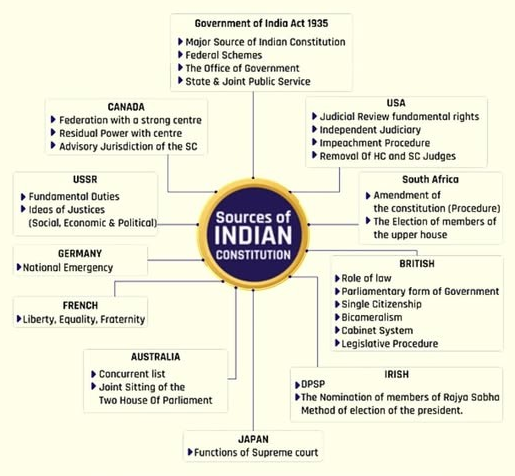
The framers of the Constitution did not hesitate to borrow and adapt ideas from around the world, ensuring they were suitable for Indian conditions.
|
Source Country |
Features Borrowed |
|
United Kingdom |
Parliamentary government, Rule of Law, Single citizenship, Cabinet system |
|
United States |
Fundamental Rights, Judicial Review, Impeachment of the President |
|
Ireland |
Directive Principles of State Policy (DPSP), Method of presidential election |
|
Canada |
Federation with a strong Centre, Residuary powers with the Centre |
|
Australia |
Concurrent List, Joint sitting of two Houses of Parliament |
 Adoption, Implementation, and Early Tests
Adoption: The Constitution was adopted on November 26, 1949. This day is now celebrated as Constitution Day.
Implementation: It came into full force on January 26, 1950. This date was chosen to commemorate the Purna Swaraj (Complete Independence) resolution of 1930.
Early Challenges: The Constitution's flexibility was tested early on by issues like the linguistic reorganization of states and the implementation of land reforms, both of which required significant political negotiation and constitutional amendments.
The Constitution is a dynamic document that has evolved over time. As of late 2025, there have been 106 amendments to the Constitution.
Major Amendments
1st Amendment (1951): Added the Ninth Schedule to protect land reform laws from judicial review.
42nd Amendment (1976): Known as the 'Mini-Constitution', it added 'Socialist' and 'Secular' to the Preamble, and introduced Fundamental Duties.
44th Amendment (1978): Reversed many provisions of the 42nd Amendment and removed the Right to Property from the list of Fundamental Rights.
73rd & 74th Amendments (1992): Granted constitutional status to Panchayati Raj and Urban Local Bodies, promoting decentralization.
101st Amendment (2016): Introduced the Goods and Services Tax (GST).
106th Amendment (2023): Reserved one-third of all seats for women in the Lok Sabha and state legislative assemblies.
 Supreme Court Judgments
Kesavananda Bharati vs State of Kerala (1973): The Supreme Court introduced the revolutionary concept of the 'Basic Structure Doctrine,' stating that Parliament's power to amend the Constitution is not absolute and cannot be used to alter its fundamental features.
S.R. Bommai vs Union of India (1994): This judgment curbed the misuse of Article 356 (President's Rule) by laying down guidelines for its imposition and making it subject to judicial review.
The Constitution's interpretive depth allows it to remain relevant in the face of modern challenges:
The Indian Constitution, a social contract and roadmap for the nation's progress, demonstrates resilience through its adaptability while relying on the continuous commitment of citizens and institutions to uphold its core values of Justice, Liberty, Equality, and Fraternity.
Source: newsonair
|
PRACTICE QUESTION Q. Despite its robust framework, Indian constitutionalism faces persistent challenges related to federalism and the separation of powers. Critically analyze. 150 words |
The Indian Constitution is called a 'living document' because it is not static or rigid. It can be amended (as per Article 368) to adapt to changing societal needs and aspirations, and its interpretation by the judiciary evolves over time to address new challenges, ensuring its continued relevance.
The 'Basic Structure Doctrine' is a judicial principle established by the Supreme Court in the Kesavananda Bharati case (1973). It holds that while Parliament has the power to amend the Constitution, it cannot alter or destroy its fundamental features, such as democracy, secularism, federalism, and the rule of law.
Moved by Jawaharlal Nehru in 1946, the Objectives Resolution was a declaration that laid down the philosophical foundation and guiding principles for the Constitution. It defined the aims of the Constituent Assembly, promising justice, equality, and freedom, and ultimately shaped the Preamble of the Indian Constitution.
© 2026 iasgyan. All right reserved