

Why In News?
The Union government is boosting National Waterways through the PM Gati Shakti initiative to create a cost-effective, eco-friendly logistics network and enhance regional connectivity.
Inland Waterways are navigable water bodies located within a country’s landmass, such as rivers, canals, backwaters, creeks, and lakes, used for the transportation of goods and passengers.
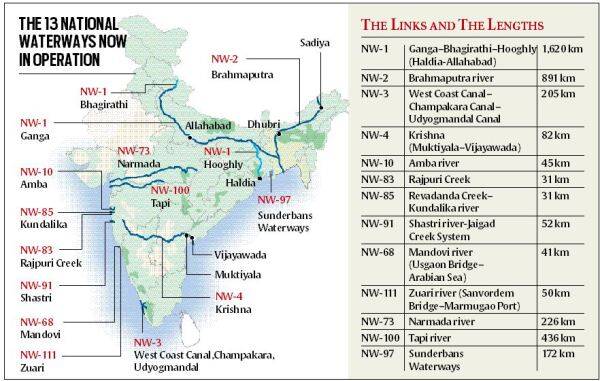 What is the current status of Inland Waterways in India?
India possesses a vast network of inland waterways, but they remain underutilized compared to road and rail.
Key Initiatives
Seasonal River Flow: Rain-fed Indian rivers experience dry-season drops, hindering year-round navigation compared to European systems.
Siltation and Draft Issues: High sediment in the Ganga and Brahmaputra reduces the Least Available Depth (LAD) necessary for commercial vessels.
Rail and Road Dominance: Historical investment bias toward rail and road networks has restricted waterways to a 2% modal share.
Infrastructure Deficit: A shortage of multimodal terminals, night navigation (DGPS), and mechanized port systems persists.
Regulatory Complexities: Inter-state legal friction over water rights and maintenance has obstructed unified waterway development.
Cost-Effectiveness: Inland water transport is significantly cheaper than other modes. A World Bank study estimates it is roughly 30% cheaper than rail and 60% cheaper than road transport.
Fuel Efficiency: It is the most energy-efficient mode. One liter of fuel can move 24 ton-km by road, 85 ton-km by rail, but 105 ton-km by inland waterway. (Source: RITES Report)
Environmental Sustainability: It has the lowest carbon footprint, emitting less CO2 per ton-km compared to trucks and trains, aligning with India's climate goals.
Minimal Land Acquisition: Unlike highways or railway lines which require massive land acquisition and displacement, waterways utilize existing natural channels, avoiding litigation and social conflict.
Connectivity for the Northeast: It provides an alternative route to the "Chicken's Neck" corridor, connecting the Seven Sisters via the Brahmaputra (NW-2) and the Indo-Bangladesh Protocol Route.
What major initiatives has the government taken?
Jalvahak Scheme: It offers a 35% reimbursement on operating costs to cargo owners who shift from road/rail to waterways (specifically NW-1, NW-2, and NW-16). It also funds scheduled cargo services to build market confidence.
Harit Nauka Guidelines: A push for "Green Vessels." It mandates that 50% of all inland passenger fleets must run on green fuels (like hydrogen or electric) by 2033, and 100% by 2045. (Source: MoPSW)
Budget 2026-27 Push: The Union Budget announced the operationalization of 20 new National Waterways over the next 5 years and introduced a "Coastal Cargo Promotion Scheme" to integrate inland and coastal shipping.
Infrastructure & Connectivity
Return Cargo Dilemma: The lack of return cargo on routes like NW-1 (Ganga) doubles operational costs, as vessels often return empty after upstream deliveries.
Depth (LAD) Constraints: Maintaining a 3-meter Least Available Depth year-round is difficult, particularly in the Varanasi-Prayagraj stretch during summer.
Last-Mile Connectivity: Inadequate rail sidings and high transport costs from river ports to factories often negate the financial benefits of water transport.
Ecological Impact: Dredging conflicts with environmental norms by threatening the habitat of the Gangetic Dolphin.
Inland waterways offer a pathway to reduce logistics costs from the current 13-14% of GDP to approximately 8-9%.
Decongestion of Trunk Routes: By shifting bulk cargo (coal, cement, steel, fertilizers) to rivers, waterways can reduce pressure on the Golden Quadrilateral highways and the Dedicated Freight Corridors.
Cost Competitive Exports: Lowering transport costs for the hinterland (e.g., UP, Bihar, Jharkhand) via NW-1 to the Haldia/Kolkata ports makes Indian exports more competitive in global markets.
Regional Economic Hubs (Arth Ganga): Transforming riverbanks into economic corridors through "Freight Villages" and "Community Jetties" promotes local trade, MSMEs, and agro-processing industries.
Connectivity to Landlocked Regions: Indo-Bangladesh Protocol Route (IBPR) and NW-2 (Brahmaputra) provide the Northeast with a shorter, cheaper transit route, bypassing the narrow Siliguri Corridor.
Ensuring "Assured Depth": Moving away from ad-hoc dredging to Performance-based Dredging Contracts that guarantee a minimum Least Available Depth (LAD) of 2.5 to 3 meters year-round, giving shippers the confidence to sign long-term contracts. (Source: World Bank)
Intermodal Integration: Developing Rail-River-Road connectivity at all Multi-Modal Terminals (like Varanasi and Sahibganj). Without "last-mile" rail sidings, the cost advantage of water transport is lost in the final delivery.
Hybrid Vessel Technology: Promoting the indigenous manufacturing of Low-Draft High-Capacity vessels designed for Indian river conditions, and incentivizing the shift to Hydrogen and Electric propulsion under the Harit Nauka guidelines.
Demand Side Incentives: Expanding schemes like the Jalvahak Scheme to include more commodities beyond bulk goods, encouraging Fast-Moving Consumer Goods (FMCG) and automobile companies to use rivers for distribution.
Sustainable Ecosystem Management: Implementing "Soft Engineering" for river training to minimize the ecological impact on the Gangetic Dolphin and other aquatic life, ensuring that navigation and conservation coexist.
Inland waterways are vital for the "Viksit Bharat @ 2047" goal, aiming to strengthen manufacturing by lowering logistics costs below 10% of GDP. Expanding the Jal Marg Vikas Project, India must develop a digitalized, sustainable transport network that meets international benchmarks like the Rhine or Yangtze.
Source: PIB
|
PRACTICE QUESTION Q. "Despite vast natural endowments, India's inland waterways remain an underutilized component of its multimodal transport network." Discuss. 150 words |
India's logistics cost currently hovers around 13-14% of its GDP. Shifting cargo to inland waterways can significantly reduce this burden, as water transport is inherently cheaper (₹1.19/ton-km) compared to railways (₹1.41/ton-km) and highways (₹2.28/ton-km).
India has declared 111 National Waterways under the National Waterways Act of 2016, with 32 currently fully operational. The most prominent are NW-1 (Ganga-Bhagirathi-Hooghly, 1,620 km) and NW-2 (Brahmaputra, 891 km).
The JMVP is a ₹5,061 crore mega-project implemented by the Inland Waterways Authority of India (IWAI) with assistance from the World Bank. It aims to augment the navigational capacity and infrastructure of NW-1 to facilitate the movement of large commercial vessels.
© 2026 iasgyan. All right reserved