

PM Narendra Modi’s six-day tour to Indonesia, Australia, and New Zealand activates the "Arc of Trust," a maritime and economic coalition countering Indo-Pacific geopolitical disruptions.
The "Arc of Trust" represents a strategic, non-alliance architectural blueprint that unites democratic middle powers—primarily India, Indonesia, Australia, and New Zealand—to stabilize the Indo-Pacific through trusted defense partnerships, resilient supply chains, and shared technological ecosystems.
The framework emerges as a direct response to intensifying US-China rivalry, shifting global supply chains, and the weaponization of economic dependencies.
The Arc builds upon the foundational SAGAR (Security and Growth for All in the Region, 2015) doctrine, expanding it into the MAHASAGAR (2025) framework to integrate the Global South into a cohesive maritime strategy.
It avoids traditional military blocs, preferring strategic autonomy where resident nations dictate regional maritime rules rather than inheriting an external superpower's order.
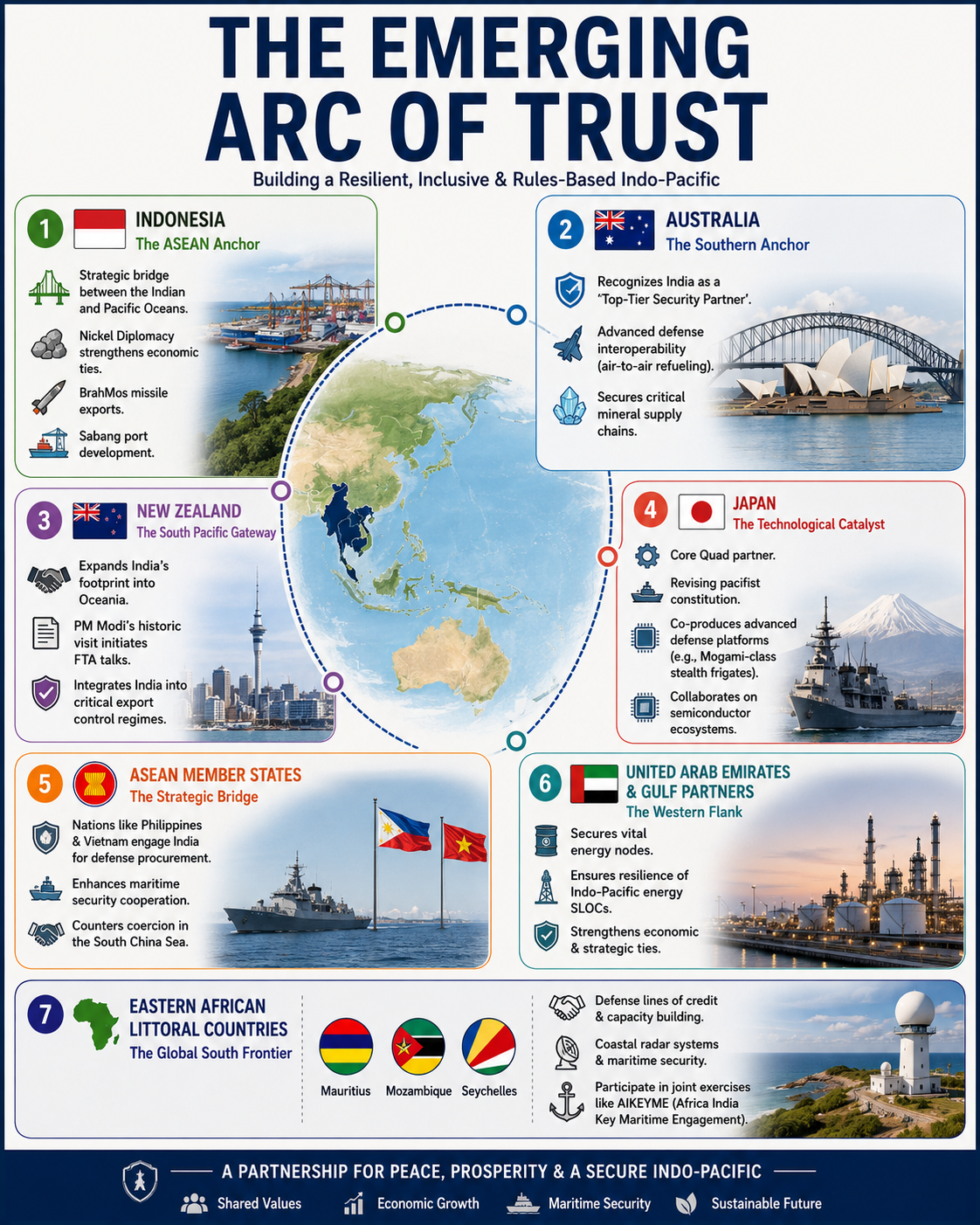 Objectives
Establish Collective Insurance: Provide a mutual security buffer against regional hegemony without triggering direct great-power confrontation.
Secure Value Chains: Break monopolies on critical minerals (like nickel and lithium) required for clean energy transitions.
Ensure Maritime Freedom: Defend open sea lanes and enforce international maritime law through joint patrols and Maritime Domain Awareness (MDA).
Managing Strategic Competition
Alternative to Binary Choices: The Arc offers Southeast Asian and Pacific nations a "hedge and a partner in diversification," helping them avoid choosing between the US and China during trade and tariff wars.
Balancing Power: Leveraging India's demographic and military scale, Indonesia's chokepoint control, and Australia's technological edge, the coalition naturally balances expansionist powers.
Preserving Maritime Security
Chokepoint Defence: Collaborative security prevents hostile domination of transit corridors like the Malacca, Sunda, and Lombok Straits.
Combatting Grey-Zone Coercion: Trilateral mechanisms address non-traditional threats, including Illegal, Unreported, and Unregulated (IUU) fishing, piracy, and maritime militias.
Building Trusted Supply Chains
Nickel Diplomacy: Indonesia controls approximately 21% of global nickel reserves. India partners with Jakarta to process these minerals, bypassing Chinese-dominated refineries for electric vehicle (EV) batteries.
Lithium and Rare Earths: Australia serves as the primary supplier of lithium and rare earths, driving India's high-tech manufacturing and achieving supply chain resilience.
Strengthening Regional Connectivity
Strategic Corridors: India and Indonesia develop the Andaman-Nicobar-Sabang corridor, integrating marine tourism, shipbuilding, and maritime surveillance directly at the mouth of the Malacca Strait.
Promoting Collective Economic Resilience
Trade Integration: India maintains a $24.78 billion trade relationship with Indonesia and pursues deep tariff liberalizations via the Comprehensive Economic Cooperation Agreement (CECA) with Australia and a Free Trade Agreement (FTA) with New Zealand.
Supporting a Rules-Based International Order
UNCLOS Compliance: The Arc members support the 1982 United Nations Convention on the Law of the Sea (UNCLOS), endorsing the 2016 Arbitral Award that invalidated unlawful territorial claims in the South China Sea.
ASEAN Centrality
India anchors regional architecture around the Association of Southeast Asian Nations (ASEAN), aligning Act East Policy directly with the ASEAN Outlook on the Indo-Pacific (AOIP) to ensure inclusive regional growth.
Maritime Security and Freedom of Navigation
The Indian Navy acts as the "sentinel" of the Indian Ocean, utilizing the Information Fusion Centre – Indian Ocean Region (IFC-IOR) to share real-time white shipping data and combat transnational maritime crimes.
Economic and Technology Partnerships
India exports Digital Public Infrastructure (DPI) (like the Indonesia Open Network based on ONDC) and collaborates on AI, cyber security, and submarine cable protection.
Resilient Critical Mineral and Supply Chains
India establishes a "resource-to-market" loop, combining Australian and Indonesian raw materials with Indian manufacturing to execute the National Critical Minerals Mission (NCMM).
Blue Economy Cooperation
The strategy emphasizes sustainable marine resource exploitation, green shipping corridors, and deep-sea exploration while protecting coastal ecology.
Climate and Disaster Resilience
India positions itself as the "First Responder" for Humanitarian Assistance and Disaster Relief (HADR), actively deploying disaster response frameworks across cyclone and tsunami-prone littoral zones.
Securing Sea Lines of Communication (SLOCs)
The Indian Ocean facilitates 66% of the world's oil supply and 50% of global container shipments. India must secure these choke points to prevent energy and economic starvation.
Protecting Maritime Trade Routes
More than 90% of India's trade by volume and 55% of its trade passing through the South China Sea rely entirely on maritime access across the Indo-Pacific.
Countering Emerging Security Challenges
India faces hostile encroachments, including "String of Pearls" port investments, dual-use research vessels, and grey-zone warfare tactics deployed by adversarial powers in its maritime backyard.
Expanding Economic Diplomacy
Achieving a target of 30% electric vehicle penetration by 2030 will create a $300 billion domestic battery market, requiring secure overseas mineral assets to bypass China's 90% monopoly on rare-earth refining.
Strengthening Strategic Autonomy
Dominating the Indo-Pacific narrative allows India to build robust middle-power coalitions, maintaining the flexibility to engage the Quad without sacrificing its independent foreign policy.
Intensifying Great Power Rivalry
The escalating US-China geopolitical conflict places pressure on middle powers like Indonesia to take sides, complicating India's efforts to build a non-aligned security architecture.
Maritime Territorial Disputes
Aggressive territorial claims, artificial island-building, and maritime militia deployments in the South China Sea threaten international law and regional stability.
Supply Chain Vulnerabilities
China controls 65% of global lithium processing and 74% of cobalt refining, granting it leverage to execute sudden export bans that cripple Indian manufacturing.
Non-Traditional Security Threats
Littoral states face existential threats from climate change-induced sea-level rise, devastating cyclones, trans-national drug trafficking, and marine plastic pollution.
Divergent Strategic Priorities Among Regional States
Australia prioritizes the Pacific Islands, Indonesia focuses on the South China Sea, and India primarily guards the Indian Ocean. Aligning these disparate theaters into an operational strategy requires immense diplomatic effort.
Deepening Maritime Cooperation
Execute complex, trilateral naval maneuvers (e.g., expanding India-Indonesia-Australia coordinated patrols) to secure the Malacca, Sunda, and Lombok Straits.
Expanding Critical Minerals Partnerships
Leverage the National Critical Minerals Mission to acquire overseas mining blocks and build midstream processing "islands" with Australia and Indonesia, excluding adversarial tech.
Strengthening Defence Interoperability
Institutionalize mutual logistics support agreements and expand joint exercises like Talisman Sabre, Austrahind, and Pitch Black to ensure seamless operational integration across domains.
Building Trusted Technology Ecosystems
Export India's Digital Public Infrastructure (DPI) to developing nations and establish joint R&D hubs for AI, cyber-security, and uncrewed aerial systems (UAS).
Enhancing Blue Economy Cooperation
Invest in sustainable fisheries management, coral reef restoration, and joint disaster-resilient coastal infrastructure projects.
Promoting Development Partnerships Across the Global South
Deploy transparent, unconditional grants and concessional lines of credit that avoid the "debt-trap" mechanics inherent in rival initiatives like the BRI.
Expanding People-to-People and Innovation Linkages
Operationalize agreements for professional mobility, university branch campuses (e.g., IIM Bangalore in Indonesia), and reciprocal visa facilitation.
The "Arc of Trust" transforms India from a regional participant into a proactive global maritime leader, anchoring Indo-Pacific stability through strategic autonomy, economic resilience, and unyielding democratic partnerships.
Source: INDIANEXPRESS
|
PRACTICE QUESTION Q. "In an era of geopolitical uncertainty, strategic trust has emerged as an important pillar of regional stability." Discuss. (250 Words, 15 Marks) |
It is a strategic, non-alliance framework championing a network of trusted partnerships among democratic middle powers (like India, Indonesia, and Australia) designed to ensure regional stability, secure supply chains, and prevent the dominance of any single superpower.
The Indo-Pacific is the lifeblood of Indian economy, facilitating over 90% of its trade by volume. It secures vital Sea Lines of Communication (SLOCs) responsible for global energy flows, enabling India to expand its economic diplomacy and counterbalance regional hostility.
Unlike binding mutual defense treaties (like NATO), the Arc of Trust relies on strategic autonomy and functional cooperation. It focuses on capacity building, technology sharing, critical minerals security, and interoperability without forcing members into rigid military blocs.
The Quad (India, USA, Japan, Australia) operates as a critical plurilateral mechanism to guarantee a free, open, and rules-based Indo-Pacific. It complements the Arc of Trust by delivering regional public goods, such as advanced Maritime Domain Awareness (MDA) and disaster relief coordination.
© 2026 iasgyan. All right reserved