

India and New Zealand elevated their bilateral relationship to a Strategic Partnership and adopted the "India-New Zealand Strategic Partnership: Roadmap to 2030".
|
Read all about: INDIA NEW ZEALAND RELATIONS |
The Strategic Partnership is a comprehensive diplomatic, economic, and security framework designed to institutionalise cooperation across trade, maritime security, education, and regional alignment between India and New Zealand over the next four years.
Background
Formal diplomatic relations established in 1952, driven by shared democratic values and Commonwealth ties.
Historical bonds trace back to 1915, when Indian soldiers fought alongside ANZAC forces at Gallipoli during World War I.
Relations gained momentum through New Zealand’s "Opening Doors to India" (2011) and "India–New Zealand 2025" (2020) policy strategies.
Objectives
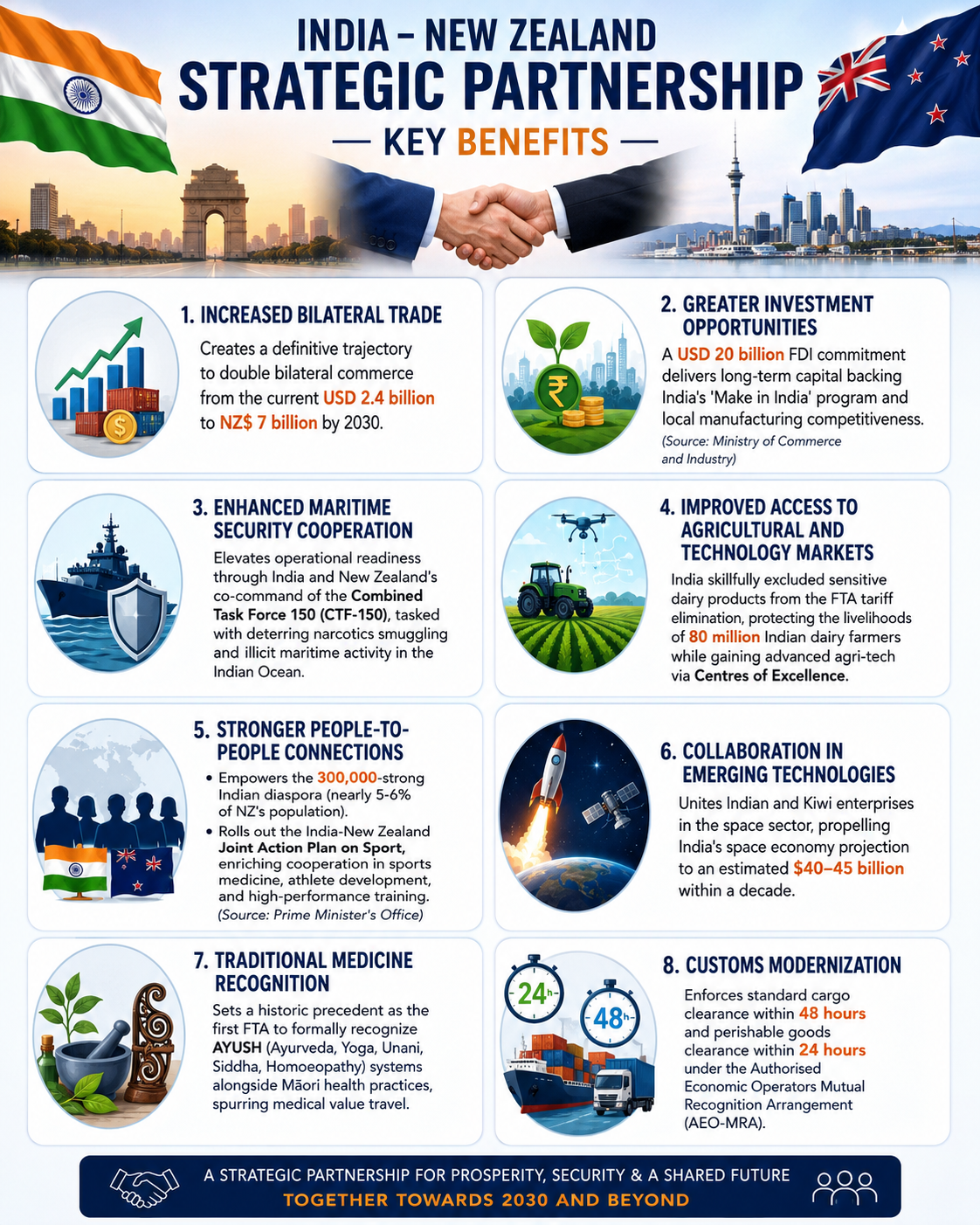
Double bilateral two-way trade in goods and services to NZ$7 billion (approx. ₹35,000 crore) by 2030 (Source: Ministry of External Affairs).
Guarantee a free, open, and rules-based Indo-Pacific.
Advance military interoperability via the newly operationalized Mutual Logistics Support Arrangement.
Strengthens India's Indo-Pacific Strategy
Expands India's strategic maritime footprint into the South Pacific, firmly complementing the Act East Policy and the Indo-Pacific Oceans Initiative (IPOI).
New Zealand officially nominated Maritime Security as its priority pillar under India's IPOI framework.
Enhances Economic Diversification
Secures 100% duty-free access for Indian merchandise, making labour-intensive sectors like textiles, leather, footwear, and engineering goods globally competitive.
Promotes Supply Chain Resilience
Constructs transparent and resilient supply chains required to bypass geopolitical disruptions in the Indo-Pacific, securing critical logistics and trade corridors.
Expands India's Engagement with Pacific Nations
Utilises New Zealand as a logistical hub and diplomatic gateway to connect closely with Pacific Island Countries (PICs), amplifying the Forum for India-Pacific Islands Cooperation (FIPIC).
Supports a Rules-Based International Order
Reaffirms unconditional support to UNCLOS (United Nations Convention on the Law of the Sea), ASEAN centrality, and freedom of navigation.
New Zealand formally backs India’s bid for permanent UNSC membership and entry into the Nuclear Suppliers Group (NSG).
Trade and Investment Cooperation
Wellington committed to a USD 20 billion FDI infusion over 15 years in India’s renewable energy, agri-tech, and infrastructure sectors.
Integrates India's Unified Payments Interface (UPI) with New Zealand’s domestic fast payment systems to enable seamless digital cross-border transactions.
Defence and Maritime Security Collaboration
Executes the Maritime Cooperation Arrangement and Mutual Logistics Support Arrangement, enabling reciprocal port access and bilateral naval exercises.
Forms a dedicated Joint Working Group (JWG) on Counter-Terrorism to dismantle violent extremism, terror-financing networks, and transnational cybercrime.
Critical Minerals Partnership
Aligns supply chain collaborations to secure resources necessary for clean energy transitions, supporting India’s regional resource resilience within the broader Indo-Pacific architecture.
Science, Technology and Innovation Cooperation
Space Sector Synergy: New Zealand's private space ecosystem provided technological support for India's Chandrayaan-3 lunar mission.
Advances joint Antarctic research involving the National Centre for Polar and Ocean Research (NCPOR) and the University of Canterbury.
Education and Skill Development Initiatives
Unveils an annual quota of 5,000 Temporary Employment Entry (TEE) Visas for skilled Indian professionals across IT, healthcare, and engineering.
Introduces 1,000 Working Holiday Visas annually for Indian youth aged 18–30, marking the first such agreement for India.
Expands Post-Study Work Visas: Allows 3 years for STEM graduates and 4 years for PhD holders.
Climate Change and Sustainable Development Cooperation
New Zealand formally joins the India-led Global Biofuels Alliance (GBA).
Deepens active operations within the International Solar Alliance (ISA) and the Coalition for Disaster Resilient Infrastructure (CDRI).
Agriculture and Dairying
Drives the Agricultural Productivity Partnership, featuring a Kiwifruit Action Plan and the establishment of two Centres of Excellence in Nagaland and Uttarakhand.
 What are the Major Challenges/Concerns Associated with India–New Zealand Relations?
Relatively Low Bilateral Trade Volumes
Despite aggressive goals, current trade is modest relative to India's engagements with Australia or ASEAN, requiring massive scale-ups in exports to achieve the 2030 milestone.
Geographical Distance and Connectivity Constraints
The absence of direct, non-stop aviation routes restricts optimal tourism flows, rapid business travel, and efficient cargo logistics.
Trade Negotiation Challenges
The FTA faces a three-reading parliamentary ratification process in New Zealand, meaning implementation delays could temporarily stall economic momentum.
Competition from Other Regional Economic Blocs
New Zealand's structural economic reliance on China (representing nearly 30% of its exports) forces Wellington into a cautious geopolitical posture, limiting the strategic depth of its Indo-Pacific alignments.
Differences in Agricultural Market Access Issues
The absolute protection of India’s domestic dairy sector discourages New Zealand’s primary exporters, ensuring that dairy market access will remain an ongoing source of bilateral friction.
Expanding Trade and Investment Flows
Institute a dedicated Joint Investment Monitoring Committee to track and actualize the USD 20 billion capital inflow specifically into agri-tech, renewable energy, and infrastructure.
Deepening Defence and Maritime Cooperation
Rapidly operationalize the Mutual Logistics Support Arrangement by staging frequent, complex bilateral naval exercises and establishing real-time maritime domain awareness networks.
Strengthening Critical Minerals Supply Chains
Pioneer joint ventures focusing on clean energy technologies and secure supply chains essential for realizing the mandates of the Global Biofuels Alliance and the International Solar Alliance.
Promoting Academic and Research Partnerships
Leverage the 2025 Education Cooperation Arrangement to drive institutional R&D specifically in biotechnology, artificial intelligence, and climate-resilient agriculture.
Enhancing Connectivity and Tourism
Incentivize aviation partners under the updated Air Services Agreement to launch direct, non-stop commercial flights connecting Auckland with major Indian metros
Collaborating in Digital and Green Technologies
Execute the integration of India's Unified Payments Interface (UPI) into New Zealand’s domestic banking ecosystem, slashing remittance costs and supporting bilateral digital commerce.
Accelerate Security Enforcement
Formalize the Mutual Legal Assistance Treaty (MLAT) to disrupt transnational organized crime, terror financing, and extremist activities directly threatening bilateral trust.
The elevation of bilateral ties to a Strategic Partnership, driven by the Roadmap to 2030 and a Free Trade Agreement, accelerates economic resilience and maritime security in the Indo-Pacific.
Source: THEHINDU
|
PRACTICE QUESTION Q. India's growing engagement with New Zealand reflects the expanding geographical scope of its Indo-Pacific strategy. Examine (250 Words, 15 Marks) |
It is an elevated diplomatic, economic, and security alliance formed in July 2026. It utilizes a framework—the Roadmap to 2030—to institutionalize cooperation across trade, defence, space technology, and maritime security.
New Zealand acts as a crucial democratic anchor and maritime gateway in the South Pacific. It strengthens India’s Act East Policy, enhances naval interoperability through logistics pacts, and co-secures vital sea lines of communication against regional disruptions.
It is a four-year master blueprint defining bilateral action across six pillars: political engagement, defence and security, trade and economy, cultural exchange, education and innovation, and multilateral regional cooperation.
By implementing the 2026 Free Trade Agreement, executing the USD 20 billion FDI commitment, integrating UPI systems, advancing the Kiwifruit Action Plan, and maximizing the newly established skilled professional and student visa pathways.
© 2026 iasgyan. All right reserved
