Copyright infringement not intended
Picture Courtesy: INDIAN EXPRESS
Relationship between India and France has been elevated to a "Special Global Strategic Partnership" following the visit of French President Emmanuel Macron to India in February 2026 for the AI Impact Summit.
The visit consolidated outcomes across defence, technology, and global governance, transitioning the relationship from "buyer-seller" to "co-creators."
Elevation of Ties: The relationship was formally upgraded to a "Special Global Strategic Partnership", aiming to build stability in an uncertain global order.
Defence & Security: Defense partnership saw progress with the Rafale deal, the inauguration of the H125 Final Assembly Line (Tata/Airbus), and enhanced Safran-HAL cooperation for jet engine technology and 'Make in India.'
Technology & AI (The "Third Way")
Economic & Connectivity:
The relationship between India and France is one of the most consistent and reliable in India's foreign policy portfolio.
It has evolved from a commercial relationship to a deep, multi-faceted strategic partnership built on shared values of democracy, secularism, and a commitment to a multipolar world order.
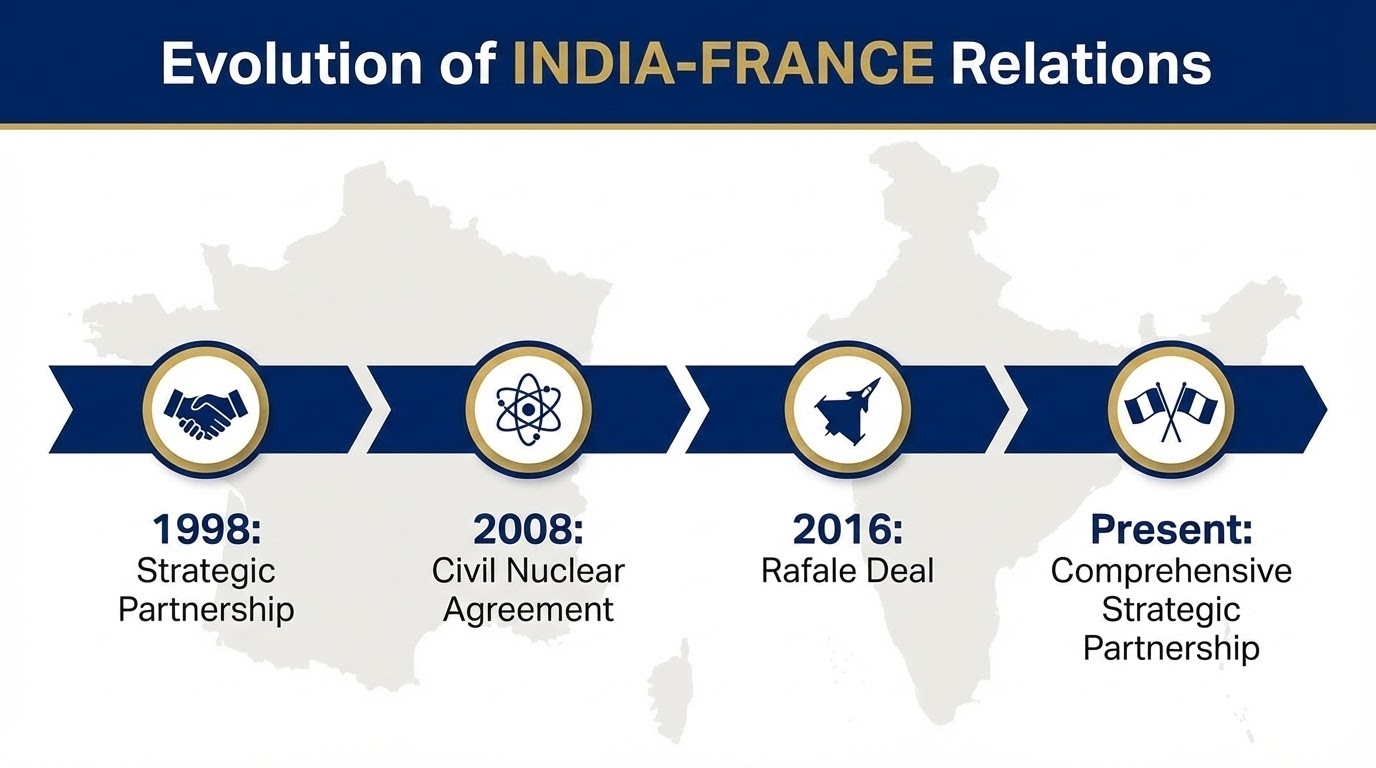
The 1998 establishment of the Strategic Partnership was solidified by France's decision not to impose sanctions on India after its nuclear tests, demonstrating trust and creating an "all-weather" relationship.
 Why France is Important to India?
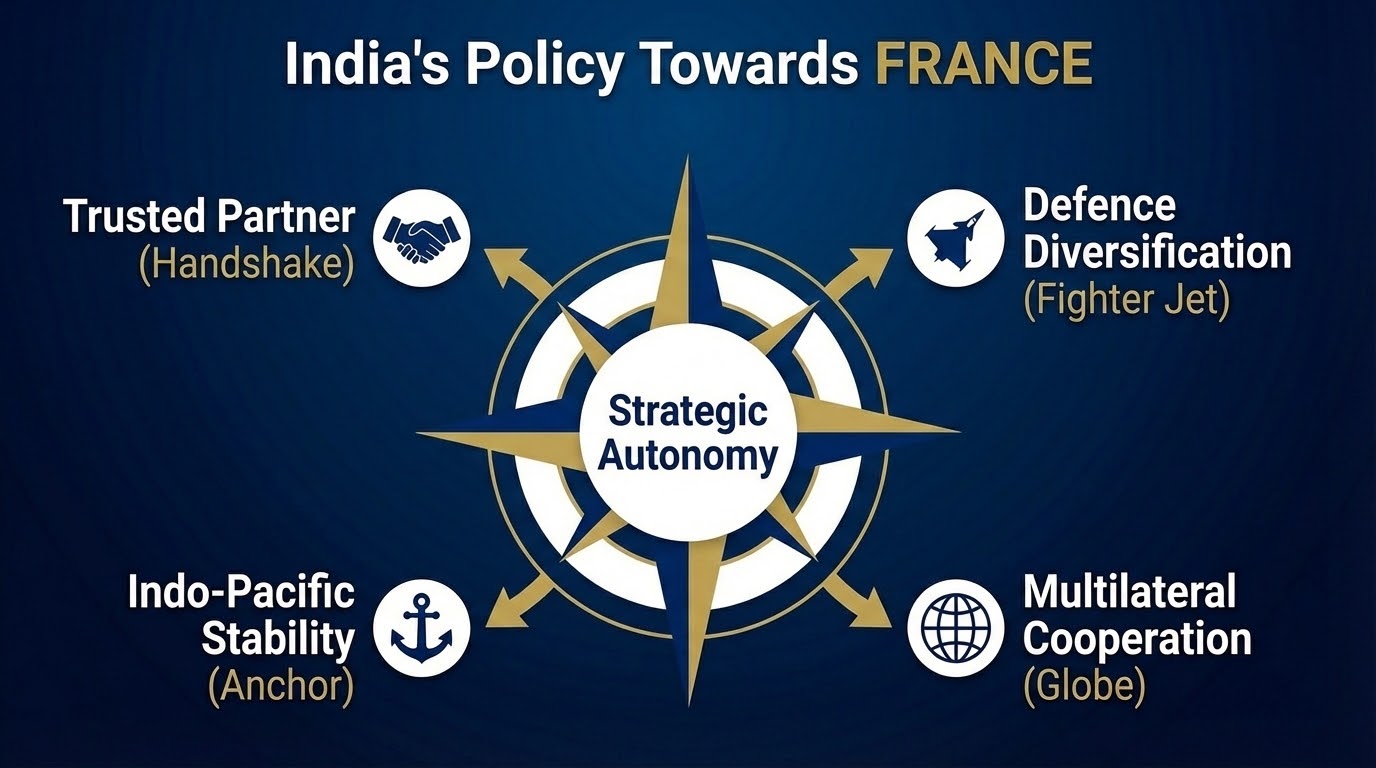
Reliable Defence Partner
France is a key supplier of advanced defence equipment, but the relationship has matured from a simple buyer-seller dynamic to one involving technology transfer and co-production, with key examples including the Rafale fighter jets and the Scorpène-class submarines (built in India under Project-75).
Support on the Global Stage
France consistently and vocally supports India's bid for a permanent UN Security Council seat and its entry into technology control regimes like Missile Technology Control Regime (MTCR), Wassenaar Arrangement, and Australia Group.
Key Partner in the Indo-Pacific
As a resident power in the Indo-Pacific with overseas territories like Réunion Island, France shares India's vision of a free, open, and inclusive Indo-Pacific (FOIP), a convergence vital for maritime security and countering regional hegemony.
Access to High Technology
Cooperation extends to sectors like space and civil nuclear energy, with partnership between ISRO (India) and CNES (France), and France was the first to sign a civil nuclear cooperation agreement with India in 2008, after the Nuclear Suppliers Group (NSG) waiver.
 Why India is Important to France?
Partner for Indo-Pacific Strategy: India is the cornerstone of France's Indo-Pacific strategy, indispensable for regional stability due to its strategic location and growing influence.
Major Economic and Defence Market: India is a rapidly growing major economy and a key market for French companies in defence, aerospace, energy, and infrastructure.
A Stable Democratic Ally: As a large, stable democracy, India is a natural and reliable political ally for France in a complex geopolitical region.
Bridge to the Global South: India's leadership offers France a crucial partner for addressing global challenges and engaging with the Global South on issues like climate change and sustainable development.
The comprehensive India-France partnership, spanning various strategic areas, is guided by the "Horizon 2047 Framework" unveiled in 2023.
|
Sector |
Key Initiatives and Significance |
|
Defence & Security |
|
|
Economic and Trade Relations |
|
|
Space Cooperation |
|
|
Civil Nuclear Energy |
|
|
Climate Change & Environment |
|
Sub-Optimal Economic Ties
Trade and investment below potential compared to other partners (e.g., Germany).
Defence Procurement Delays
Projects like Rafale and Scorpene slowed by contract negotiations, policy changes, and localisation demands.
Differing Security Priorities
India's regional focus and "non-aligned" policy occasionally clash with France's global interests (e.g., Russia-Ukraine).
India's ties with Russia (for energy/defence) create tension with France, a key backer of Ukraine. India refused to join NATO-led sanctions.
Market Access Issues
France seeks access for pharmaceuticals, luxury goods, and defence; India seeks access for IT, agriculture, and generic drugs. India faces Sanitary and Phytosanitary (SPS) barriers.
Disagreements on Global AI/Data Regulation
France favors strict EU's GDPR; India prefers a flexible approach under DPDP Act, 2023. Disagreements exist on open-source AI, cybersecurity, and digital sovereignty.
Immigration Issues
Visa restrictions, work permit limits, and qualification recognition hinder Indian students and professionals. India seeks easier residency/work opportunities; France prioritizes EU-wide policies.
Enhance Economic Engagement
Utilize the Free Trade Agreement (FTA) to promote balanced bilateral trade, and address market access barriers through joint working groups in sectors like aeronautics, space, and high-speed rail.
Deepen Defence Industrial Collaboration
The focus should move further from "Make in India" to "Co-design, Co-develop, and Co-produce." Joint development of next-generation military hardware should be a priority.
Collaborate in Emerging Technologies
There is immense potential for cooperation in new-age domains like Artificial Intelligence (AI), supercomputing, cybersecurity, and digital governance.
Strengthen Trilateral Cooperation
Building on the success of the India-France-Australia and India-France-UAE trilaterals can create a network of like-minded partners to ensure stability in the Indo-Pacific and the Middle East.
Promote People-to-People Ties
Increasing student exchanges, simplifying visa regimes, and promoting tourism and cultural collaborations are essential to build a durable foundation for the strategic partnership.
Energy and Climate
Expand collaboration in renewable energy, green hydrogen, and clean technologies, supported by joint investments in critical minerals and advanced materials to achieve shared climate goals.
The India-France strategic partnership built on trust, consistency, shared interests, and a common vision for a stable, multipolar world, with strong convergence on strategic, defence, and technological issues despite economic challenges.
Source: INDIAN EXPRESS
|
PRACTICE QUESTION Q. With reference to the 'Horizon 2047 Roadmap', consider the following statements: 1. It was adopted during the visit of the French President to India in 2026. 2. It aims to strengthen bilateral ties for the centenary of India's independence and 50 years of the strategic partnership. 3. It focuses exclusively on defence procurement and nuclear energy. Which of the statements given above is/are correct? A) 1 only B) 2 only C) 1 and 3 only D) 1, 2, and 3 Answer: B Explanation: Statement 1 is incorrect: The Horizon 2047 Roadmap was adopted in July 2023 during Prime Minister Narendra Modi's visit to France as the Guest of Honour for Bastille Day. While the French President visited India in February 2026 to elevate ties to a "Special Global Strategic Partnership," the roadmap itself was already in place. Statement 2 is correct: The Horizon 2047 Roadmap is a strategic blueprint that sets the course for the India-France bilateral relationship up to the year 2047. This year is significant as it marks the centenary of India's independence (1947–2047), 100 years of diplomatic relations between the two countries, and the 50th anniversary of their Strategic Partnership (established in 1998). Statement 3 is incorrect: The roadmap is not exclusive to defence and nuclear energy. It is built on three broad pillars—Partnership for Security and Sovereignty, Partnership for the Planet, and Partnership for the People. It encompasses a wide range of sectors including space, AI, critical minerals, climate action, digital technology, and cultural exchanges. |
This elevation, announced during the 2026 visit, signifies a move beyond traditional diplomatic ties to a deeper integration in defence, technology, and global governance. It aims to promote stability in a multipolar world and operationalize the Horizon 2047 roadmap.
Adopted in 2023, Horizon 2047 is a strategic document charting the course of India-France relations until 2047 (the centenary of India's independence). It focuses on three pillars: partnership for security and sovereignty, partnership for the planet, and partnership for the people.
The "Third Way" represents a shared Indo-French vision for AI governance. It rejects the binary of US Big Tech dominance and Chinese state control. Instead, it prioritizes "Digital Sovereignty," ethical regulation, and the use of AI for public good, similar to the EU’s risk-based regulatory approach.
© 2026 iasgyan. All right reserved