

Copyright infringement not intended
Picture Courtesy: The Hindu
The International Institute of Migration and Development (IIMAD) report projects India will transition from a youth-dominated profile to an ageing society by 2051.
India’s fertility rates falling below the replacement level => Challenge of an aging population before achieving high-income status.
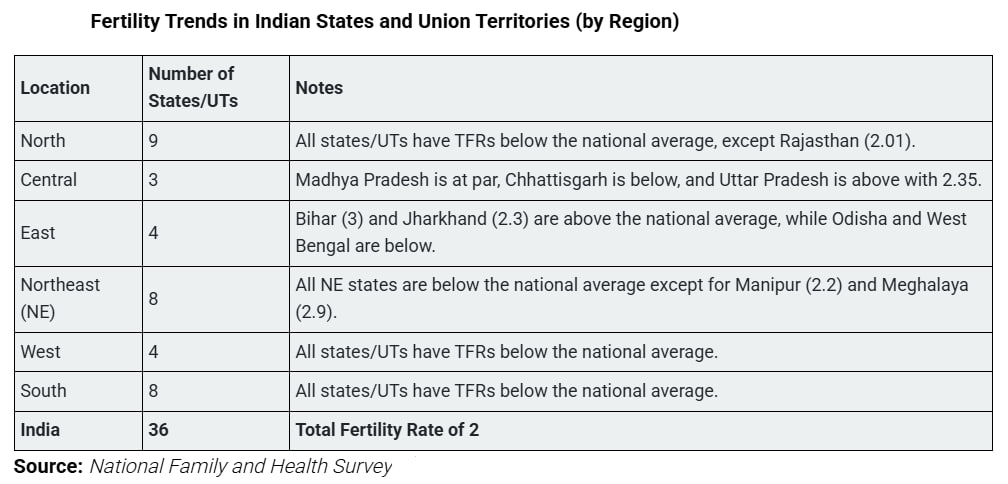 Why India's Demographic Window is Closing Fast?
While India is known as a young nation, its demographic foundations are changing faster than previously thought.
Declining Fertility: India's Total Fertility Rate (TFR) has fallen to 2.0, which is below the replacement level of 2.1. (Source: National Family Health Survey 5)
Rapidly Aging Population: The elderly population (60+ years) is set to more than double from 149 million in 2022 to 347 million by 2050, making up 20.8% of the total population. (Source: UNFPA India Ageing Report).
Peaking Workforce: The share of the working-age population (15-59 years) will peak between 2035-2045 and then begin to decline. (Source: Economic Survey 2023-24)
Risk of Middle-Income Trap: India is a lower-middle-income country and has a limited window of 15-20 years to transition to a high-income economy.
Regional Divergence
Southern and Western states have low TFRs and are aging faster, while Eastern and Central states like Bihar (TFR 3.0) and Uttar Pradesh (TFR 2.35) have a growing young workforce.
Rise of the Care Economy
With smaller families and the decline of the joint family system, the burden of eldercare is increasing, particularly on women.
Strain on Public Finances
The old-age dependency ratio is projected to almost double from 16 in 2021 to 30 by 2050. (Source: UNFPA India Ageing Report)
Urbanisation Pressure
Indian cities will need to accommodate over 400 million new migrants by 2050, requiring massive investment in infrastructure, housing, and jobs while also becoming age-friendly and climate-resilient. (Source: UN Habitat World Cities Report)
Outcome-Driven Skilling
Align the skilling ecosystem with industry needs as envisioned in the National Education Policy (NEP) 2020.
Link the National Skilling Grid with Digital Public Infrastructure (DPI) to provide workers with verifiable credentials.
Incentivise the Silver Economy
Promote startups in health-tech, telemedicine, and geriatric care to turn a longer lifespan into a longer productive span.
The Kerala ‘Harsham’ initiative, which trains women as eldercare providers, is a successful domestic model for formalizing the care economy.
Anchor Industries Regionally
Establish special employment zones in labor-surplus states like UP, Bihar, and Jharkhand for labor-intensive sectors like textiles and electronics assembly.
Build Sovereign Technology Capacity
Invest in R&D to achieve self-reliance in critical technologies. The ₹10,372 crore India AI Mission and the National Deep Tech Startup Policy are right steps towards building indigenous AI and semiconductor capabilities.
Promote Global Talent Mobility
Use agreements like the Migration and Mobility Partnership Agreements (MMPA) with countries like Germany and Australia to provide safe and legal pathways for Indian professionals to fill labor shortages abroad.
Become a Global Talent Hub
Position India as the premier destination for Global Capability Centres (GCCs), which already number over 1,700. (Source: NASSCOM)
Learn from Japan’s "Society 5.0"
Facing a shrinking workforce and an ultra-aged population, Japan launched the "Society 5.0" initiative. By integrating AI, IoT, and robotics into manufacturing and eldercare, Japan maintained high industrial productivity and created a new "Silver Economy."
Shift to a Productivity-Led Growth Model
To avoid the middle-income trap, India must change its core economic engine from labor quantity to productivity and technology.
The Solow Growth Model shows that economic growth depends on labor, capital, and Total Factor Productivity (TFP), which represents technological innovation. As labor growth slows, technology must become the primary driver.
|
Demographic Dividend Model (Labor-led) |
Productivity Dividend Model (Technology-led) |
|
|
Primary Growth Driver |
Large, young, and low-cost labor force. |
Technological innovation, automation, and AI. |
|
Economic Focus |
Labor-intensive manufacturing and services. |
High-value R&D, deep tech, and capital-intensive industries. |
|
Key Challenge |
Job creation and skilling the massive workforce. |
Improving output per worker and fostering innovation. |
|
Policy Goal |
Reaping the benefits of a large population. |
Ensuring the population gets rich before it gets old. |
Conclusion
To avoid the middle-income trap as its population ages, India must transition to a productivity-driven economy by strategically investing in deep tech, skilling, and the formalization of the care economy.
Source: The Hindu
|
PRACTICE QUESTION Q. "India's demographic destiny is shifting from managing a population explosion to addressing the socio-economic complexities of an ageing society." Analyze 150 words |
A demographic dividend is economic growth driven by an increasing share of working-age people in the population (relying on labor quantity). A productivity dividend is economic growth driven by maximizing the output per worker through technology, enhanced skills, and innovation (relying on labor quality).
The Middle-Income Trap refers to a scenario where a rapidly growing economy stagnates at a middle-income level. This happens when a developing nation exhausts its low-cost labor advantage but lacks the technological and institutional capacity to transition into a high-income, innovation-driven economy.
The Silver Economy refers to the market of goods and services specifically tailored to the needs of the elderly population. This encompasses sectors like geriatric healthcare, telemedicine, age-friendly infrastructure, specialized housing, robotics for eldercare, and pension services.
© 2026 iasgyan. All right reserved