

Copyright infringement not intended
Picture Courtesy: INDIANEXPRESS
The official visit of Canadian Prime Minister Mark Carney to India resulted in a reset of bilateral ties.
|
Read all about: India Canada Relations l India and Canada Strategic Partnership |
Strategic Energy Partnership
Uranium Supply Deal: A $2.6 billion agreement to supply nearly 22 million pounds of uranium to India from 2027 to 2035.
Energy Dialogue: Relaunched the Canada–India Ministerial Energy Dialogue to cooperate on LNG, LPG, and small modular reactors.
Global Alliances: Canada announced its intention to join the International Solar Alliance and upgraded to full membership in the Global Biofuels Alliance.
Trade and Economic Cooperation
CEPA Progress: Signed the Terms of Reference to fast-track a Comprehensive Economic Partnership Agreement (CEPA), aiming to conclude talks by the end of 2026.
Bilateral Trade Target: Set an ambitious target to increase bilateral trade to $50 billion–$70 billion by 2030.
Financial Dialogue: Launched a new Finance Ministers’ Economic and Financial Dialogue to focus on payments modernization and cross-border remittances.
Technology, Innovation, and Talent
Talent Strategy: Launched the Canada-India Joint Talent and Innovation Strategy, including 13 new university partnerships and funded research internships for 300 Indian students annually.
AI and Space: Signed a trilateral MOU (with Australia) on AI cooperation. The Canadian Space Agency (CSA) and Indian Space Research Organisation (ISRO) agreed on new arrangements for Earth observation and quantum technologies.
Infrastructure: Established the first Dalhousie University innovation campus in partnership with IIT Tirupati.
Defence and Security
Defence Dialogue: Established a formal India-Canada Defence Dialogue and a new Maritime Security Partnership.
Security & Law Enforcement: Agreed on a shared workplan to combat transnational organized crime, including the illegal flow of fentanyl precursors.
Diplomatic Normalization: Formally acknowledged the return of diplomatic representatives and a "pragmatic" shift from past crisis management.
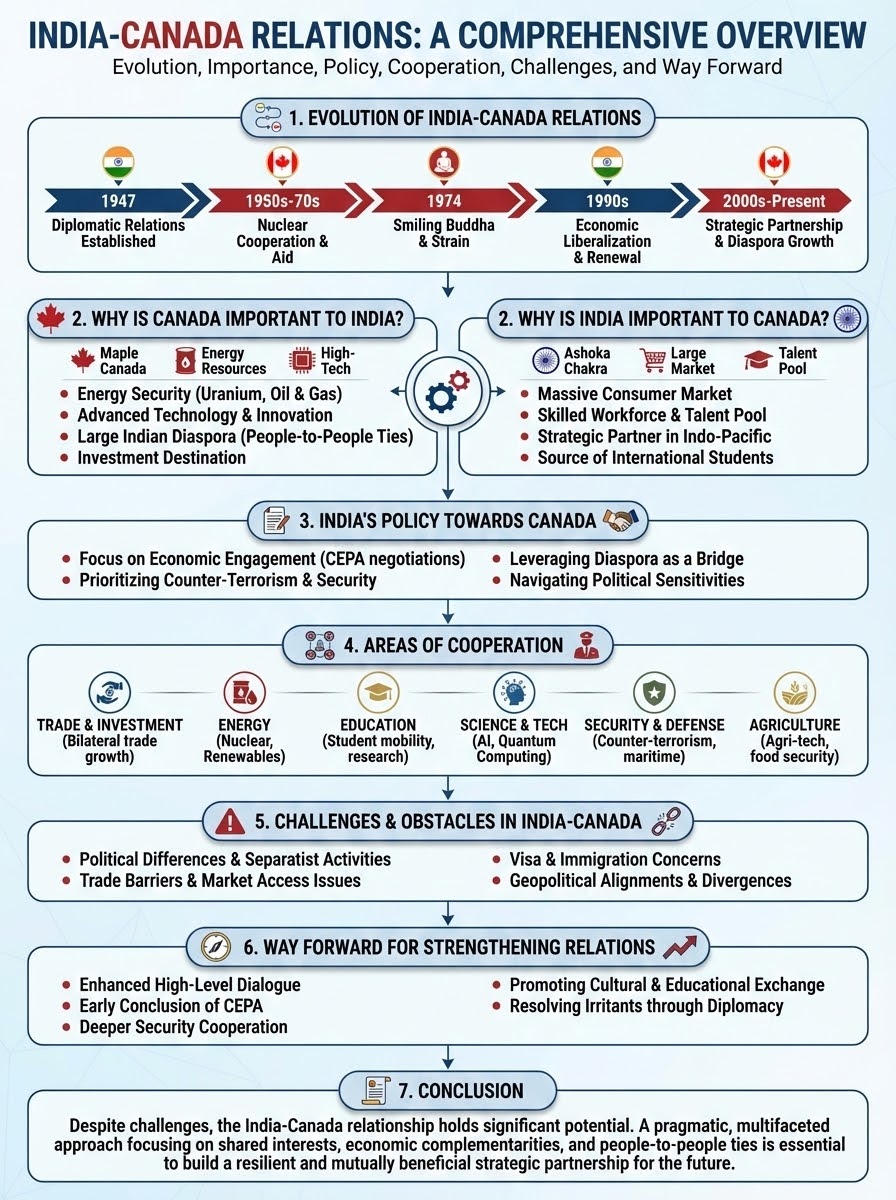 India-Canada Strategic Partnership
Early Years (Post-1947)
Diplomatic relations were established in 1947. Early ties were positive, built on Commonwealth membership and cooperation via initiatives like the Colombo Plan for development in Asia.
Nuclear Disagreement (1974)
Relations soured after India used Canadian-supplied civilian nuclear technology for its first nuclear test, "Smiling Buddha." Canada viewed this as a violation and suspended all nuclear cooperation.
The Khalistan Issue & Air India Bombing (1985)
The bombing of Air India Flight 182 by Canada-based Sikh extremists, killing 329, caused deep mistrust. India views the presence of Khalistani separatist elements in Canada as a major national security threat.
Economic Re-engagement (1990s-2000s)
India's economic liberalization in the 1990s renewed Canadian business interest, culminating in the Civil Nuclear Cooperation Agreement in 2010, which formally repaired the damage from the 1974 test.
Diplomatic Crisis (2023-2024)
Relations deteriorated in 2023 after PM Trudeau alleged Indian government involvement in the killing of Hardeep Singh Nijjar, a designated terrorist in India, leading to diplomatic expulsions and the temporary suspension of Indian visa services.
Reset and Re-engagement (2025-2026)
The visit of the Canadian Prime Minister to India in February 2026 was a key move to reset and normalize the relationship, focusing on economics and strategy after a leadership change.
Economic and Trade Partner
Canada is an important economic partner. Both nations are aiming to increase bilateral trade to $50 billion by 2030, from US$ 8.6 billion in FY25. (Source: IBEF).
Source of Critical Resources
Canada is a vital supplier of resources for India, including pulses, potash, uranium (secured by a long-term supply agreement for India's civil nuclear program), and critical minerals essential for manufacturing and clean energy.
Investment Hub
Canadian pension funds have invested around $100 billion in the Indian economy, focusing on infrastructure, renewable energy, and logistics, signaling strong confidence in Indian growth. (Source: PIB)
Hub for Indian Diaspora and Students
Canada is home to a large and influential Indian diaspora of over 1.8 million people (Source: 2021 Canadian Census) and is the top destination for Indian international students, with 392,810 study permit holders in 2024. (Source: Global Affairs Canada)
Geopolitical Alignment
A positive relationship with Canada, a G7 and NATO member, is vital for India's global standing. Both nations support a rules-based international order, especially in the Indo-Pacific.
Major Economic & Indo-Pacific Partner
India is a critical partner in Canada's Indo-Pacific Strategy, central to diversifying trade and accessing the world's fastest-growing economic region.
Fast-Growing Market
India offers massive opportunities for Canadian businesses in sectors like clean technology, advanced manufacturing, financial services, and green infrastructure due to its rapidly expanding economy.
Source of Talent and Human Capital
As Canada's largest source of immigrants and international students, India boosts the Canadian economy and enriches its society.
Democratic Ally
As the world's largest democracy, India is a natural partner for Canada in promoting shared values globally.
Khalistani Extremism
Differing views exist on issues like free speech versus hate speech, complicating the handling of extremist activities. India sees Khalistani activism as a direct threat to its sovereignty, while Canada views it through a domestic law and order lens.
Diplomatic and Political Trust Deficit
The 2023 diplomatic crisis eroded mutual trust. Restoring confidence at the political and bureaucratic levels is essential for the relationship to move forward.
Trade Negotiations
Negotiations for the CEPA) were frozen for over two years due to political rifts. While talks have officially relaunched, many non-tariff barriers, market access issues, and complex labour laws still need resolution.
Agricultural Disagreements
Issues over India’s restrictions and high tariffs on agricultural imports, particularly pulses like lentils and peas, which are major Canadian exports.
Strategic Difference
India, a key Quad member, focuses on countering Chinese influence in the Indo-Pacific, while Canada's approach is viewed as inconsistent due to balancing economic interests and security concerns.
Immigration Tensions
Previous visa service suspensions and reduced Canadian diplomatic staff created a massive backlog, and Canada's planned reduction in international student intake has worried the large Indian student population.
Human Rights Issues
Canada has been vocal about the treatment of religious minorities in India, while India has countered by expressing concern over attacks on Hindu temples and minorities within Canada.
Institutionalizing Security Cooperation
Revitalizing the Joint Working Group on Counter-Terrorism to share intelligence on organized crime and extremist funding.
Separating Disputes from Cooperation
Treating sensitive cases as law enforcement and judicial matters rather than allowing them to stall the entire diplomatic agenda.
Anchoring the Relationship in Economic Ties
Prioritize mutual economic benefit to shield the relationship from political instability. Top goals include finalizing the CEPA and boosting investment in clean energy and critical minerals.
Leveraging People-to-People Connections
The large Indian diaspora and many Indian students in Canada are key assets. Stronger educational, cultural, and innovation partnerships promote long-term goodwill.
Consistent High-Level Engagement
Sustained high-level dialogue is essential for rebuilding trust, resolving differences, and guiding the partnership strategically. Recent positive visits and meetings indicate this renewed commitment.
Aligning Indo-Pacific Strategies
Greater convergence between Canada's Indo-Pacific Strategy and India's 'Act East' policy can create opportunities for collaboration on regional security, connectivity, and maritime issues.
Skilled Talent Framework
Shift from a student-centric model to a "skilled talent partnership" through the mutual recognition of professional qualifications for doctors, engineers, and nurses.
India and Canada are committed to rebuilding their strained relationship into a pragmatic and resilient strategic partnership by focusing on shared economic interests, security cooperation, and strong people-to-people ties.
Source: INDIANEXPRESS
|
PRACTICE QUESTION Q. "De-risking the bilateral relationship from public recriminations is essential for long-term stability." Analyze in the context of India-Canada Relationship. 150 words |
The crisis was triggered in 2023 when then-Canadian Prime Minister Justin Trudeau alleged the potential involvement of the Indian government in the assassination of Hardeep Singh Nijjar, a pro-Khalistani separatist, in Canada. India dismissed these allegations as "absurd and motivated."
The relationship was restored by a new Canadian government that separated the Nijjar case as a domestic judicial matter from broader bilateral ties. Key steps included high-level re-engagement, like G7 meetings, and an NSA-led framework to address security concerns.
The Comprehensive Economic Partnership Agreement (CEPA) is a proposed free trade agreement between India and Canada designed to deepen economic integration by reducing or eliminating trade barriers.
© 2026 iasgyan. All right reserved