

Copyright infringement not intended
Picture Courtesy: reuters
Context
Brazilian President Visit to India strengthened the India-Brazil Strategic Partnership through diplomatic and economic engagements.
|
Read all about: India-Brazil Relations Explained l About India-Brazil Relationship Deepen |
Trade and Economic Goals
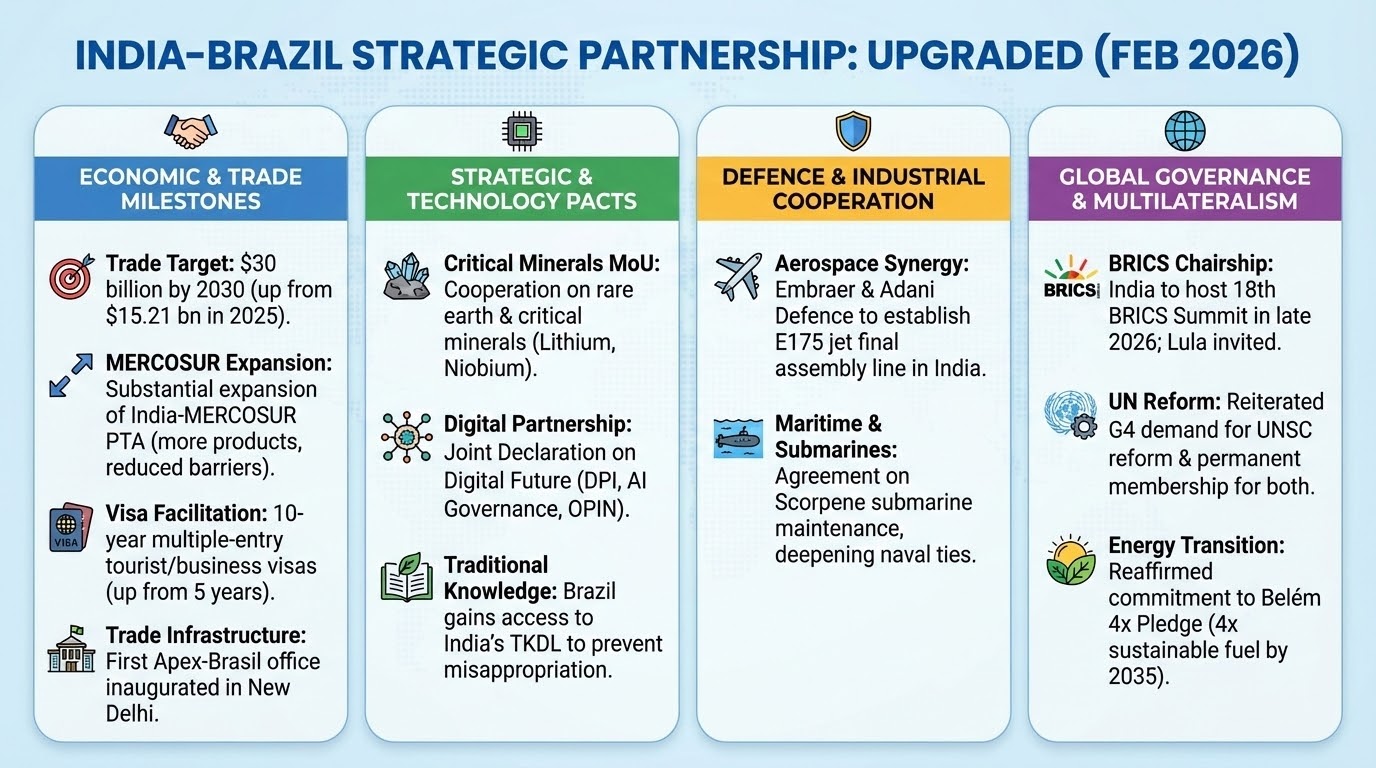
Target $30 Billion: Leaders committed to doubling bilateral trade to $30 billion by 2030, up from approximately $15.2 billion in 2025.
MERCOSUR Expansion: Agreed to broaden the India-MERCOSUR Preferential Trade Agreement (PTA) to reduce tariffs and improve market access.
ApexBrasil Office: President Lula inaugurated the first ApexBrasil trade office in New Delhi to attract Indian investment and promote Brazilian exports.
Strategic and Technology Pacts
Critical Minerals: Signed MoU on Rare Earths and Critical Minerals covering exploration, mining, and processing to build resilient supply chains.
Digital Partnership: Launched the Joint Declaration on a Digital Partnership for the Future, focusing on AI, Digital Public Infrastructure (DPI), and supercomputing.
Traditional Knowledge: Signed an agreement giving Brazil access to India’s Traditional Knowledge Digital Library (TKDL) to prevent biopiracy.
Sectoral Cooperation
Defence: Deepened cooperation in naval systems and military technology, including a deal for Embraer to establish a Final Assembly Line for E175 jets in India with Adani Defence.
Energy Transition: Commitment to the Global Biofuels Alliance and the "Belém 4x Pledge" to quadruple sustainable fuel use by 2035.
Health: Signed an MoU for R&D and innovation in medicines.
Postal Sector: Formalised an agreement to collaborate on postal service digital transformation.
Global Governance and Multilateralism
UNSC Reform: Both nations reiterated their joint G4 demand for urgent UN Security Council reform, supporting each other’s bids for permanent membership.
BRICS 2026: PM Modi invited President Lula to the 18th BRICS Summit to be hosted by India in 2026.
Visa Facilitation: Extended the validity of multiple-entry tourist and business visas from five to ten years on a reciprocal basis.
 India-Brazil Relations Strategic Partnership
India and Brazil, two of the world's largest democracies and emerging economies, share a strategic partnership centered on Global South leadership, energy transition, and digital innovation.
Historical Evolution
Early Ties (1948–1990s): Diplomatic relations were established in 1948. Early friction occurred in 1961 when Brazil initially opposed India's liberation of Goa.
Plurilateral Awakening (2003–2005): The 2003 IBSA Dialogue Forum (India, Brazil, South Africa) and the 2004 G4 (seeking UNSC reform) signaled a shift toward collective global influence.
Strategic Partnership (2006–2020): Elevated to a Strategic Partnership in 2006. This era saw the rise of BRICS and deep cooperation in climate negotiations under the BASIC grouping.
The Modern Vanguard (2021–Present): PM Modi's 2025 visit to Brazil and President Lula’s February 2026 state visit to India.
Economic Powerhouse
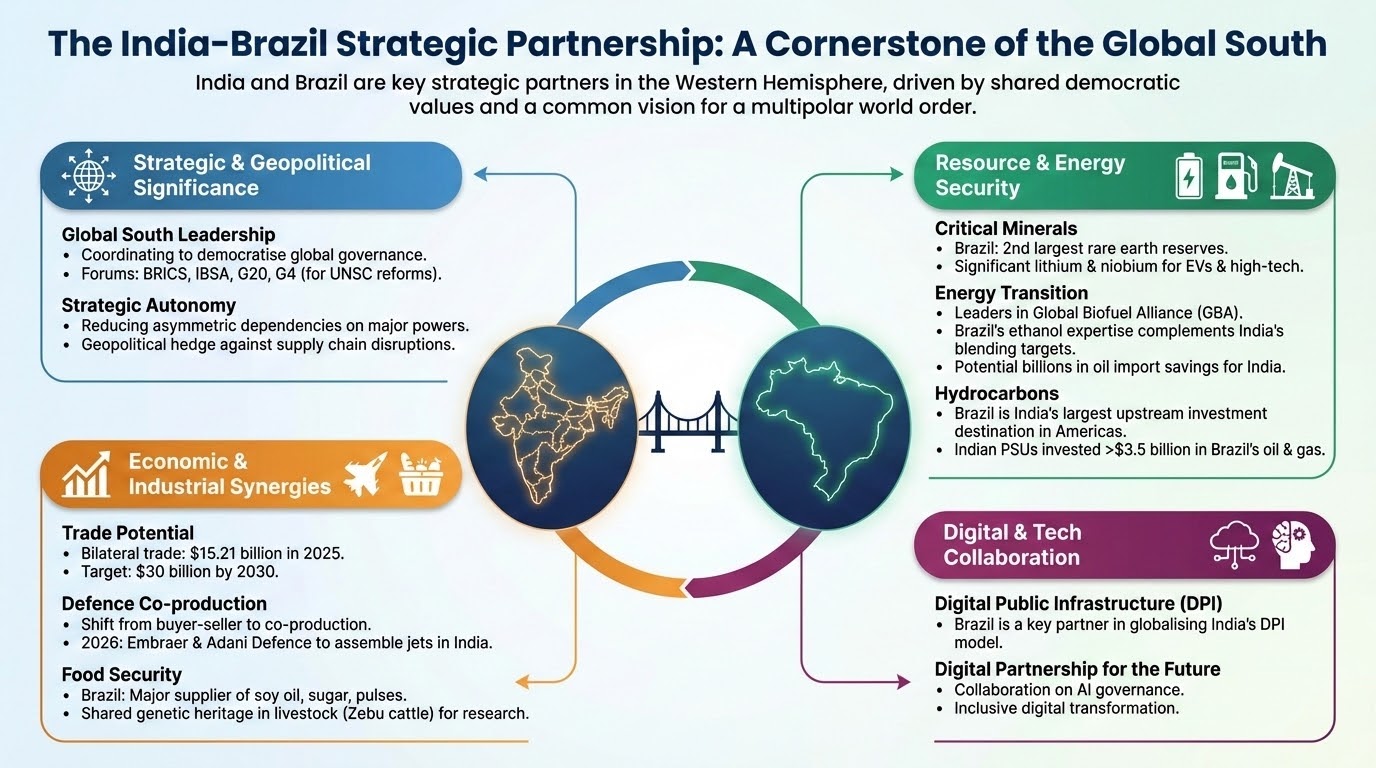
Brazil is India's largest trading partner in Latin America and a gateway to the MERCOSUR trade bloc. Bilateral trade reached USD 15.21 billion in 2025, with an ambitious target of USD 30 billion by 2030.
Resource Security
Brazil is a resource-rich country with the world's second-largest rare earth reserves. It is a key source of critical minerals like lithium, niobium, and iron ore, which are vital for India's growing manufacturing, electronics, and green energy sectors.
Energy Cooperation
As "renewable energy superpowers," both nations lead in biofuels. Brazil's expertise in sugarcane-based ethanol and flex-fuel technology is vital for India to achieve the 20% ethanol blending target, reducing oil dependency. The Global Biofuel Alliance (GBA) highlights this joint effort. (Source: ICWA)
Geopolitical Alignment
As key leaders of the Global South, India and Brazil share a commitment to a multipolar world order and advocate for reforms in global governance institutions, including the UN Security Council, through forums like the G4 (India, Brazil, Germany, Japan).
 Why is India Important to Brazil?
Major Market
India's booming economy and huge population are key markets for Brazilian exports (crude oil, soya oil, gold, sugar).
Technology & Pharmaceutical Hub
India's strengths in IT, AI, and pharmaceuticals offer collaboration opportunities. Brazil seeks affordable, high-quality generic medicines and vaccines; agreements were signed for Indian tech transfer to boost local cancer drug production in Brazil.
Diversification of Partnerships
Strengthening ties with India is a strategic move for Brazil to diversify partnerships and reduce over-dependence on a single country, particularly China.
Defense and Space Partner
India's advanced, cost-effective space technology and growing defense manufacturing make it an attractive partner. A highlight was ISRO's successful launch of Brazil's Amazonia-1 satellite in 2021.
Trade Frictions
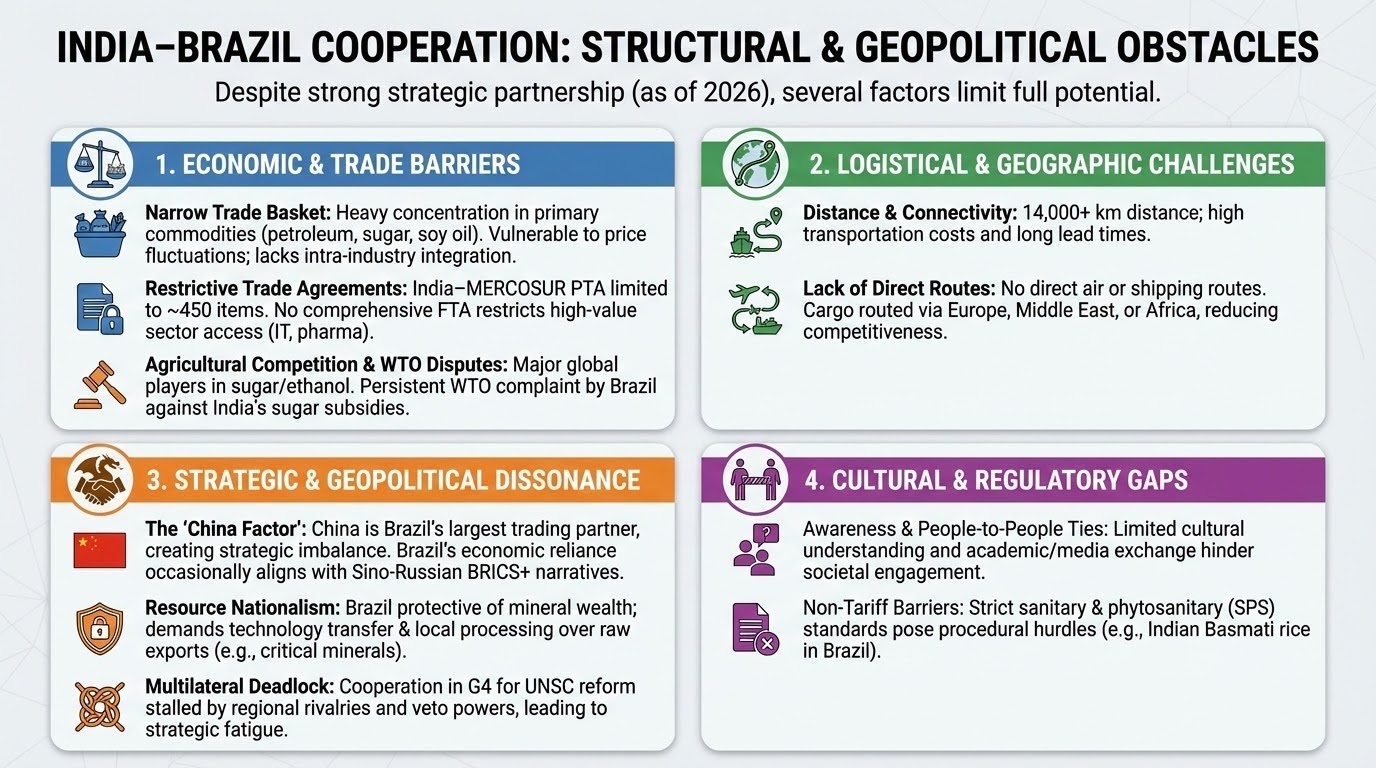
Competition in global agricultural markets, especially sugar, is a significant point of friction. Brazil has filed a complaint at the WTO against India's sugarcane subsidies.
Limited Market Access
The current India-MERCOSUR PTA is limited in scope. The absence of a comprehensive Free Trade Agreement (FTA) and existing non-tariff barriers hinder trade potential.
Limited Trade Basket
Trade is largely restricted to primary commodities (oil, gold, soy from Brazil; pharmaceuticals, engineering goods from India), restricting potential for deeper, diversified economic integration.
The China Factor
Brazil's deep economic reliance on China as its largest trading partner creates a strategic imbalance, making it harder for Indian firms to compete and creating different priorities within BRICS.
Geopolitical Nuances
While both countries advocate for a multipolar world, there are subtle differences in their approach within BRICS. India resists any anti-Western pivot, whereas Brazil sometimes aligns with Sino-Russian narratives.
Logistical Hurdles
The geographical distance (14,000+ km) and lack of direct shipping and air connectivity increase logistical costs and impede smoother trade and people-to-people contact.
 Way Forward for Strengthening India-Brazil Relations
Expanding Trade Agreements
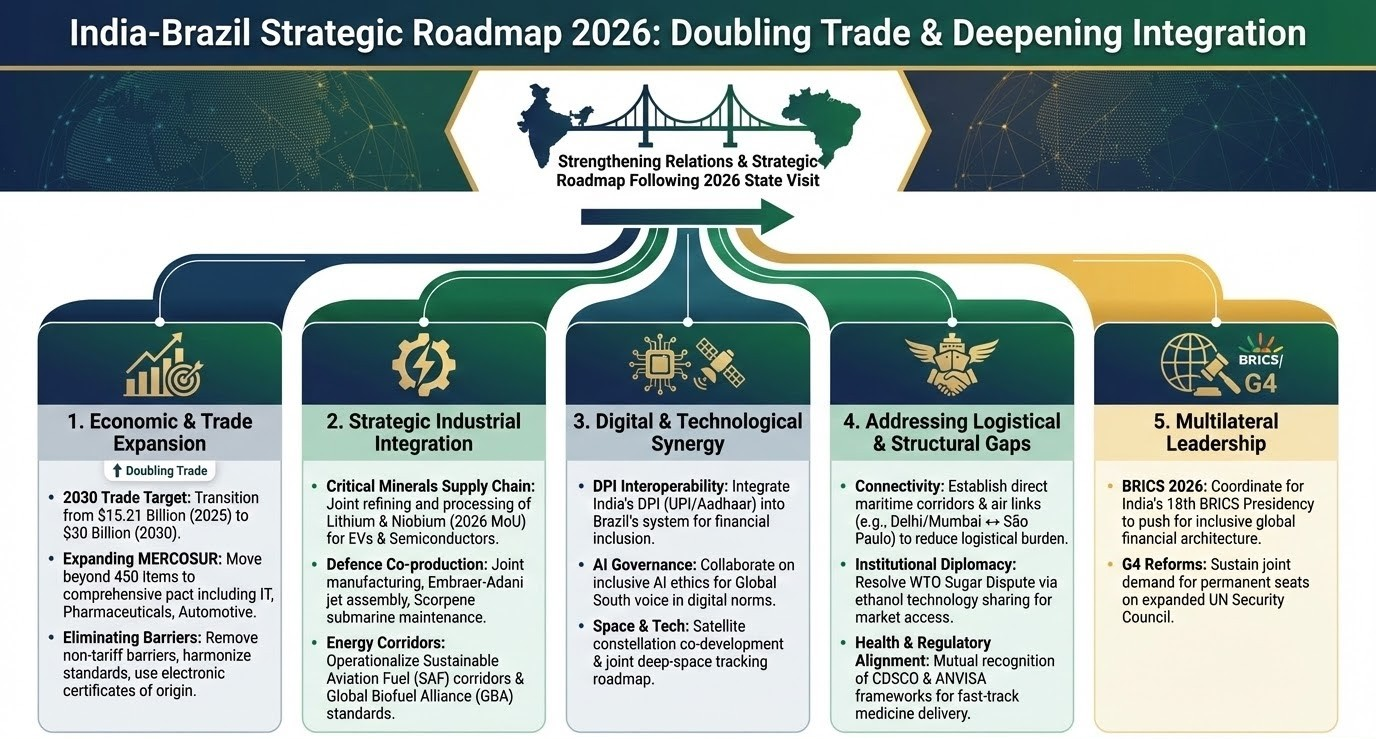
Fast-tracking the expansion of the India-MERCOSUR Preferential Trade Agreement (PTA) to cover more goods and services is crucial.
Diversifying the Trade Basket
Moving beyond traditional commodities to include high-value goods like electronics, defense equipment, and digital services.
Bioenergy Corridor
Harmonize biofuel blending mandates and exchange technology, leveraging the Global Biofuel Alliance to boost ethanol production.
Enhancing Connectivity
Establishing direct shipping lines and air routes to reduce travel time and costs, thereby boosting trade and tourism.
Deepening Strategic Convergence
Increasing coordination within multilateral forums like the G20, G4, and BRICS to jointly shape global norms and advocate for the interests of the Global South.
Leveraging Technology
Collaborating on Digital Public Infrastructure (DPI), fintech, and AI to create innovative solutions for development challenges.
 Conclusion
India and Brazil share a strategic partnership, leveraging their strengths as leading Global South powers to promote mutual growth and a new model for South-South collaboration in a complex world.
Source: reuters
|
PRACTICE QUESTION Q. The 'G4 Nations', often seen in the news, is a grouping of countries that collectively seek: A) Reform of global financial institutions like the IMF and World Bank. B) Permanent membership seats on the United Nations Security Council. C) A framework for cooperation on climate change mitigation for developing countries. D) Coordinated action against international terrorism and its financing. Answer: B Explanation: The G4 Nations is a coalition of four countries—India, Brazil, Germany, and Japan—that support each other’s bids for permanent seats on the United Nations Security Council (UNSC). Formed in 2005, the group advocates for a comprehensive reform of the UNSC to better reflect contemporary geopolitical realities, arguing that the current structure (the P5) is outdated and lacks representation from the Global South and major financial contributors. |
The partnership between two major Global South democracies and economies is crucial for driving reforms in international organizations like the UN Security Council, advancing clean energy through initiatives like the Global Biofuel Alliance, and fostering a multipolar world by diversifying supply chains.
Key achievements included creating a "Digital Partnership for the Future" centered on AI and Digital Public Infrastructure (DPI), setting a trade target of USD 30 billion by 2030, signing an MoU for rare earth and critical minerals to reduce dependence on China, and formalizing a trilateral MoU for maintaining Scorpene-class submarines.
The Global Biofuel Alliance, an initiative from India's G20 presidency, is driven by India and Brazil ("renewable energy superpowers") to accelerate the global adoption of sustainable biofuels. The alliance aims to support the energy transition by standardizing regulations, facilitating technology transfer, and establishing an international biofuel market.
© 2026 iasgyan. All right reserved