The Indian labour market faces a structural paradox where record-low unemployment rates mask a crisis of low-quality jobs, high graduate unemployment, and a vast informal workforce despite rising statutory wages.
Key Employment Indicators
Unemployment Rate (UR): The overall unemployment rate for persons aged 15 years and above was estimated at 4.9% in February 2026. (Source: Periodic Labour Force Survey (PLFS))
Labour Force Participation Rate (LFPR): The LFPR remained steady at 55.9% in February 2026. (Source: PLFS)
Worker Population Ratio (WPR): The WPR, reflecting the proportion of the population that is employed, stood at 53.2% in February 2026. (Source: PLFS)
Workforce Size: On average, 61.6 crore persons were employed in the country during the 2025 calendar year. (Source: PLFS)
Structural & Sectoral Trends
Shift to Formalisation: Share of workers in regular wage or salaried employment increased to 23.6% in 2025 compared to 22.4% in 2024. (Source: PLFS)
Sectoral Distribution: Agriculture remains the largest employer, although its share declined from 44.8% in 2024 to 43.0% in 2025, while manufacturing participation improved to 12.1%. (Source: PLFS)
Rise of the Gig Economy: India's gig workforce is estimated to grow from 1 crore in 2024–25 to 2.35 crore by 2029–30. (Source: NITI Aayog)
Female Participation: Female LFPR reached 40.0% in 2025, though it still lags behind the male participation rate of 79.1%. (Source: PLFS)
Education Mismatch: Approximately 40% of young graduates remain unemployed or underemployed, indicating a persistent mismatch between educational attainment and professional requirements.
Based on international frameworks—specifically the OECD Job Quality Framework and the ILO Decent Work Agenda—job quality is generally evaluated through three primary dimensions:
The United Nations Economic Commission for Europe (UNECE) adds that job quality must also measure "security of employment," "skills development," and "social dialogue".
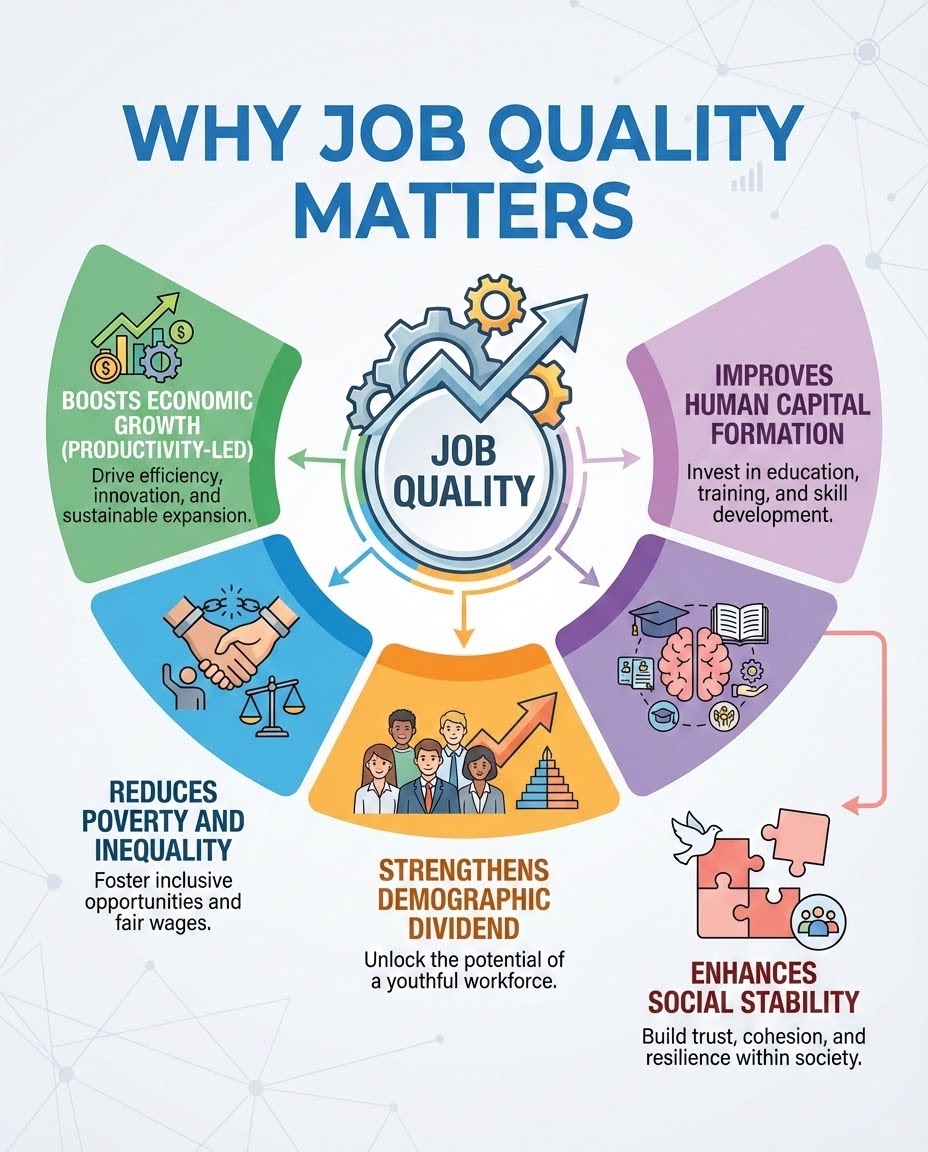 Current Scenario of Job Quality in India
High Informality and Lack of Security
Informal Employment: About 90% of India's total workforce is engaged in informal work, meaning they lack legal protection and social security.
Lack of Contracts: Among regular wage/salaried employees in the non-agriculture sector, 58% do not have a written job contract. (Source: PLFS)
No Social Benefits: Approximately 53.4% of regular wage/salaried employees are not eligible for any social security benefits (Source: PLFS)
Stagnant Wages and Earnings
Wage Stagnation: While casual labour wages saw a modest upward trend between 2012 and 2022, the real wages of regular workers have either remained stagnant or declined. (Source: India Employment Report)
Minimum Wage Compliance: Unskilled casual workers in agriculture (62%) and construction (70%) did not receive the prescribed daily minimum wage in 2022. (Source: India Employment Report)
Structural Regression in Employment
Reverse Migration: Post-2019, there has been a reversal of the slow transition towards non-farm employment, with a rise in the share of agricultural employment. (Source: India Employment Report 2024)
Youth Unemployment: Share of educated youth among all unemployed people increased from 54.2% in 2000 to 65.7% in 2022. (Source: India Employment Report)
Youth Share: India's youth account for almost 83% of the total unemployed workforce. (Source: India Employment Report)
Gender Disparities in Job Quality
Distress-Led Participation: Recent rise in the Female Labour Force Participation Rate (LFPR) is largely driven by an increase in self-employment, specifically unpaid family work, rather than high-quality wage employment. (Source: State of Working India)
Self-Employment Earnings: Real earnings from self-employment declined after 2019, indicating that the rise in employment numbers did not translate to better incomes. (Source: State of Working India)
The inability to move workers from low-productivity sectors (like subsistence farming) to high-productivity sectors (like modern manufacturing) is the primary bottleneck.
Structural Mismatch (GDP vs Jobs)
Agriculture: Contributes only 18.2% to GDP but still employs 45.8% of the workforce, leading to massive "disguised unemployment". (Source: PLFS)
Manufacturing Stagnation: Share of manufacturing in total employment has remained stagnant at around 12-14% for decades, failing to become the mass employer that it was for China or Vietnam. (Source: India Employment Report)
Services-Led Growth: While the services sector drives over 50% of GDP, it requires high skills (IT, Finance) that the average rural worker lacks, creating a "skills barrier". (Source: RBI)
The "Missing Middle" Syndrome
Indian industry is dominated by millions of micro-enterprises (employing <10 people) and a few large conglomerates, with very few medium-sized firms.
Dwarfism: Micro-enterprises account for 99% of MSMEs but often lack the capital to upgrade technology or pay productivity-linked wages.
Productivity Gap: Labour productivity in the informal sector is nearly one-fifth of that in the formal sector, keeping wages perpetually low.
The Employability Crisis
Skill Deficit: Only 4.4% of the workforce has received formal vocational training, compared to 52% in the USA and 96% in South Korea. (Source: NSDM)
Graduate Unemployment: Unemployment rate is highest among graduates (29.1%), indicating that the education system is not producing industry-ready skills. (Source: India Employment Report)
The government has shifted focus from "wage entitlement" (like MGNREGA) to "productivity enhancement" schemes.
Linked Incentive (PLI) Scheme: Targeting 14 key sectors (like Electronics, Pharma, Textiles) with an outlay of ₹1.97 lakh crore. Sectors like mobile manufacturing have seen massive employment surges, though lagging in others.
PM Vishwakarma Scheme: Targeting the informal artisan economy. Provides collateral-free loans (5% interest), ₹15,000 toolkit incentive, and skill training to artisans in 18 traditional trades .
Skill India Mission (PMKVY 4.0): Focuses on Industry 4.0 skills like AI, Robotics, and 3D Printing to improve employability.
PM SVANidhi: Micro-credit facility for street vendors to restart businesses, promoting self-reliance over charity.
Employment Linked Incentive (ELI) Scheme: Announced in the Union Budget 2024-25 to bridge the gap between "having a job" and "having a formal job."
eShram Portal: To create a National Database of Unorganized Workers (NDUW) and link them to social security schemes.
Implementing a National Employment Policy (NEP)
India currently manages employment through fragmented schemes across different ministries (Labour, Skill, MSME, Commerce).
Scaling up MSMEs: From "Dwarfs" to "Giants"
Most Indian firms are too small to be productive. Policy must incentivize "scaling up" rather than just "staying small."
Closing the Skill-Employability Gap
Education must translate into market-ready skills to reduce graduate unemployment.
Leveraging the Care and Green Economies
Formalizing the Informal through Social Security
Universal Social Security: Effective implementation of the Code on Social Security (2020) to provide insurance and pension benefits to gig and platform workers.
Urban Employment Guarantee: Parliamentary Standing Committee on Labour suggested piloting an Urban Employment Guarantee Scheme (on the lines of MGNREGA) to provide a safety net and build climate-resilient urban infrastructure.
Enhancing Female Labour Force Participation (FLFP)
Support Infrastructure: Providing safe transport, creche facilities, and flexible working modules to move women from "unpaid family work" to "paid formal work".
The transition from low-productivity informal work to high-productivity formal jobs is not just an economic necessity but a social imperative. By shifting focus from "minimum wages" to "living wages" and from "survival" to "security," India can truly capitalize on its demographic dividend.
Source: BUSINESS-STANDARD
|
PRACTICE QUESTION Q. Distinguish between "Job Quantity" and "Job Quality." Why is "Earnings Quality" and "Labour Market Security" essential for India’s long-term economic stability? 150 words |
Job quality goes beyond merely having work. It refers to employment that provides a fair living wage, job security via formal contracts, social protection (such as health insurance and provident funds), safe working conditions, and the proper utilization of a worker's educational skills.
The recent rise in self-employment is largely driven by an increase in "unpaid helpers in household enterprises." This indicates that individuals, lacking access to formal, productive jobs, are taking up low-productivity, informal work out of economic necessity rather than choice.
The "missing middle" highlights a structural weakness where 99% of India's MSMEs operate as micro-enterprises. They lack the scale, technology, and access to credit required to grow into medium-sized enterprises, thereby severely limiting their ability to create formal, high-paying jobs.
© 2026 iasgyan. All right reserved