

Copyright infringement not intended
Picture Courtesy: TIMESOFINDIA
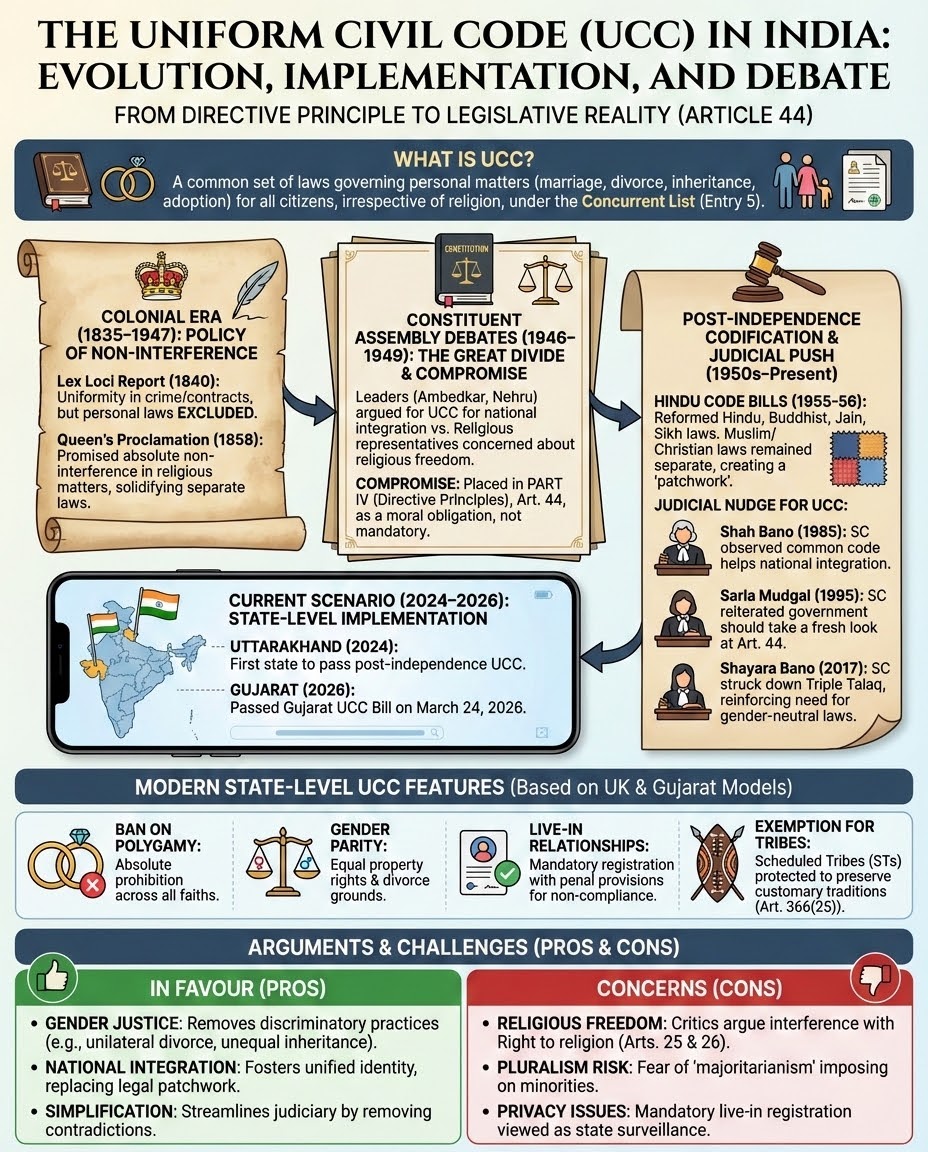
Gujarat became the second state in India (after Uttarakhand) to enact a law implementing a Uniform Civil Code, fulfilling the constitutional aspiration enshrined in Article 44.
The Uniform Civil Code (UCC) refers to a common set of laws governing personal matters such as marriage, divorce, inheritance, adoption, and succession for all citizens of a country, regardless of their religion, caste, or creed.
Article 44: UCC enshrined as a Directive Principle of State Policy (DPSP) in Part IV of the Constitution, which states: "The State shall endeavour to secure for the citizens a uniform civil code throughout the territory of India".
Concurrent List: Personal laws like “Marriage and divorce; infants and minors; adoption; wills, intestacy and succession" fall under the Concurrent List (Seventh Schedule). This gives States the power to legislate, provided they receive Presidential assent to override any conflicting Central laws.
While there is no national UCC, some states states have implemented or passed such codes:
 What is the Gujarat UCC Bill 2026?
The Bill proposes a common set of laws governing marriage, divorce, succession, and live-in relationships for all citizens of the state, irrespective of their religion, caste, or creed.
It aims to replace personal laws based on religious scriptures (like the Hindu Marriage Act, Muslim Personal Law, etc.) with a single statutory framework.
Drafting Committee: The Bill is based on the recommendations of a state-appointed committee headed by Justice (Retd.) Ranjana Prakash Desai, who also headed the committee for the Uttarakhand UCC.
Marriage & Divorce
Mandatory Registration: Registration of marriages is now compulsory for all communities. Failure to register within 60 days attracts a fine of up to ₹10,000.
Ban on Polygamy: The Bill prohibits bigamy and polygamy. A marriage is valid only if neither party has a living spouse. Violation can lead to imprisonment of up to 7 years.
Ban on 'Halala' & 'Iddat': Practices like Nikah Halala (where a woman must marry another man and divorce him to remarry her first husband) are banned and criminalized.
Uniform Divorce Process: "Out-of-court" divorces (like Triple Talaq or customary divorces) are invalid. All divorces must be largely court-monitored to ensure gender justice.
Right to Remarry: Women are granted the unconditional right to remarry after a divorce without observing specific religious waiting periods aimed at restricting this right.
Live-in Relationships
Mandatory Registration: Couples in a live-in relationship must register with a designated local authority.
Termination: Formal notice is required to terminate the relationship.
Penalties: Non-registration can invite a jail term of up to 3 months or a fine.
Legitimacy of Children: Children born out of live-in relationships will be considered legitimate and entitled to inheritance rights.
Maintenance: A woman deserted by her live-in partner is entitled to claim maintenance.
Succession & Inheritance
Gender Equality: The Bill ensures equal property rights for sons and daughters across all communities.
Parental Rights: In the absence of a will (intestate succession), parents (both mother and father) have a claim to the property, ensuring their old-age security.
Exemptions
Scheduled Tribes (STs): The Bill does not apply to members of STs constitutionally protected under Article 366(25). This exemption is designed to preserve their distinct customs and traditions.
Promotion of Gender Justice: Many existing personal laws are viewed as inherently patriarchal, particularly regarding marriage, divorce, and inheritance.
National Integration and Secularism: The current system of different laws for different religions creates a sense of "legal segregation."
Fulfilling Constitutional Mandate: The UCC is not a new or "alien" concept but a specific goal set by the makers of the Constitution.
Simplification of the Legal System: Judiciary currently deals with a complex overlap of various personal laws, customary practices, and religious interpretations.
Modernisation and Global Standards: Most developed and progressive nations have a uniform civil code that applies to all citizens irrespective of faith.
Conflict with Religious Freedom: Constitutional friction between Article 44 (UCC) and Articles 25-28 (Right to Freedom of Religion).
Threat to Cultural Diversity and Pluralism: India’s "Unity in Diversity" is built on the recognition of distinct cultural identities.
The "Uniformity" Paradox: The UCC models (Uttarakhand 2024 and Gujarat 2026) have explicitly exempted Scheduled Tribes (STs).
Violation of Privacy: Gujarat UCC bill includes mandatory registration for live-in couples, which has sparked a debate on civil liberties.
Federalism and Legislative Conflict: Since "Marriage and Divorce" fall under the Concurrent List, states are enacting their own UCCs.
Lack of Political and Social Consensus: The 21st Law Commission noted that a UCC is "neither necessary nor desirable at this stage" without a broad consensus.
Codification and Reform of Existing Personal Laws: Instead of an abrupt replacement, the government could first focus on removing discriminatory practices within individual personal laws.
Building a Broad Socio-Political Consensus: A UCC cannot be successful if it is perceived as an imposition of majority values on minorities.
Addressing the "Tribal Exception" Dilemma: Exempting Scheduled Tribes (as seen in the Uttarakhand and Gujarat models) creates a legal paradox for a "Uniform" code.
Balancing Privacy with Regulation: The mandatory registration of live-in relationships has sparked significant "State overreach" concerns.
Transitioning to an "Optional" UCC Initially: To reduce social friction, the government could consider an optional model first.
Judicial Review of State-Level UCCs: Since states are passing individual UCC bills, there is a risk of a "legal patchwork."
Transitioning from formal to substantive equality, the UCC must prioritize gender justice and dignity (Article 21) over mere uniformity. By building social consensus, it can protect the vulnerable and foster national integration without eroding India’s essential cultural pluralism.
Source: TIMESOFINDIA
|
PRACTICE QUESTION Q. With reference to the Uniform Civil Code (UCC) in India, consider the following statements: 1. The mandate to secure a Uniform Civil Code is a Fundamental Duty under Part IVA of the Constitution. 2. Personal laws concerning marriage and divorce fall under the Concurrent List of the Seventh Schedule. Which of the statements given above is/are correct? a) 1 only b) 2 only c) Both 1 and 2 d) Neither 1 nor 2 Answer: b Explanation: Statement 1 is incorrect: The mandate to secure a Uniform Civil Code (UCC) is a Directive Principle of State Policy (DPSP) under Article 44 in Part IV of the Constitution, not a Fundamental Duty in Part IVA. It states that "The State shall endeavour to secure for the citizens a uniform civil code throughout the territory of India". Statement 2 is correct: Personal laws, including subjects like marriage, divorce, infants and minors, adoption, wills, intestacy, and succession, are listed under Entry 5 of the Concurrent List (List III) in the Seventh Schedule. This allows both the Parliament and State Legislatures to enact laws on these subjects. |
The UCC is a proposed common set of civil laws for all citizens of India, aiming to replace existing personal laws that vary by religion. Currently, different communities follow their own scriptures for matters like marriage and succession (e.g., Hindu Marriage Act, Muslim Personal Law).
Article 44 of the Constitution, under the Directive Principles of State Policy, states that the State shall "endeavour to secure for the citizens a uniform civil code throughout the territory of India". However, unlike Fundamental Rights, these principles are not legally enforceable by courts.
Supporters argue that a uniform code will:
Promote National Integration: Create a shared identity for all citizens beyond religious lines.
© 2026 iasgyan. All right reserved