

Copyright infringement not intended
Picture Courtesy: INDIANEXPRESS
Several states are discussing farm loan waivers, reviving debate about their impact on the banking system and agricultural credit.
Farm loan waivers are government-led relief measures where the state or central government agrees to forgive the outstanding debts of farmers.
Under these schemes, the government takes over the liability and repays the lending institutions (like banks) using taxpayer money from the budget.
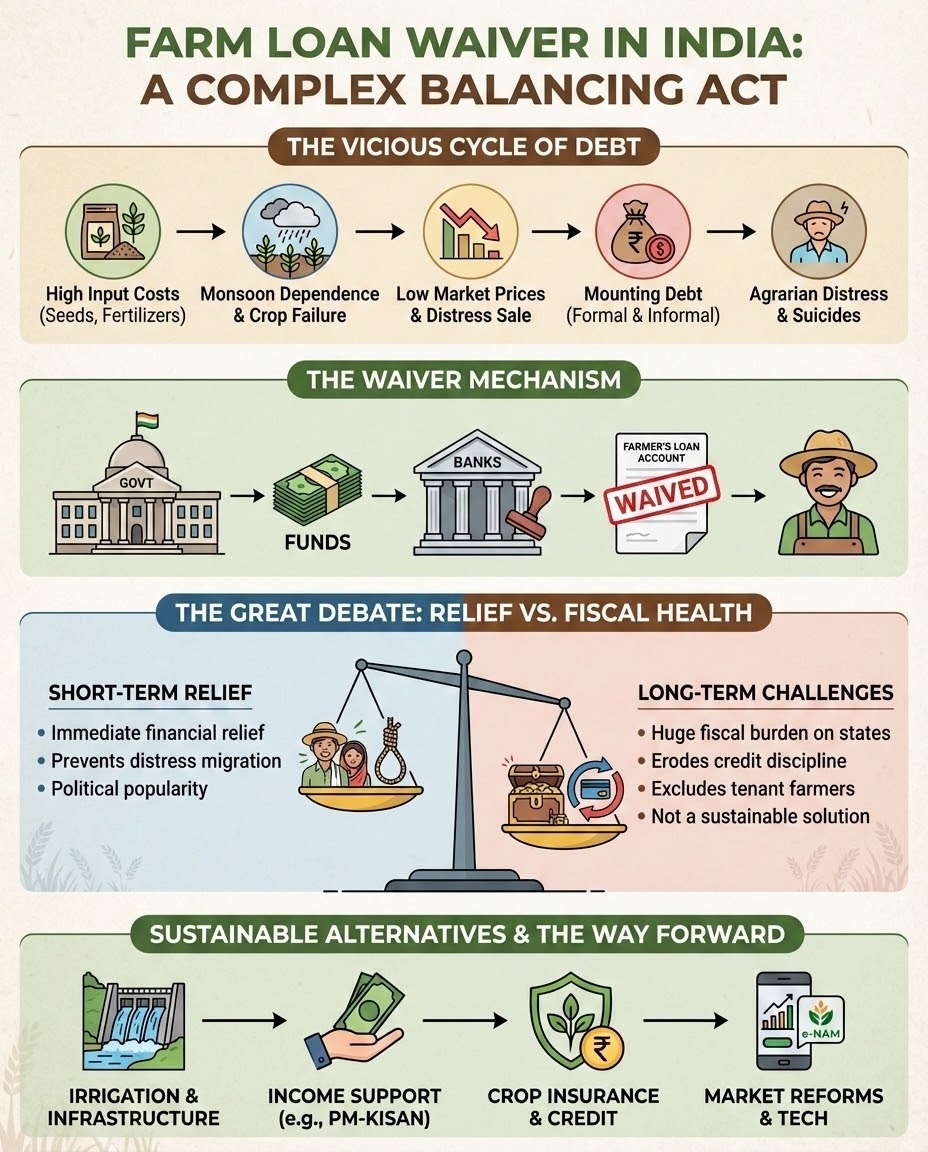 What is the Rationale Behind Farm Loan Waivers?
The rationale behind farm loan waivers is rooted in the need for immediate humanitarian and economic relief for a highly vulnerable agricultural sector.
Humanitarian Crisis and Distress Mitigation
Preventing Suicides: Indebtedness is a leading cause of farmer suicides; waivers serve as an emergency intervention to provide a "safety net" during times of extreme psychological and financial distress.
Natural Calamities: Agriculture is heavily dependent on unpredictable monsoons; a single bad harvest due to drought or floods can wipe out a farmer's income, making debt repayment impossible.
Revitalizing the Economy
New Credit: Defaulting farmers are barred from taking fresh institutional loans. By waiving old debts, governments allow farmers to qualify for new credit to purchase seeds and fertilizers for the next crop cycle.
Boosting Consumption: Removing debt obligations frees up household income for essential spending on health, education, and food, which supports the broader rural economy.
Structural Vulnerabilities
Small Landholdings: More than 85% of Indian farmers possess less than 2 hectares of land, which lacks the scale to generate sufficient profit to absorb economic shocks like price volatility. (Source: PIB)
Market Failures: Farmers often fail to receive remunerative prices (like MSP) due to a lack of storage, cold chains, and excessive dependence on middlemen, keeping them in a perpetual debt cycle.
Political Rationale
Electoral Success: Farm loan waivers are a powerful political tool; between 1987 and 2020, 17 out of 21 political parties that promised such schemes won their state elections (Source: Forbes India).
Medieval Origins
Taccavi Loans: The first recorded instance was during the reign of Muhammad-bin-Tughluq (1325–1351), who advanced loans to villagers to alleviate distress.
First Write-off: These loans were later written off by the subsequent ruler, Firoz Shah Tughluq, following rebellion and famine.
Post-Independence Nationwide Waivers
1990 ARDRS: The first pan-India waiver, the Agricultural and Rural Debt Relief Scheme, was launched by the V.P. Singh government. It provided relief of up to ₹10,000 per borrower and cost approximately ₹7,825–₹10,000 crore.
2008 ADWDRS: The second major national waiver, the Agricultural Debt Waiver and Debt Relief Scheme, was implemented by the UPA government. It cost the exchequer roughly ₹71,680 crore and benefited an estimated 3.7 to 4.3 crore farmers.
State-Level Waivers (The "New Era" Since 2014)
Scale of Announcements: Between 2014 and 2024, various state governments announced waivers totaling nearly ₹2.52 lakh crore. (Source: SBI)
Recent Major State Schemes: Maharashtra (2026) announced a new ₹35,000 crore waiver, targeting crop loans for small and marginal farmers.
Incentivising Non-Repayment: Regular waivers create a "moral hazard" where even farmers with the capacity to pay withhold their installments in anticipation of future waivers, especially near election cycles.
Punishing Honesty: Penalise disciplined borrowers who repay their loans on time, while rewarding those who default, thereby destroying long-term credit discipline.
Expectation Cycle: Once a waiver is announced, repayment rates drop dramatically; for example, in Uttar Pradesh, average repayment rates fell from 25-50% to just 10-25% following a waiver announcement. (Source: International Growth Centre).
Transfer of Taxpayer Wealth: Former RBI Governor Urjit Patel stated that waivers represent a transfer of taxpayer money to private borrowers, which can lead to a higher cost of borrowing for the general public.
Unproductive Spending: Households receiving waivers often divert the "freed-up" funds toward unproductive consumption and social events rather than reinvesting in agricultural productivity. (Source: International Growth Centre)
What are the Consequences of Farm loan waivers?
Fiscal Impact on State Finances
Expansion of Fiscal Deficit: Farm loan waivers directly increase state government expenditures; for example, actual waivers in 2017–18 accounted for nearly 12% of the total fiscal deficit for the implementing states. (Source: RBI)
Deterioration of Expenditure Quality: To accommodate unexpected fiscal shocks from waivers, states reduced capital expenditure, which is harming long-term agricultural growth by cutting productive assets like irrigation and roads.
Increased Interest Burden: Persistent deficits lead to higher outstanding liabilities; as of 2023–24, states spent an average of 13% of their revenue receipts solely on interest payments. (Source: PRS)
Economic and Banking Sector Consequences
Erosion of Credit Culture: The RBI warns that waivers create a "moral hazard", where borrowers strategically default in anticipation of future waivers, undermining the honest credit culture.
Squeeze on Fresh Credit: Post-waiver, banks often become conservative, leading to a shrinkage in fresh lending to the agricultural sector. This forces farmers to rely more on informal moneylenders with high interest rates.
Structural and Implementation Lapses
Exclusion of Small Farmers: NITI Aayog notes that waivers benefit only the 10-15% of farmers who have access to institutional credit, while the poorest, who rely on non-institutional sources, receive no relief but suffer from the resulting credit squeeze.
Mismanagement and Fraud: A performance audit by the Comptroller and Auditor General (CAG) of the welfare scheme found errors, including the inclusion of ineligible beneficiaries and the exclusion of deserving small farmers.
Shift from Loan Waivers to Direct Income Support
Expansion of PM-KISAN: The RBI Internal Working Group recommends replacing unpredictable waivers with a predictable, universal direct benefit transfer (DBT) to provide a steady safety net.
Investment Support: Expand State models like Rythu Bandhu (Telangana) to incentivize production rather than rewarding default.
Strengthening Risk and Price Management
Robust Crop Insurance: Enhancing the Pradhan Mantri Fasal Bima Yojana (PMFBY) through AI-based yield estimation can ensure faster payouts, reducing the immediate need for debt relief during disasters.
Market Integration (e-NAM): Accelerating the One Nation One Market initiative ensures farmers receive remunerative prices, addressing the low income that leads to debt.
Enhancing Credit Ecosystems
Credit Discipline: The RBI emphasizes maintaining a healthy credit culture by strictly limiting waivers to rare, extreme calamities rather than electoral cycles.
Interest Subvention: Strengthening the Modified Interest Subvention Scheme (MISS) encourages prompt repayment by offering effective interest rates as low as 4% for disciplined borrowers (Source: PIB).
Infrastructure and Value Addition
Capital Expenditure Over Waivers: States must prioritize the Agriculture Infrastructure Fund (AIF) to build cold chains and warehouses, which helps prevent distress sales.
Promotion of FPOs: Encouraging Farmer Producer Organisations (FPOs) allows small farmers to gain bargaining power and access cheaper inputs through collective action.
Institutional Reform
Digitization of Land Records: Full implementation of the SVAMITVA scheme to provide clear collateral, allowing farmers to bypass high-interest informal moneylenders.
Farm loan waivers provide immediate humanitarian relief for distressed farmers but create a moral hazard that erodes credit culture and strains state finances, therefore, the way forward lies in replacing reactionary waivers with Direct Income Support, robust crop insurance, and investment in post-harvest infrastructure to address the root causes of agricultural indebtedness
Source: INDIAN EXPRESS
|
PRACTICE QUESTION Q. Farm loan waivers are a classic example of treating the symptom rather than the disease. Critically analyze. (250 words) |
A farm loan waiver is a policy where the government forgives certain agricultural loans of farmers, relieving them of the burden of repayment. These schemes are announced by either the central or state governments, typically in response to agrarian distress caused by factors like drought, floods, or price crashes.
Experts criticize loan waivers because they damage the credit culture by creating a "moral hazard"—farmers who can repay may default in anticipation of a waiver. They also impose a heavy fiscal burden on the government, forcing cuts in essential long-term investments like irrigation and rural infrastructure.
Better alternatives focus on long-term solutions. These include direct income/investment support schemes like PM-KISAN and Telangana's Rythu Bandhu, which empower farmers without distorting the credit market. Other key alternatives are investing in agricultural infrastructure (irrigation, cold storage) and strengthening crop insurance schemes like PMFBY for timely claim settlements.
© 2026 iasgyan. All right reserved