

The rapid proliferation of Unmanned Aerial Vehicles (UAVs) and autonomous combat systems fundamentally alters global military doctrines, shifting the focus from expensive, platform-centric assets to cost-effective, AI-integrated Drones technologies.
A UAV (Unmanned Aerial Vehicle) functions as an aircraft operating entirely without an onboard human pilot, controlled either remotely via ground stations or autonomously through Artificial Intelligence (AI) and pre-programmed flight paths.
Operational Range: They range from nano-drones weighing under 250 grams to heavy 13-ton stealth combat vehicles designed for deep-strike missions.
Classification: Militaries categorize drones based on altitude and endurance:
Early Reconnaissance: Militaries initially deployed drones as passive intelligence-gathering tools. India began this journey in 1998 by acquiring the Searcher Mark 1 from Israel for discreet aerial reconnaissance.
Weaponization: The transition from expensive manned fighter jets to Unmanned Combat Aerial Vehicles (UCAVs) allows militaries to project lethal force while minimizing human casualties.
Swarm Technology: The tactical landscape now favors swarm drones, where hundreds of AI-coordinated, low-cost units overwhelm traditional air defenses.
AI-Enabled Autonomy: Modern drones utilize Edge AI to process data onboard, allowing them to lock onto targets and execute strikes in electronic warfare environments where radio-frequency links to human operators remain jammed.
ISR (Intelligence, Surveillance, and Reconnaissance) Drones: These provide 24-hour persistent visibility. India deploys the IAI Heron Mk-II and indigenous Nishant tactical UAVs to monitor the Line of Actual Control (LAC) and Line of Control (LoC).
Combat Drones (UCAVs): These carry missiles and bombs to penetrate defended airspace. The US-made MQ-9B Predator and the DRDO Ghatak UCAV represent deep-strike and SEAD (Suppression of Enemy Air Defenses) capabilities.
Loitering Munitions: Often called "Kamikaze drones," these platforms hover over target areas before crashing into objectives. The Iranian Shahed-136, Israeli Harop, and India’s Nagastra-1 exemplify this category.
Naval Drones: Drones protect maritime assets and threaten naval fleets. The Indian Navy utilizes the Drishti-10 Starliner for all-weather maritime surveillance.
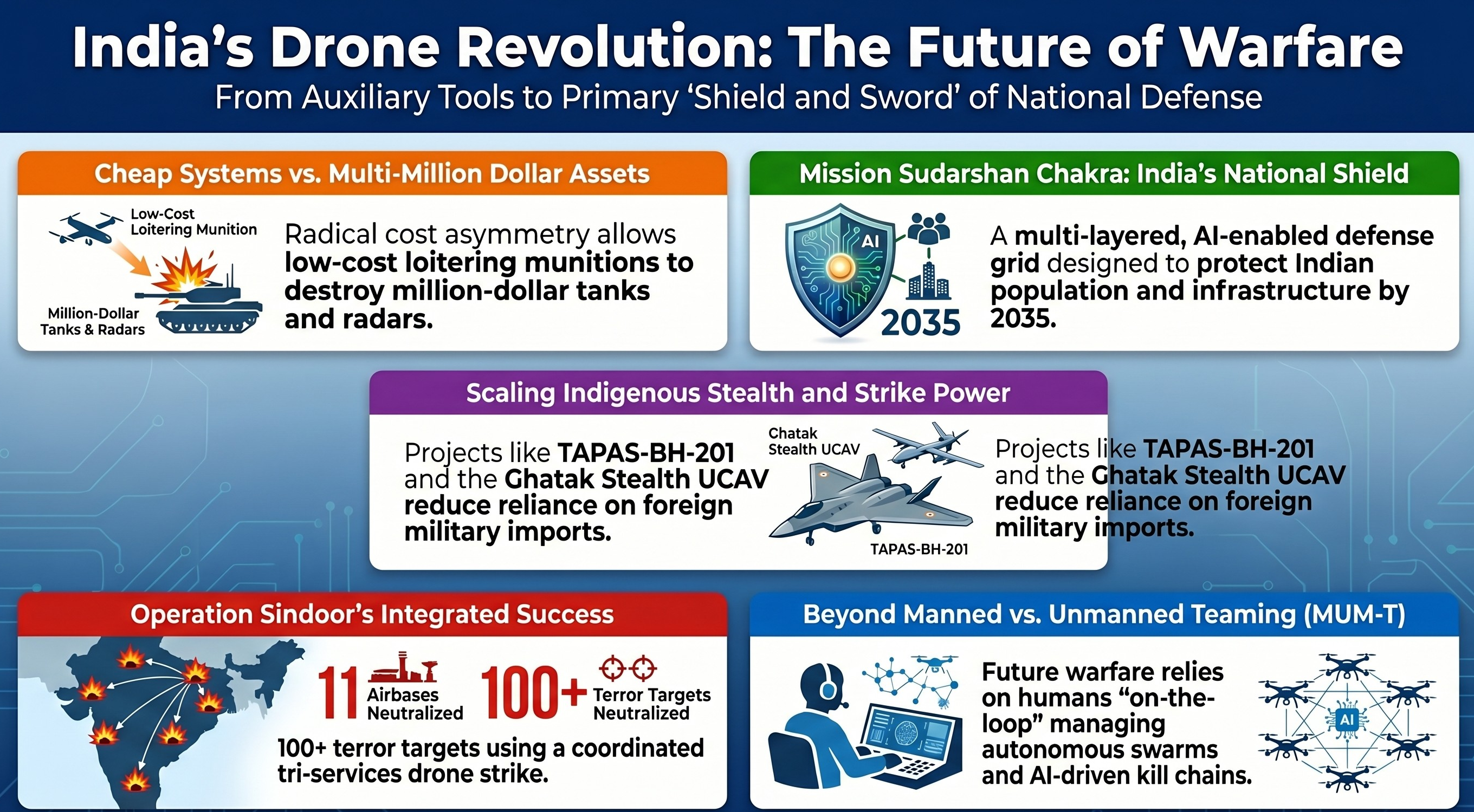
Cost Asymmetry: A $500 commercial drone can destroy a $2 million main battle tank, forcing defenders to waste $100,000 interceptor missiles to neutralize a negligible financial investment.
Risk Mitigation: Removing pilots from cockpits allows commanders to project force into politically sensitive or highly contested environments with zero risk to human personnel.
Precision Targeting: During Operation Sindoor, India utilized SkyStriker loitering munitions to strike 9 terror infrastructure sites, neutralizing over 100 terrorists with zero civilian casualties.
Real-Time Intelligence: Drones eliminate the "fog of war" by providing continuous, low-cost ISTAR (Intelligence, Surveillance, Target Acquisition, and Reconnaissance).
Persistent Surveillance: Drones blur the distinction between frontline combat zones and rear logistical areas, ensuring constant monitoring of enemy troop movements and artillery positions.
Network-Centric Operations: AI programs like Project Maven automatically scan video feeds, predict threats, and match them with military assets in seconds, compressing the kill chain.
AI Integration: AI fuses data from multiple sensors to identify threats instantly, enabling automated responses in complex, high-speed combat scenarios.
Russia–Ukraine War: This conflict serves as the world's first industrial-scale drone war.
Middle East Conflicts: The Islamic Revolutionary Guard Corps (IRGC) utilizes a proxy-centric doctrine, supplying Shahed and Ababil drones to groups in Lebanon, Iraq, and Yemen to threaten global oil infrastructure without direct state-to-state confrontation.
Red Sea Security: Non-state actors like the Houthis leverage cheap commercial drones to threaten global maritime trade, proving that non-state entities no longer require advanced domestic pipelines to project power.
Israel–Iran War: Iran deployed waves of $20,000 Shahed kamikaze drones alongside ballistic missiles to intentionally force the exhaustion of Israel's multimillion-dollar Iron Dome, David's Sling, and Arrow interceptor stockpiles.
|
Counter-Drone Technologies Electronic Warfare (EW): Systems like India’s D4 Anti-Drone System jam communication channels to sever the link between the drone and its operator. Directed Energy Weapons (DEW): These utilize high-powered microwaves or lasers to burn drone electronics. DEWs solve the cost-asymmetry problem by offering a near-zero cost per shot.
Integrated Grids: India constructs a joint Counter Unmanned Aerial Systems (CUAS) grid under Mission Sudarshan Chakra, linking the S-400, MRSAM, SPYDER, and L-70 anti-aircraft guns. |
Drone Rules, 2021: This policy liberalized the regulatory regime by abolishing numerous approvals and introducing the Digital Sky platform, which divides airspace into Green, Yellow, and Red zones.
Production Linked Incentive (PLI) Scheme: The government allocated ₹120 crore over three years to boost domestic manufacturing, while simultaneously banning the import of foreign-made finished drones.
Defence Modernization: India acquires 31 MQ-9B Predator drones in a $4 billion deal to transform its ISR and deep-strike capabilities.
Indigenous Development: The DRDO leads the development of the TAPAS-BH-201 MALE UAV, the Archer weaponized drone, and the SWiFT technology demonstrator.
|
Future Of Warfare Human–Machine Teaming (MUM-T): Future operations will feature the Ghatak UCAV and HAL CATS Warrior flying alongside manned fighter jets like the Tejas, acting as "loyal wingmen." Battlefield Automation: AI command systems will analyze satellite data, track targets, and launch robotic strikes within seconds, rendering traditional, slow-reacting militaries obsolete. Multi-Domain Operations: Drones will integrate air, land, sea, and space assets into a single cohesive strike network utilizing predictive AI algorithms. |
Cybersecurity Risks: Reliance on data links exposes fleets to cyber-attacks, where adversaries hijack drones or steal sensitive surveillance feeds.
Lethal Autonomous Weapons Systems (LAWS): These systems raise severe moral questions regarding accountability. AI lacks the capacity to understand human suffering or proportionality, creating gaps in International Humanitarian Law.
Accountability: If an AI-driven drone targets a civilian entity due to an algorithmic error, identifying the liable party—the programmer, commander, or manufacturer—remains legally unresolved.
Develop and Deploy Directed Energy Weapons (DEW): India must rapidly scale the deployment of high-power microwave and laser weapons to solve the cost-asymmetry problem. DEWs offer a near-zero cost per shot, making them the only economically viable defense against mass swarms.
Establish a Layered, AI-Driven Air Defence Grid: Builds a dedicated Counter Unmanned Aerial Systems (CUAS) grid separate from traditional aircraft tracking systems.
Boost Indigenous Manufacturing and R&D: Expand the Production-Linked Incentive (PLI) scheme to foster the domestic ecosystem.
Strengthen Border Surveillance Infrastructure: Border forces must deploy localized, specialized anti-drone technology to secure porous borders.
Establish a Joint Drone & Electronic Warfare Command: India must eliminate operational silos by uniting electronic warfare units, air-defense systems, and signal-intelligence teams into a single joint command. This ensures rapid, synchronized responses to multi-vector aerial threats.
Enforce "Human-in-the-Loop" Mandates: Military doctrine must hardcode meaningful human control, ensuring a human commander retains the final, legally accountable authority to deploy lethal force.
The drone revolution irreversibly obliterates traditional platform-centric warfare. To survive the battlespace of the 21st century, nations must master industrial-scale mass production, AI-integrated swarms, and cost-effective directed-energy defenses.
Source: THEHINDU
|
PRACTICE QUESTION Q. Discuss the internal security threats posed by the illicit use of drones across India’s western borders. 150 words |
Drone warfare is the tactical or strategic deployment of uncrewed, remote-controlled, or autonomous aerial, surface, or underwater vehicles to conduct military surveillance, reconnaissance, and precision combat strikes.
Drones fundamentally reshape conflicts by democratizing precision air support, reducing soldier casualties through remote piloting, and making battlefield tracking vastly cheaper and more continuous than traditional fighter jet operations.
Swarm drone technology is an advanced combat network where dozens of autonomous drones communicate in real-time to organically coordinate flight paths, bypass air defenses, and overwhelm enemy targets as a unified hive.
Military forces counter drone strikes by deploying integrated anti-drone air defense shields that combine radar tracking, electronic jamming to sever communication frequencies, high-powered lasers, and tactical interceptor nets.
© 2026 iasgyan. All right reserved