During the Netherlands visit, Punjab CM Bhagwant Singh Mann secured a Basmati Centre of Excellence to drive crop diversification and sustainability, for boosting farmer income and decreasing reliance on wheat-paddy cycles.
Crop diversification involves cultivating multiple crop varieties in one area to expand production and minimize risk. It marks a transition from single-crop dominance to producing various crops, such as fruits and spices.
 Why is Crop Diversification Becoming Necessary in India?
Mitigating Climate Risk: Weather is responsible for about 70% of the variability in crop productivity, making diversification essential to ensure some yield during adverse weather conditions. (Source: Indian Council of Agricultural Research).
Soil Health Restoration: Replacing continuous rice-wheat monoculture with leguminous crops restores depleted nutrients and micro-fauna through natural nitrogen fixation.
Addressing Water Stress: Shifting from Northwest India's rice-wheat system to less water-intensive crops is vital to arrest severe groundwater depletion.
Boosting Farmer Income: Switching to fruits, vegetables, and spices offers higher profits than grains and buffers against market price crashes.
Improving Nutrition: Diversification reduces undernutrition; replacing calories with nutrient-dense pulses and oilseeds combats "hidden hunger".
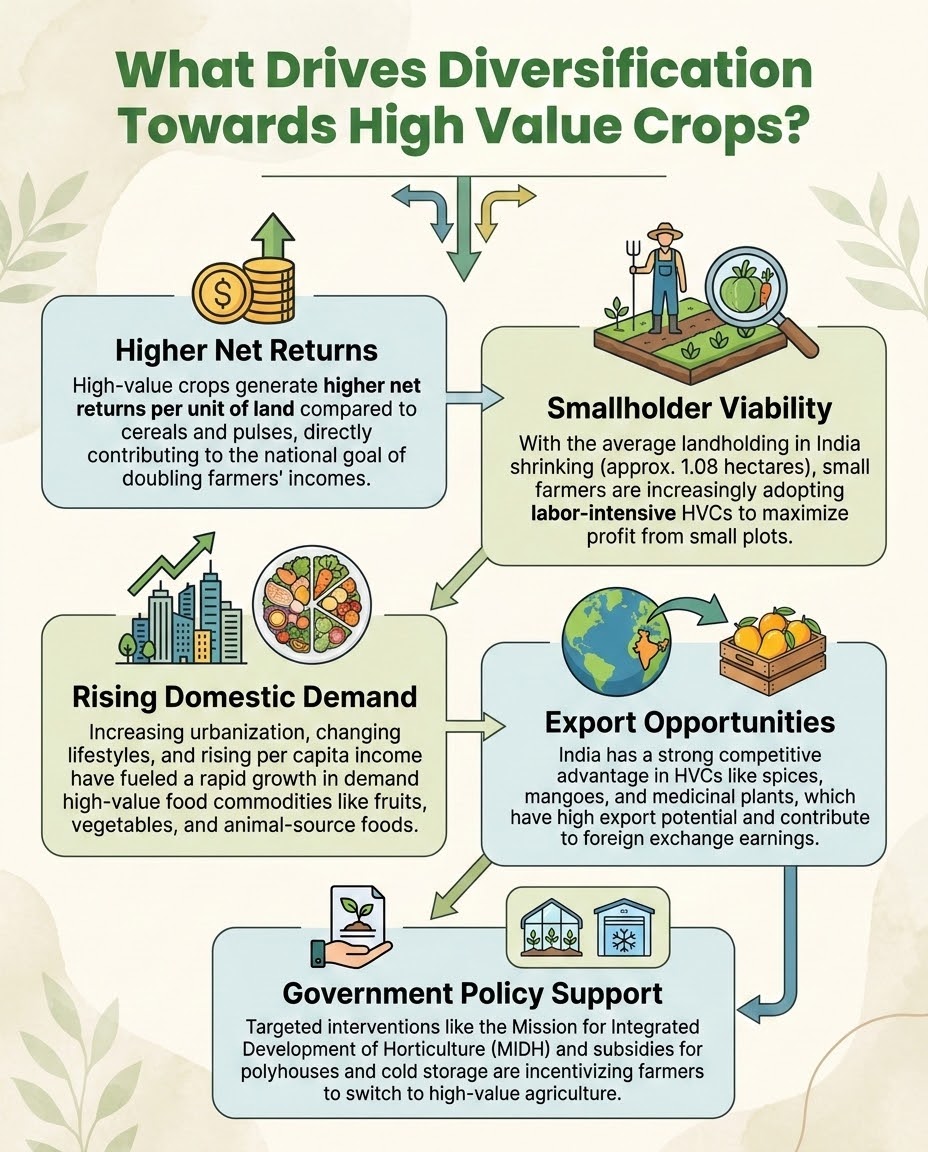
Optimizing Small Farms: With India's average farm size at just 1.08 hectares, intensive cropping is essential for smallholder economic viability.
Economic Benefits: Stabilizing and Increasing Income
Risk Mitigation: Growing a mix of crops (cereals, pulses, oilseeds) creates a safety net; if one crop fails due to pests or market crashes, income from others compensates for the loss.
Year-Round Income Flow: Unlike monoculture, which provides income only once or twice a year, diversified systems (especially with horticulture or livestock) ensure a steady cash flow throughout the year.
Higher Profitability: Shifting towards high-value crops like fruits, vegetables, and spices generates significantly higher net returns per unit of land compared to traditional staple grains.
Employment Generation: High-value crops and diversified farming systems are more labor-intensive, generating steady employment opportunities for rural households and reducing seasonal unemployment.
Ecological Benefits: Restoring Natural Resources
Water Conservation: Replacing water-guzzling crops like paddy with less water-intensive alternatives such as maize, millets, and pulses helps arrest the critical decline of groundwater tables.
Soil Health Restoration: Incorporating leguminous crops (pulses) naturally fixes atmospheric nitrogen, improving soil fertility and reducing the dependency on chemical fertilizers.
Pest and Disease Control: Crop rotation and intercropping break the life cycles of specific pests and diseases that thrive in monoculture environments, reducing the need for pesticide applications.
Climate Resilience: Diverse cropping systems are better equipped to withstand extreme weather events; for instance, deep-rooted crops may survive droughts where shallow-rooted ones fail.
Social & Nutritional Benefits: Fighting Hidden Hunger
Nutritional Security: Moving from calorie-dense cereals to nutrient-rich crops (pulses, fruits, vegetables) is essential to combat malnutrition and micronutrient deficiencies, often called "hidden hunger".
Food Availability: A diverse farm produces a wider basket of food groups, directly improving the dietary diversity and health outcomes of farming households.
Economic and Market Barriers
MSP Bias: Current procurement systems prioritize rice and wheat, offering price guarantees that pulses and millets lack, which deters farmers from switching.
Price Volatility: High-value perishables like fruits face extreme market fluctuations. Without a safety net, farmers encounter significant financial risks.
Poor Infrastructure: Shortages in cold storage and specialized transport cause 15–20% post-harvest losses in horticulture, further discouraging diversification.
Ecological and Climatic Constraints
Rainfall Dependency: Since over 50% of India's farmland is rain-fed, switching to water-sensitive high-value crops is risky without guaranteed irrigation.
Biological Threats: New crops bring unfamiliar pests and diseases, yet many farmers lack the technical expertise to manage these specific risks.
Structural and Policy Challenges
Land Fragmentation: India's small average landholding (1.08 hectares) causes marginal farmers to prioritize subsistence grains over market-driven diversification.
Weak Value Chains: Numerous middlemen in traditional supply chains reduce the farmer's profit share for high-value products like spices and vegetables.
Limited Seed Access: Unlike rice and wheat, alternative crops such as pulses and oilseeds suffer from a shortage of high-yielding, certified seeds.
Technical and Behavioral Hurdles
Information Gap: Farmers often lack the market intelligence and technical training necessary for high-value agriculture.
Green Revolution Legacy: Long-term focus and subsidies for cereals have built an ecosystem and mindset centered on rice and wheat, hindering transitions to other crops.
Dedicated Schemes and Programmes
Crop Diversification Programme (CDP): An Rashtriya Krishi Vikas Yojana (RKVY) sub-scheme targeting Green Revolution states to transition from water-intensive paddy to pulses, oilseeds, cotton, and maize.
Mission for Integrated Development of Horticulture (MIDH): A centrally sponsored initiative providing financial aid to boost high-value horticulture crops like fruits, vegetables, and spices.
National Mission on Edible Oils – Oil Palm (NMEO-OP): Offers incentives and price security to expand oil palm cultivation, primarily in the Northeast and Andaman Islands, reducing import reliance.
Price and Marketing Support
PM-AASHA (Pradhan Mantri Annadata Aay SanraksHan Abhiyan): This umbrella scheme secures MSP for pulses, oilseeds, and copra through procurement and price deficiency payments.
MSP Expansion: Higher MSP increases for pulses, oilseeds, and millets compared to wheat and paddy incentivize economic diversification.
FPO Promotion: The formation of 10,000 new Farmer Producer Organizations helps smallholders achieve economies of scale for high-value produce.
Resource and Technology-Led Initiatives
Promoting "Shree Anna" (Millets): Post-2023 International Year of Millets, the government provides seed hubs, branding, and PDS inclusion to increase production of these climate-resilient crops.
Per Drop More Crop (PDMC): Through Pradhan Mantri Krishi Sinchayee Yojana, micro-irrigation subsidies support diversifying into horticulture in water-stressed regions.
Soil Health Card Scheme: With over 220 million cards issued, the government assists farmers in identifying suitable alternative crops based on their land's specific nutrient profile.
State-Specific Success Models
Mera Pani-Meri Virasat (Haryana): Provides a financial incentive of ₹7,000 per acre to farmers who switch from paddy to alternative crops like maize or pulses..
Market and Price Risk
High Volatility: Unlike wheat or paddy, HVCs lack stable government procurement and suffer from sharp, demand-driven price crashes.
No Price Floor: Most HVCs lack effective MSP coverage, leaving farmers vulnerable to private traders and market instability.
Production and Biological Risk
Perishability: High-value crops (HVCs) have short shelf lives, leading to 15–30% harvest loss without cold storage or rapid transport.
Pest and Disease Sensitivity: Exotic and off-season crops are highly vulnerable to local pests and viruses, necessitating costly chemical management.
High Input Intensity: Transitioning to HVCs demands significant capital for seeds, fertilizers, and irrigation compared to traditional staples.
Climatic and Resource Risk
Weather Vulnerability: High-value crops (HVCs) are sensitive to "weather shocks," where minor temperature spikes or unseasonal storms can destroy months of growth.
Resource Dependency: HVCs demand precise water and nutrient management; any irrigation or power failure can result in total crop loss.
Knowledge and Skill Risk
Technical Skill Gap: Lack of expertise in specialized methods like pruning and grafting reduces HVC yields among traditional farmers.
Market Intelligence: Missing real-time price data causes production gluts that crash local markets.
Reforming Incentive Structures
Eliminate Cereal Bias: Shift subsidies to crop-neutral income support. Level the field by expanding MSP and procurement for pulses, oilseeds, and millets.
Price Deficiency Payments: Use schemes like Bhavantar Bhugtan Yojana to pay farmers the market-MSP difference, guarding against price crashes in high-value crops.
Infrastructure and Value Chain Development
Cold Chain Investment: Combat post-harvest losses by funding cold storage, reefer vans, and village-level processing centers.
Integrated e-NAM: Enhance the Electronic National Agriculture Market to facilitate direct pan-India sales, bypassing middlemen for superior price discovery.
Leveraging Technology and Research
Climate-Resilient Varieties: Research should prioritize developing hardy, short-duration pulse and oilseed varieties to provide farmers security comparable to rice or wheat.
Precision Farming: Advancing micro-irrigation via the Per Drop More Crop initiative is essential for the exact water management high-value crops demand.
Promoting Collective Farming (FPOs)
Scaling Farmer Producer Organizations: Encouraging small and marginal farmers to form FPOs will give them the "bargaining power" to negotiate better prices for seeds and fertilizers, and higher selling prices for their produce.
Consumer-Side Interventions
Demand Creation: Including millets, pulses, and fortified foods in the Public Distribution System (PDS) and Mid-Day Meal schemes will create a guaranteed domestic market for diversified crops.
Crop diversification is an ecological and economic necessity for India, particularly in the water-stressed Northwest. Transitioning to High-Value Crops like Basmati improves soil health and farmer livelihoods, though success depends on government-backed infrastructure, price protection, and technical support.
Source: THESTATESMAN
|
PRACTICE QUESTION Q. Consider the following statements regarding the 'PM Dhan-Dhaanya Krishi Yojana': 1. It aims to provide a mandatory Minimum Support Price (MSP) for all horticulture and high-value crops. 2. It targets districts exhibiting low productivity to provide credit and infrastructure support for crop diversification. Which of the statements given above is/are correct? a) 1 only b) 2 only c) Both 1 and 2 d) Neither 1 nor 2 Answer: b Explanation: Statement 1 is incorrect: The scheme aims to boost agricultural productivity, crop diversification, and improve post-harvest storage through the convergence of 36 existing schemes. It does not introduce a mandatory Minimum Support Price (MSP) for all horticulture and high-value crops. Statement 2 is correct: The scheme targets 100 agricultural districts identified based on low productivity, low cropping intensity, and low credit disbursement, specifically to provide infrastructure (storage, irrigation) and credit support to enhance farm incomes and promote crop diversification. |
Crop diversification is the practice of adding new crops or cropping systems to agricultural production, shifting away from single-crop dominance (monocropping). It includes horizontal diversification (growing multiple crops together) and vertical diversification (integrating farming with allied sectors like food processing or dairy).
High-Value Crops are agricultural commodities that generate higher net monetary returns per hectare compared to basic staples. Examples include fruits, vegetables, spices, medicinal plants, and floriculture, as well as allied activities like fisheries and poultry.
Introduced in the Union Budget 2025-26, it is a government scheme covering 100 low-productivity districts. It provides targeted credit and infrastructure support to directly facilitate crop diversification and promote sustainable agriculture practices among farmers.
© 2026 iasgyan. All right reserved