

The Ministry of Home Affairs (MHA) reported to Parliament that 170 custodial deaths occurred across India between January 1 and March 15, 2026, with Bihar (19) and Rajasthan (18) recording the highest numbers.
Custodial Death refers to the death of a person while in the custody of the state, whether in a police station, a prison, or during interrogation by law enforcement agencies.
It is considered one of the "worst crimes in a civilized society" because it occurs in a space where the individual is totally helpless and under the state's guardianship (custodia).
The Two Main Types
Police Custody Death: Occurs in a police lock-up or while the suspect is physically with the police for interrogation. Linked to "Third-Degree" torture to extract confessions or recover assets.
Judicial Custody Death: Occurs in a Central or District Jail. Caused by overcrowding, medical negligence, poor hygiene, violence between inmates (gang wars), or suicide.
Note: According to the NCRB report, deaths in Judicial Custody are far higher than in Police Custody, largely due to illness and poor prison infrastructure, though Police Custody deaths garner more media attention due to the violence involved.
Structural & Infrastructural Deficiencies
The "Forensic Deficit": With inadequate forensic labs and a lack of training in modern investigation techniques (cyber-tracking, DNA profiling), the "Third Degree" becomes the primary tool to "crack" a case quickly.
Overburdened & Stressed Force: The police-to-population ratio in India is approximately 152.8 per lakh, far below the UN recommended 222 per lakh. (Source: Bureau of Police Research)
Prison Overcrowding: While police torture grabs headlines, most deaths occur in judicial custody due to squalid conditions. Indian prisons operate at 131% occupancy, leading to the spread of diseases (TB, HIV) and inmate violence. (Source: NRCB)
Legal & Institutional Lacunae
Absence of an Anti-Torture Law: India signed the UN Convention Against Torture (UNCAT) in 1997 but has never ratified it. India does not have a standalone Anti-Torture Law. Cases are registered under generic IPC/BNS sections (Hurt/Murder), which are easier to dilute.
The "Sanction" Shield (Section 197 CrPC / BNSS): To prosecute a public servant, the government’s permission (sanction) is mandatory. This permission is often delayed or denied to "protect the morale of the force," effectively granting immunity to errant officers.
Flawed Inquiry Mechanisms: Under Section 176(1A) CrPC (now Section 196 BNSS), inquiries are often conducted by Executive Magistrates (who work closely with police for law and order maintenance) rather than Judicial Magistrates, leading to a conflict of interest and biased reports.
Institutional Impunity
The greatest hurdle to justice is that the "protectors" are also the "investigators."
Policing the Police: Investigations into custodial deaths are conducted by the same police department or local colleagues of the accused. This leads to the "Blue Wall of Silence," where officers refuse to testify against each other.
Tampering with Evidence: Despite the Paramvir Singh Saini (2020) judgment, CCTVs are frequently reported as "non-functional" or "under repair" during the exact window an incident occurs. (Source: Supreme Court of India observation)
Socio-Psychological Factors
"Mai-Baap" Syndrome: The colonial legacy of the police as a force of "control" rather than "service" persists. There is a psychological sense of impunity where the uniform is seen as a license to punish.
Public Approval of "Instant Justice": Cinematic portrayals of "tough cops" who bypass the law to deliver "justice" have created a social environment where the public often tolerates or even cheers for custodial violence.
Bias Against Marginalized Sections: Custodial violence is not distributed equally. It disproportionately affects the poor, Dalits, Adivasis, and minorities who lack the legal awareness or financial power to fight back.
Constitutional Safeguards
Article 21: The Right to Life and Dignity. The Supreme Court has ruled that this right does not stop at the prison gates.
Article 20(3): Right against Self-Incrimination ("Nemo tenetur seipsum accusare"). No one can be compelled to be a witness against themselves—the primary motive for torture.
Article 22: Protection against arrest and detention; right to a lawyer and production before a magistrate within 24 hours.
The New Criminal Laws (2023-24)
The transition from IPC/CrPC to BNS/BNSS has specific implications for custodial violence:
|
Old Law (IPC/CrPC) |
New Law (BNS/BNSS) |
Provision Details |
|
IPC Sec 330/331 |
BNS Section 120 |
Penalizes voluntarily causing hurt/grievous hurt to extort a confession or compel restoration of property. |
|
CrPC Sec 176(1A) |
BNSS Section 196 |
Mandates a Magisterial Inquiry (in addition to police investigation) for any death, disappearance, or rape in custody. |
|
Evidence Act |
Bharatiya Sakshya Adhiniyam (Sec 109) |
While not a specific "torture" clause, Section 109 places the burden of proof on the person who has "special knowledge" of a fact. Courts use this to shift the burden to police officers to explain how a prisoner died in their lock-up. |
Institutional Framework
NHRC/SHRC: The National Human Rights Commission mandates that every custodial death must be reported to it within 24 hours.
Police Complaints Authority (PCA): Mandated by the SC in the Prakash Singh Judgment, to investigate serious misconduct (death/rape) by police, though many states have not fully empowered them.
Nilabati Behera vs State of Orissa (1993)
The Supreme Court held that the State is strictly liable for the death of a person in its custody. It established that the High Courts and Supreme Court can award immediate monetary compensation to the victim's family under Article 32/226, distinct from any criminal trial.
D.K. Basu vs State of West Bengal (1997)
The Supreme Court termed custodial torture a "naked violation of human dignity" and issued 11 commandments. 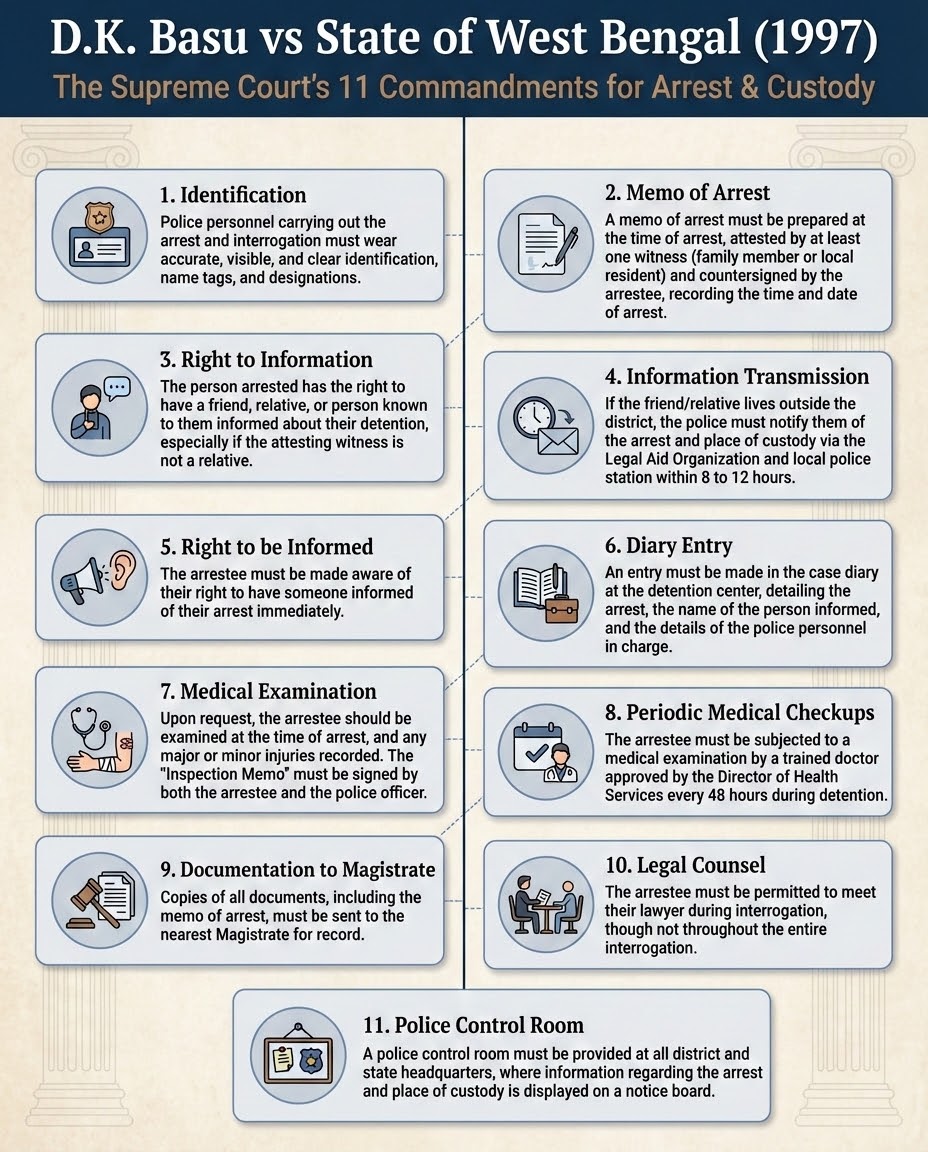
Consequences of Non-Compliance => Disobedience of these guidelines constitutes contempt of court and constitutes grounds for departmental action, alongside legal liability for the damage caused.
Joginder Kumar vs State of U.P. (1994)
The Court curbed the power of arrest, stating, "No arrest can be made just because it is lawful for the police officer to do so." There must be a justification and a reasonable need (preventing escape or tampering with evidence).
Paramvir Singh Saini vs Baljit Singh (2020)
The SC directed that CCTV cameras must be installed in every police station in India.
Significance: If a custodial death occurs and the CCTV is "not working," the Court can draw an adverse inference against the police.
Hansura Bai vs State of Madhya Pradesh
The SC established a rebuttable presumption of bias if the local police investigate a custodial death involving their own staff. Key Directive:
Legislative Reform
Ratify UNCAT: India must ratify the UN Convention Against Torture (1997). This would legally bind the state to define torture as a distinct crime and allow for international scrutiny.
Enact the "Prevention of Torture Bill": As recommended by the Law Commission’s 273rd Report, Parliament must pass a standalone law that:
Institutional Autonomy
Independent Investigation Agency: Following the Hansura Bai (2025) guidelines, investigations into custodial deaths must be automatically transferred to an agency independent of the local police hierarchy (e.g., a dedicated CBI wing or a functionally autonomous CID).
Police Complaints Authorities (PCA): States must fully operationalize District and State-level PCAs as mandated by the Prakash Singh (2006) judgment, ensuring they are headed by retired judges, not serving bureaucrats.
Technology must replace the "Blue Wall of Silence"
Strict CCTV Compliance: The Supreme Court’s directive in Paramvir Singh Saini (2020) must be enforced with a "Zero Tolerance" policy.
Body-Worn Cameras: Mandatory for arresting officers to record the entire sequence of arrest and transit to the station, eliminating the "he said, she said" ambiguity.
Digitized Health Records: Medical examination reports (Section 54 CrPC/BNSS equivalent) should be digitized and uploaded to a central server immediately to prevent retrospective manipulation.
Scientific Policing
Invest in Forensics: Scaling up of forensic labs to reduce the pendency of DNA and ballistics reports. When scientific evidence is available, the need for a "confession" (and thus torture) diminishes.
Interrogation Training: Police academies must shift focus from physical coercion to psychological interrogation techniques (like the PEACE model used in the UK) that rely on interviewing skills rather than intimidation.
Conclusion
Custodial death is not just a crime; it is a betrayal of the Constitution. As long as a citizen can be killed in the very place they are meant to be safe, the "Rule of Law" remains a hollow promise. The path forward lies in replacing the colonial stick with scientific tools, and the culture of impunity with a culture of accountability.
Source: DECCANHERALD
|
PRACTICE QUESTION Q. “Custodial violence is a naked violation of human dignity and strikes a blow at the Rule of Law.” Critically Analyze. 150 Words |
In Police Custody, a suspect is kept in the lock-up of a police station under the direct control of investigating officers. In Judicial Custody, the accused is lodged in a central or district jail and is legally under the custody and protection of a Magistrate.
Section 120 of the Bharatiya Nyaya Sanhita (BNS) penalizes public servants who cause hurt to extort confessions. Section 196 of the Bharatiya Nagarik Suraksha Sanhita (BNSS) mandates a compulsory Magisterial Inquiry for any death, disappearance, or rape occurring in custody. However, the BNS lacks a standalone chapter specifically defining "Custodial Torture".
While police custody deaths are often linked to direct physical torture, judicial custody accounts for the vast majority of fatalities due to systemic neglect, severe prison overcrowding, inter-inmate violence, and abysmal medical infrastructure in jails.
© 2026 iasgyan. All right reserved