

Copyright infringement not intended
Picture Courtesy: BUSINESS-STANDARD
Context
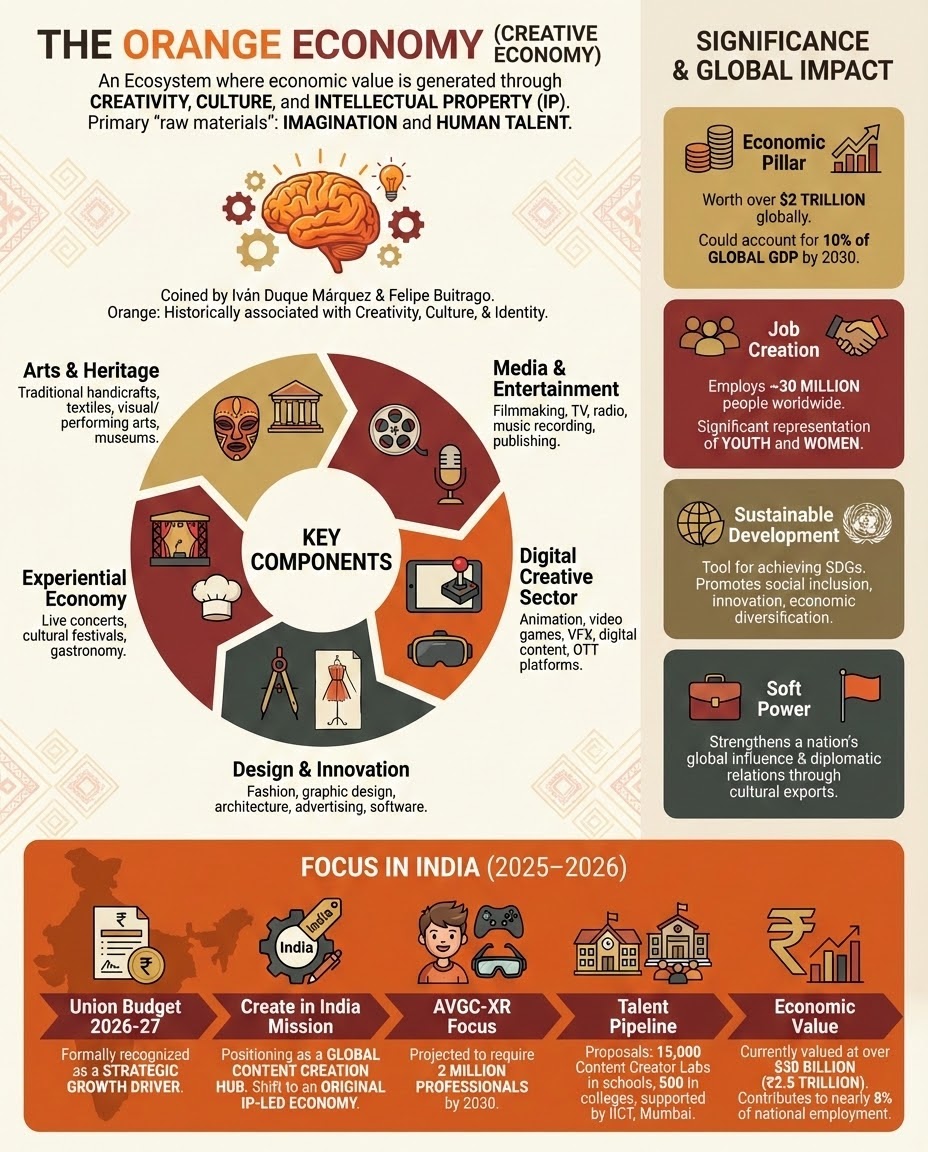
The Ministry of Information and Broadcasting has identified the Animation, Visual Effects, Gaming, Comics, and Extended Reality (AVGC-XR) sector as a primary driver for India's creative economy, often termed the "Orange Economy."
|
Read all about: CREATIVE ECONOMY I INDIA'S RISE IN THE ORANGE ECONOMY |
The Orange Economy includes all economic activities where value is derived from creativity, culture, technology, and Intellectual Property (IP).
Economic Powerhouse
India’s Media and Entertainment (M&E) sector was valued at ₹2.5 trillion in 2024 and is projected to reach ₹3.06 trillion by 2027, growing at 7% annually. (Source: Economic Survey 2025-26)
Export Diversification
Online gaming generated ₹232 billion in 2024, projected to reach ₹316 billion by 2027, highlighting how creative services can diversify India's export basket beyond traditional goods and services. (Source: PIB)
Alignment with SDGs
The sector directly supports SDG 8 (Decent Work and Economic Growth) and SDG 4 (Quality Education) by creating new, formalized career pathways for youth.
Job Creation and Economic Impact
Massive Employment: The industry supports over 10 million livelihoods and is projected to require 2 million new professionals by 2030. (Source: Economic Survey 2025-26)
High Economic Multiplier: For every direct job created in the AVGC sector, it generates 2 to 3 indirect jobs in related fields like digital marketing and tech infrastructure. (Source: PIB)
Decentralized Growth: The sector is developing tech hubs beyond major metros. Cities like Pune and Indore have emerged as key centers for VFX and animation.
Enhancing India's Soft Power
Rooted in the constitutional guarantee of Article 19(1)(a) (Freedom of Speech and Expression), the AVGC-XR sector is a powerful tool for cultural diplomacy.
Global Cultural Footprint: High-quality visual effects have propelled movies like RRR and Project K to global success, boosting tourism and promoting Indian narratives worldwide.
Gaming as a Cultural Export: The government has strategically shifted its perspective on gaming, now treating it as a legitimate competitive sport and a key cultural export, moving away from past stigma.
Government Initiatives
Union Budget 2026-27: Formally mainstreamed the Orange Economy as a services-led growth engine.
WAVES Summit (World Audio Visual and Entertainment Summit): A global forum held in Mumbai to position India as a media and entertainment hub.
Creative Economy Fund: A proposed $1 billion fund to invest in creative industries like film, animation, and digital content.
National Centre of Excellence (NCoE): Established in Mumbai (also known as the Indian Institute for Immersive Creators) to provide industry-aligned training and R&D.
Institutional Framework: The Indian Institute of Creative Technologies (IICT), modelled after IITs/IIMs, has partnered with global giants like Google, Netflix, and NVIDIA for curriculum development.
Early Skilling: Plans to set up AVGC Content Creator Labs in 15,000 secondary schools and 500 colleges to nurture talent from a young age.
National AVGC-XR Policy: To establish India as a global hub for extended reality and animation by offering incentives for co-production and IP creation.
The "Service Provider" Trap
Historically, Indian studios have performed backend work for foreign companies. While Indian talent provides the labor, the valuable Intellectual Property (IP) and profits remain with foreign studios.
Weak Academic Infrastructure
India lacks a premier national institution for AVGC education, equivalent to the IITs for engineering, to set standards and foster world-class talent.
Lack of Competitive Fiscal Incentives
Compared to countries like the UK and Canada, India has historically offered fewer tax rebates and financial incentives to attract and retain VFX and gaming studios.
Career Stigma
Animation and gaming are often viewed as "hobbies" rather than serious, high-paying career paths, leading to a "brain drain" where top talent leaves for studios in Canada or the US.
The government-appointed AVGC Promotion Task Force, led by Apurva Chandra, has outlined a clear roadmap. The key recommendations include:
Mainstreaming AVGC in Education
Integrating creative arts and digital media into the National Education Policy (NEP) 2020 at the school level to build a foundational talent pool
Digital Infrastructure
Expanding the Green Energy Corridor and high-speed 5G connectivity to Tier-II and Tier-III cities to allow decentralized "remote-work" studios to thrive.
Learn from Global Best Practices
South Korea's Gaming Industry Transformation
South Korea's journey provides a blueprint for turning a stigmatized activity into a massive export engine.
|
Past Policy (Early 2010s) |
Current Strategy |
Economic Outcome |
|
|
Government Stance |
Stigmatized gaming; enforced a "shutdown law" for minors. |
Aggressively backed esports infrastructure and repealed restrictive laws. |
Gaming is now a $17 billion export industry for South Korea. |
|
Export Contribution |
Negligible |
Gaming accounts for nearly 60% of South Korea's total cultural content exports, surpassing K-pop and cinema. |
Dominant global position in the gaming and esports market. |
UK's Fiscal Incentive Model
The UK uses targeted tax relief to attract global creative projects. In 2023-24, it provided £2.4 billion in tax relief to its creative industries. Initiatives like the Video Games Expenditure Credits (VGEC) are designed to make the UK a magnet for global studios, a strategy India could adopt.
Transitioning India from an AVGC-XR service provider to an original IP creator through a National Mission and fiscal incentives is essential for leading the global Orange Economy and achieving a technologically sovereign Viksit Bharat @ 2047.
Source: BUSINESS-STANDARD
|
PRACTICE QUESTION Q. Evaluate the strategic importance of the 'Orange Economy' in diversifying India's export basket and addressing demographic challenges. 150 words |
The Orange Economy refers to the ecosystem of economic activities where value is primarily generated from creativity, culture, technology, and Intellectual Property (IP). It includes sectors like media, entertainment, gaming, animation, and visual effects.
AVGC-XR stands for Animation, Visual Effects, Gaming, Comics, and Extended Reality. The Ministry of Information and Broadcasting has positioned this sector as the core driver of India’s expanding creative economy.
The sector is a massive employment generator, currently supporting over 10 million direct and indirect livelihoods. It has a high employment multiplier, where every direct job creates 2 to 3 indirect jobs in allied fields like digital marketing and tech infrastructure. It also decentralizes tech hubs, heavily absorbing young talent from Tier-2 cities.
© 2026 iasgyan. All right reserved