Recent large-scale protests by industrial workers in Noida highlight the growing instability and precariousness faced by urban informal workforce.
The Informal Urban Workforce refers to individuals working in small-scale, unincorporated enterprises or holding jobs without legal protection, written contracts, or social security benefits within urban areas.
According to the International Labour Organization (ILO), the informal sector consists of units engaged in the production of goods or services with the primary objective of generating employment and income, typically operating at a low level of organization with little division between labor and capital.
It encompasses two main categories:
Scale of Informality in Urban India
Overall Prevalence: Approximately 90% of India's urban workforce is employed in the informal economy. (Source: PLFS)
Contractual Insecurity: Among urban workers who receive regular wages or salaries, 58% do not have a written job contract, effectively rendering their employment informal. (Source: PLFS)
Benefit Deprivation: About 53.4% of regular wage/salaried employees in India are not eligible for any social security benefits like provident fund or health care. (Source: PLFS)
Self-Employment Dominance: In urban areas, 39.8% of males and 42.3% of females are self-employed, operating mostly as "own-account workers" without hiring others. (Source: PLFS)
Nature of Informality in Urban India
Structural "Dwarfism": Small, solo enterprises dominate the sector, hindering growth. Over 60% are "owner-operated," serving as survival mechanisms rather than scalable businesses. (Source: NITI Aayog)
Gender Disparities: Women often occupy the informal sector's most precarious positions. In urban hubs like Delhi, 76% of female workers are informally employed, predominantly in low-wage service or home-based roles. (Source: WIEGO)
Income Levels: Most informal workers earn subsistence wages; e-Shram portal data shows 94.11% of registrants earn ₹10,000 or less monthly. (Source: Ministry of Labour & Employment)
Sectoral Distribution: The urban informal workforce is heavily concentrated in three key sectors:
Migration Linkages: Many urban informal workers are rural-to-urban migrants who, lacking formal employment, enter the city economy via casual labor or street vending.
Why Does Informality Persist in Indian Cities?
Economic Transformation: Cities have transitioned from industrial centers to hubs of survival-based "social reproduction." As formal manufacturing declined (e.g., Mumbai's mills), informal service roles emerged, focusing on daily survival rather than stable careers.
Lagging Industrialization: Unlike developed nations, India's urban expansion lacks a parallel rise in formal manufacturing. A "jobless" or informal service boom means urbanization now outpaces industrial growth.
Compliance Barriers: High costs and complex laws discourage formalization. Small businesses avoid regulatory burdens, while larger firms use informal contractors to maintain flexibility and reduce expenses.
Labor Surplus: Driven by rural agrarian distress, constant migration creates a surplus of low-skilled labor. With few formal opportunities, workers turn to the informal economy for survival.
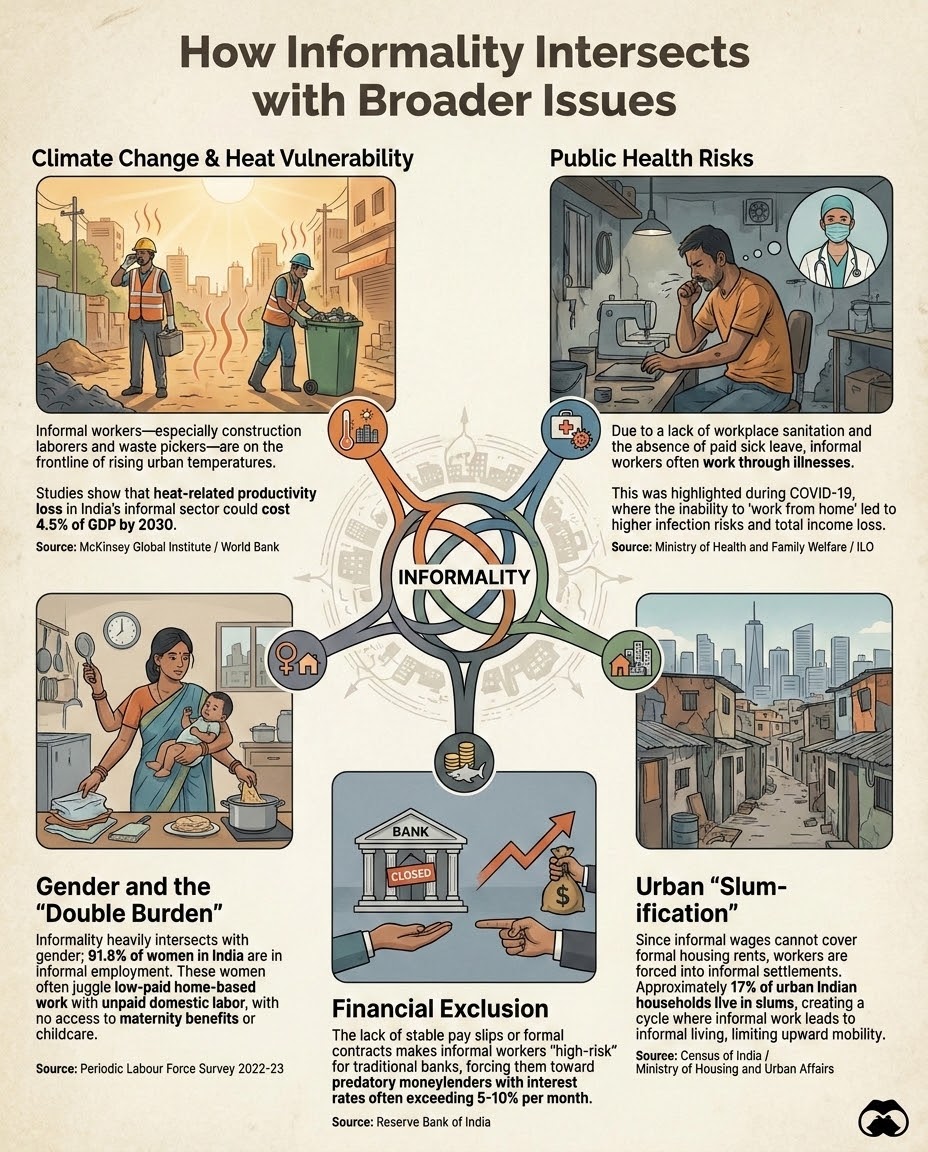 What Are the Key Challenges Faced by Informal Urban Workers?
Social Security Deficiency: About 90% of workers lack health insurance, pensions, or paid leave, with existing schemes like e-Shram providing only fragmented coverage.
Housing Instability: Residing in unplanned settlements without basic amenities, workers face frequent eviction risks from urban development or beautification projects.
Income Fluctuations: Irregular wages often fall below the legal minimum, leaving gig and home-based workers without bargaining power during market shifts.
Workplace Risks: Lack of protective gear in sectors like construction and manufacturing results in high rates of chronic illness and injury.
Legal Marginalization: Unrecognized or restricted work prevents laborers from seeking legal redress for exploitation, harassment, or wage theft.
Subsidizing Formal Economy: Informal workers offer low-cost services like transport and delivery, reducing living costs for formal employees and subsidizing business operations.
Waste Management: Informal recyclers handle 15-20% of urban waste, lowering municipal collection and disposal expenses. (Source: Ministry of Housing and Urban Affairs).
Supply Chain Linkages: Industries like electronics outsource to home-based workers, maintaining global competitiveness through minimized overheads.
Food Security: Street vendors provide affordable food to the urban poor and middle class, serving as a vital distribution link.
Last-Mile Services: The sector provides essential infrastructure labor and repair services at a scale the formal sector lacks.
e-Shram Portal: Launched in 2021, it is a national database for unorganized workers. Over 31 crore workers have registered to date, allowing for the direct delivery of social security benefits. (Source: PIB)
PM-SVANidhi (PM Street Vendor’s AtmaNirbhar Nidhi): This scheme provides micro-credit loans up to ₹50,000 to street vendors to help them resume their businesses post-pandemic and integrate them into the formal credit system.
Pradhan Mantri Shram Yogi Maandhan (PM-SYM): A voluntary and contributory pension scheme that ensures a monthly pension of ₹3,000 for unorganized workers after the age of 60.
Ayushman Bharat (PM-JAY): Provides health coverage of up to ₹5 lakh per family per year for secondary and tertiary care hospitalization, targeting the bottom 40% of the population, which includes the majority of informal workers. (Source: National Health Authority)
Code on Social Security (2020): This legislative reform aims to universalize social security for all workers, including gig and platform workers, by creating a Social Security Fund.
Deendayal Antyodaya Yojana-National Urban Livelihoods Mission (DAY-NULM): Focuses on organizing urban poor into Self-Help Groups (SHGs), providing skill training, and setting up permanent shelters for the urban homeless.
Registration vs. Benefit Delivery: While the e-Shram portal has registered over 31 crore workers, it remains a database rather than a direct pipeline for benefits; most registered workers have yet to receive substantive social security like insurance or disability cover.
Exclusionary Urban Planning: Most "Master Plans" fail to allocate dedicated spaces for vending or home-based work. For example, less than 10% of Indian cities have fully implemented the vending zones mandated by the Street Vendors Act, 2014. (Source: WIEGO)
The "Gig" Regulation Vacuum: The Code on Social Security (2020) recognizes gig workers but lacks clarity on employer contributions. Consequently, platform workers for apps like Swiggy or Zomato remain classified as "partners" rather than "employees," exempting firms from providing standard benefits.
Inadequate Minimum Wage Enforcement: Minimum wage laws are frequently bypassed in the informal sector due to a lack of labor inspectors. In some urban sectors, informal wages remain 20-30% below the legal floor. (Source: ILO)
Digital Divide in Formalization: Schemes like PM-SVANidhi require digital literacy and documentation (Aadhaar-linked mobile numbers, bank accounts) that many "ultra-poor" or migrant workers lack, leading to self-exclusion.
Universalize & Port Social Security: Fragmented benefits must be consolidated into a portable system by fully implementing the Code on Social Security (2020). This ensures health and pension benefits follow workers across states, eliminating the "migrant penalty".
Integrate "Informal" Spaces in Urban Planning: Urban master plans should formally incorporate space for informal work by establishing "vending zones" per the Street Vendors Act and developing multi-purpose hubs where home-based workers can use shared machinery and pool resources.
Digital & Financial Inclusion Beyond Registration: Beyond data collection, the e-Shram portal must connect workers to credit and skilling. Digital validation of income can replace predatory lending with formal "cash-flow based lending".
Recognize & Regulate the Gig Economy: Expanding gig work requires regulatory clarity to classify platform workers as employees or a specific category with mandatory social security. This protects basic rights while maintaining sector flexibility.
Skilling for "Green Jobs": Urban climate change impacts necessitate training informal workers for emerging "green" sectors like solar installation and e-waste recycling to ensure better pay and safety.
India’s informal urban workforce, contributing 50% to GDP, must be integrated through worker-centric formalization and social security to transform from a vulnerable "shock absorber" into a secure, productive pillar of the nation's $5 trillion economic goal.
Source: THE HINDU
|
PRACTICE QUESTION Q. Urbanization in India is often described as "informalization of cities." Discuss the socio-economic implications of this trend on the urban poor. (150 words) |
It refers to the fundamental shift in the nature of Indian cities from being hubs of industrial production (like historical mill towns) to fragmented spaces where the working class spends its primary energy on survival tasks. This includes struggling for basic daily needs such as drinking water, cooking fuel, and housing, rather than participating in organized industrial labour.
The Washington Consensus promotes fiscal discipline, privatization, and market-driven economic policies. In Indian cities, this has led the state to retreat from providing rights-based public services (like free water and housing) and shift to user-fee models. This commoditization of essential services drastically widens the gap between the rich and the poor, increasing the vulnerability of informal workers.
The e-Shram portal is a centralized national database created by the Union Government for unorganized workers. It aims to serve as a "One-Stop-Solution" by linking 14 different central welfare schemes (like Ayushman Bharat) to the registered workers. This mapping ensures that migrant workers can receive seamless and portable welfare benefits across state borders.
© 2026 iasgyan. All right reserved