

🔔Join APTI PLUS Prelims Mirror 2026 | All India Open Mock Test Series on 12th April, 26th April & 3rd May 2026 |Register Now!

Analyzing the Plight of Punjab’s Border Farmers: Caught Between the Fence and the Zero Line

20th April, 2026

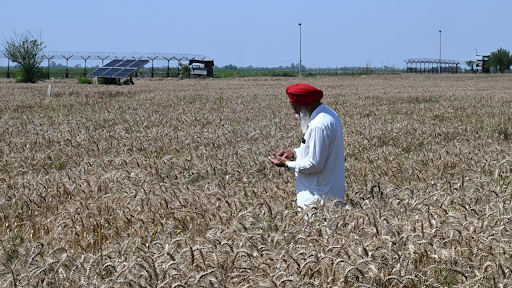
A farmer stands in his field near a damaged stretch of the India–Pakistan international border fence at Rosse village in Punjab’s Gurdaspur district. Farmers can access land beyond the fence only between 9 a.m. and 4 p.m. under BSF supervision. 

Why in News?

Farmers in Punjab’s border districts continue to face severe hardships as large tracts of their fertile agricultural land lie trapped between India’s border fence and the Zero Line. The Central government has recently initiated steps, including a social impact survey, to shift the barbed-wire fencing closer to the international boundary.

Background: Border Fencing in Punjab

  • The India-Pakistan international border in Punjab stretches approximately 543-553 km. Following heightened security concerns, particularly after the 1980s militancy and subsequent terror threats, the BSF erected a barbed-wire fence along the border. 
  • In many sectors, the fence was placed 150 meters to several kilometers inside Indian territory for operational reasons, leaving fertile farmland between the fence and the Zero Line.
  • This “no man’s land” arrangement was intended to enhance border management and prevent infiltration or smuggling. However, it has turned thousands of acres of cultivable land into restricted zones. 
  • Farmers remain legal owners of the land but must operate under stringent BSF protocols. The current fencing distance varies significantly, causing uneven impact across villages.

The Problems Faced by Border Farmers

  • Restricted Access and Timings: Farmers can cross the fence only between 9 a.m. and 4 p.m. (or similar fixed hours decided by the BSF). They are frisked on entry and exit, and their movement is supervised.
  • Security Escorts and Checks: Two Kisan Guards must accompany each tractor or group. The number of people allowed beyond the fence is limited. Farmers require special identity cards issued after multi-agency verification.
  • Limited Working Hours: Effective cultivation time is drastically reduced—often to around 200 days a year in some cases—leading to lower yields and the inability to grow certain crops.
  • Additional Challenges: Stray cattle from the Pakistan side damage crops. Irrigation, machinery use, and overnight stays are restricted. Frequent security drills and alerts further disrupt farming.
  • Scale of Impact: Nearly 12,000 farming families across hundreds of villages are affected, with lakhs of farmers indirectly impacted.

Impact on Livelihood and Economy

  • Reduced agricultural productivity and income.
  • Inability to make optimal use of fertile border land.
  • Increased costs and time loss due to daily checks and escorts.
  • Psychological and emotional stress, as farmers till their own land under constant surveillance.
  • Broader economic strain on border districts, which are otherwise agriculturally rich.

Government Response and Proposed Solution

  • The Centre has ordered a survey (to be conducted by Sub-Divisional Magistrates) to assess the feasibility of shifting the fence closer to the Zero Line, possibly within 100-300 meters.
  • Alternative proposals include granting farmers equivalent fertile land elsewhere in exchange for restricted plots.
  • Farmers have expressed willingness to allow fencing up to 300 meters from the border.

Broader Implications: Security vs Farmers’ Rights

The issue highlights the perennial challenge of balancing robust border security with the livelihood rights of citizens living near sensitive frontiers. While the fence has helped curb infiltration and smuggling, its inward placement has imposed disproportionate costs on law-abiding farmers. A well-planned relocation could enhance both security efficiency and farmer welfare. However, any shift must be preceded by thorough surveys, consultations, and safeguards against security risks.

Way Forward

  • Expedite the social impact survey and complete the fencing relocation in a time-bound manner with full transparency.
  • Ensure adequate compensation or land exchange for any farmers temporarily affected during the transition.
  • Develop a comprehensive border management policy that integrates modern technology (drones, sensors, smart fencing) to reduce human checks while allowing normal agricultural activities.
  • Provide special agricultural support packages for border farmers, including subsidies for irrigation and crop insurance.
  • Strengthen coordination between the Centre, Punjab government, and BSF for grievance redressal and long-term planning.
  • Explore community-based security models involving local farmers as stakeholders.

Conclusion

Punjab’s border farmers have borne the brunt of national security requirements for decades, cultivating their own land under severe restrictions that limit productivity and dignity. The government’s decision to survey and potentially shift the fencing closer to the Zero Line offers a ray of hope for relief. Implementing this move judiciously would not only restore farmers’ rightful access to their land but also optimize border security by reducing unnecessary checks on Indian citizens. 

Source: The Hindu

PRACTICE QUESTION

Q. "Governance at the periphery often oscillates between the demands of national security and the rights of citizens." In light of this statement, examine the impact of restricted land access on the right to livelihood of border farmers in Punjab. (250 words)

Let's Get In Touch!