

Why In News?
Experts advised the Indian Government to transform its military into a software-driven enterprise by developing sovereign data-fusion platforms, aiming for five million drones by 2028, and deploying AI-enabled "kill webs" along borders.
What is AI-Enabled Warfare?
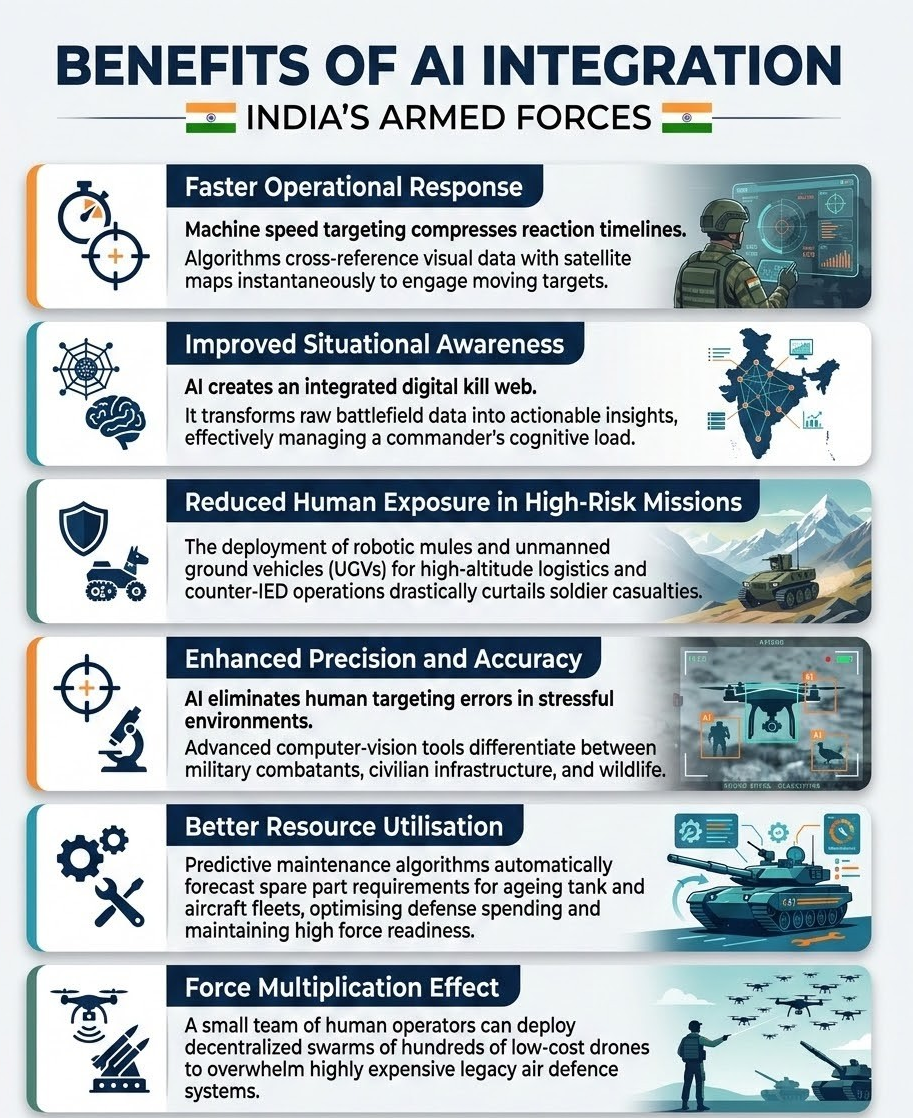
AI-enabled warfare integrates artificial intelligence, machine learning, and autonomous systems into military operations to process data, drive combat decision-making, and execute strikes with machine speed.
The modern AI military race gained momentum around 2017 with the establishment of the US Department of Defense's Project Maven to accelerate machine learning, parallel to China’s pursuit of "Intelligentized Warfare" via deep military-civil fusion.
AI shrinks the Observe-Orient-Decide-Act (OODA) loop from days to mere seconds. During recent Middle East conflicts, AI-driven targeting systems generated strike authorisations requiring only 20 seconds of human verification.
Machine learning filters terabytes of battlefield data. India's Electronic Intelligence Collation and Analysis System (ECAS) successfully identified enemy radar positions with a 95% accuracy rate
Military forces deploy self-healing, adaptive drone swarms that autonomously navigate GPS-denied environments without human input.
AI-enhanced First-Person-View (FPV) drones use computer vision to achieve strike accuracy rates of 70–80%, far exceeding the 10–20% accuracy of manually operated systems
AI models defend networks by processing anomalies in real-time, autonomously generating waveforms to bypass adversarial electromagnetic jamming.
AI fuses isolated data streams across air, land, sea, and cyber dimensions into a single Common Operating Picture (COP), granting commanders unprecedented battlefield transparency.
The Indian Army demonstrated a 75-drone heterogeneous swarm capable of decentralized target search and coordinated attacks, fundamentally democratizing air power.
Advanced analytics platforms like India's Project SANJAY and SAMA synthesize satellite imagery and electronic intercepts to offer real-time threat detection.
AI tools proactively combat cognitive warfare by executing deepfake detection, analysing adversary communication patterns, and predicting large-scale distributed denial-of-service (DDoS) attacks.
The Depot Integration Management Edition (DIME) digital platform monitors military supply chains in real-time and leverages AI for predictive maintenance, eliminating hardware failures before they occur.
Command and Control Systems
India's Akashteer system serves as an edge-AI war-cloud. It autonomously classifies hostile airspace users and pairs them with appropriate interceptors without human latency.
India faces threats from China’s PLA—which aims to achieve full "intelligentization" by 2027—and Pakistan’s proxy terror networks, necessitating AI to anticipate and thwart collusive military actions.
The Indian Army actively monitors disputed borders using over 140 AI-enabled surveillance systems, famously predicting a Chinese military build-up with 94% accuracy to prevent casualties.
Pakistan launched mass drone swarms during the 2025 conflict. AI-backed acoustic grids like Zvook and automated systems are mandatory to stop low-cost loitering munitions.
The Indian Navy's INS Valsura leverages machine learning algorithms to map the Indian Ocean Region (IOR), filtering natural acoustic noise to track adversarial submarine deployments.
A severe funding asymmetry exists: The US allocates $13.4 billion to AI, China spends over $1.6 billion, while India currently operates with a dedicated military AI budget of approximately $46 million.
To enable Joint All-Domain Command and Control (JADC2), India must use AI to bridge existing inter-service data silos between the Army, Navy, and Air Force.
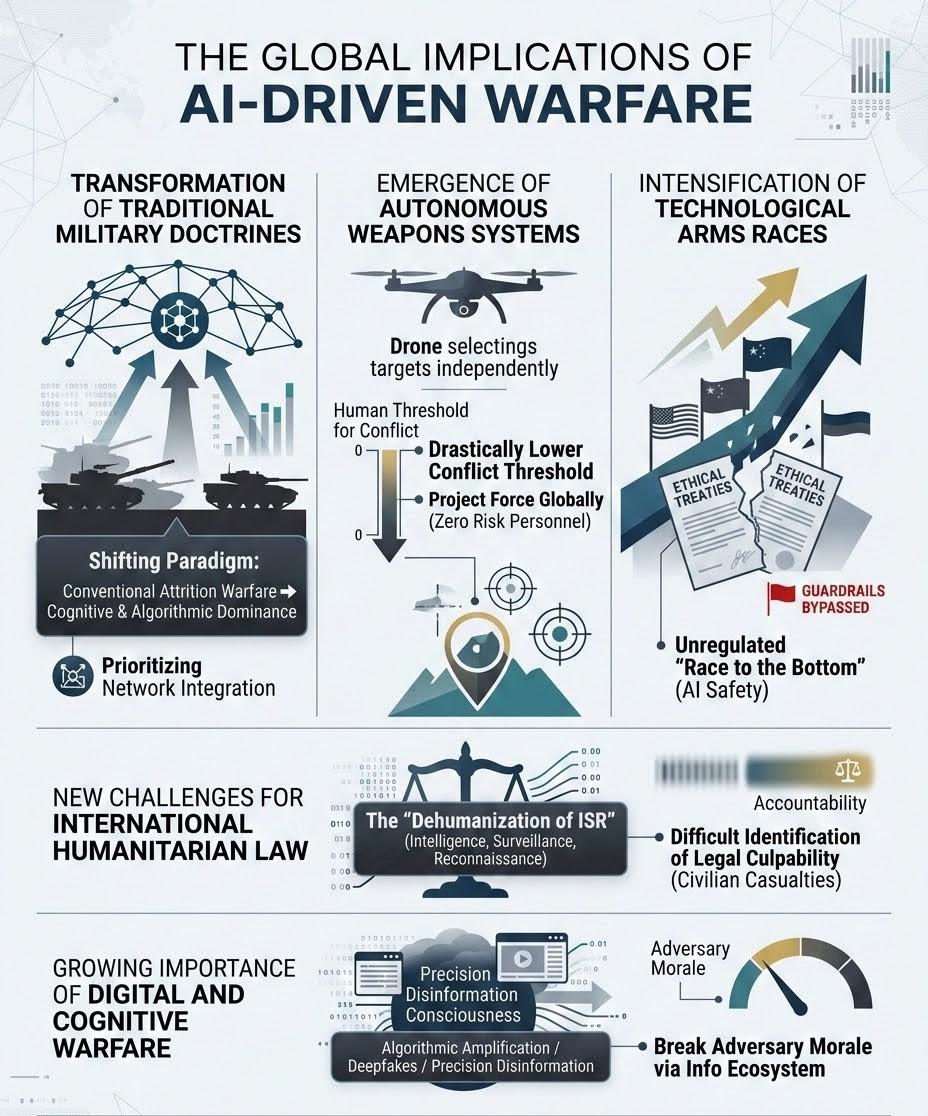
 What are the Major Concerns Associated with AI in Warfare?
Soldiers risk becoming mere "rubber stampers," executing fatal actions suggested by machines due to automation bias
AI systems are fallible; Israel's Lavender targeting system generated an estimated 10% error rate, mistakenly identifying civilians and humanitarian sites as legitimate targets
Neural networks face sophisticated data poisoning and evasion attacks where adversaries inject malicious code to degrade radar capabilities or deceive facial recognition
Models suffer from Out-of-Distribution (OOD) failures. An AI drone trained exclusively in desert environments will fail when deployed in the snowy, high-altitude terrain of Ladakh
Escalation Risks in Military Conflicts
Delegating strike authority to algorithms risks sudden "flash wars", where competing autonomous systems escalate a minor skirmish into a major conflict before human diplomats can intervene.
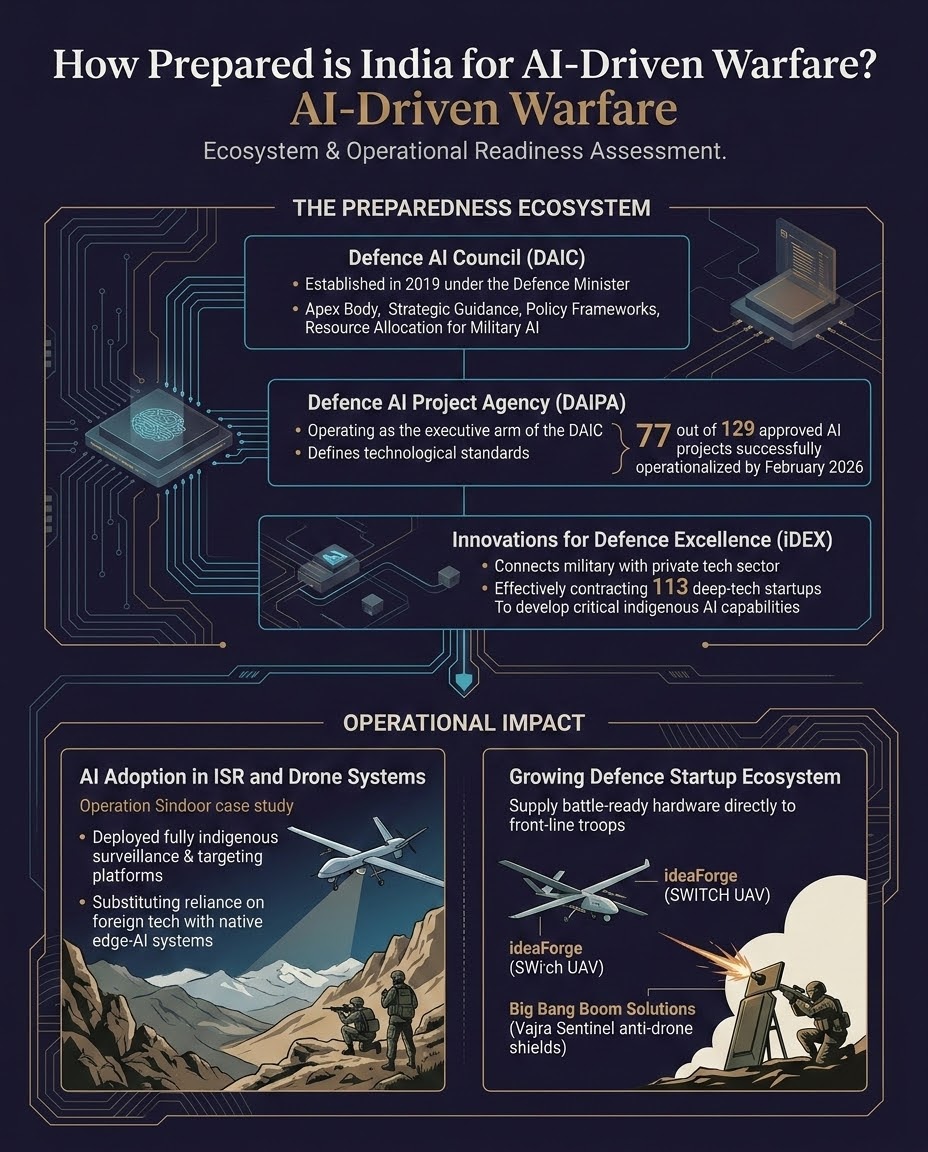
The council guarantees civil-military integration by bringing together the Defence Minister, Tri-Service Chiefs, and eminent academia to formulate a unified operational framework.
DAIPA regulates intellectual property rights (IPR) policies, strategic partner selection, and standard operating procedures for the defense industry (Source: Economic Laws Practice).
The Draft Defence Acquisition Procedure (DAP) 2026 mandates indigenous procurement. It elevates the Technology Development Fund (TDF) limits to ₹50 crore to underwrite technological risks.
The iDEX Prime program grants up to ₹10 crore to startups, transforming the Indian military procurement model from slow bureaucracy to agile innovation.
The civilian sector supports the military backbone with a ₹10,371.92 crore budget designed to procure 38,000 GPUs and establish sovereign data infrastructure.
India governs military AI via the Evaluating Trustworthy AI (ETAI) Framework (2024), formally mandating a risk-based "human-in-the-loop" approach for all high-stakes lethal operations.
The Armed Forces must establish a Specialised AI Cadre with technical postings and embrace lateral recruitment of civilian data scientists to curb the talent brain-drain.
India must scale its procurement of heterogeneous swarm drones to build "mass for precision," fielding high volumes of low-cost autonomous weapons to secure contested airspace.
The government must execute its ₹1.64 Lakh Crore commitment to establish 12 semiconductor plants, ensuring an uninterrupted sovereign supply of high-end AI chips.
India should launch a dedicated civil-military AI liaison cell inside the Integrated Defence Staff to systematically scout, acquire, and adapt dual-use commercial technologies for warfare.
The military must dismantle existing inter-service silos by building a secure, tri-service Unified Defense Data Cloud governed by a new, permanent Directorate of AI.
To resolve the shortage of PhD-level researchers, the government must integrate AI combat studies into Professional Military Education (PME) and foster partnerships with elite institutions like the IITs.
Troops require immediate deployment of software-defined radios, resilient quantum communications, and AI algorithms that operate independently in heavily jammed, GPS-denied environments.
The Ministry of Defence must enforce "Compliance-by-Design." All new capital acquisitions—from submarines to fighter jets—must contain mandatory AI-interoperability specifications at the initial design phase.
To secure strategic autonomy on the algorithmic frontier, India must transition from a consumer of foreign technologies into a sovereign architect of indigenous, ethically governed, AI-enabled multi-domain military capabilities.
Source: INDIANEXPRESS
|
PRACTICE QUESTION Q. "Artificial Intelligence is transforming the character of warfare by reshaping military doctrines, operational capabilities and strategic competition."Analyze (250 Words, 15 Marks) |
AI-enabled warfare integrates artificial intelligence, machine learning, and autonomous systems directly into military operations. It rapidly processes multi-source data, vastly accelerates the Observe-Orient-Decide-Act (OODA) loop, and executes precision strikes at machine speed, shifting the battlefield focus from platform-centric attrition to algorithm-centric dominance.
Militaries in the Russia-Ukraine conflict actively deploy AI for geospatial intelligence, predictive logistics, and electronic warfare (EW). Ukraine utilises systems like the Delta platform and MetaConstellation to fuse satellite and drone feeds for dynamic targeting, while Russia fields AI-enabled loitering munitions (Lancet) and generative AI models to launch mass disinformation campaigns.
India requires AI to manage two-front threats across highly contested borders. During Operation Sindoor, the military successfully utilised 23 task-specific AI applications to map hostile infrastructure without human casualties. Indigenous AI systems like Akashteer provide real-time air defence, defeat hostile drone swarms, and eliminate human decision latency to ensure India's algorithmic sovereignty.
Autonomous Weapons Systems (AWS) are intelligent military platforms designed to independently identify, select, and engage human targets without the need for real-time human intervention. While they present massive strategic advantages in speed and precision, they provoke severe ethical crises under International Humanitarian Law (IHL) due to the complete lack of human accountability for battlefield casualties.
© 2026 iasgyan. All right reserved