

Why Science and Technology Is Crucial for UPSC Prelims GS Paper 1
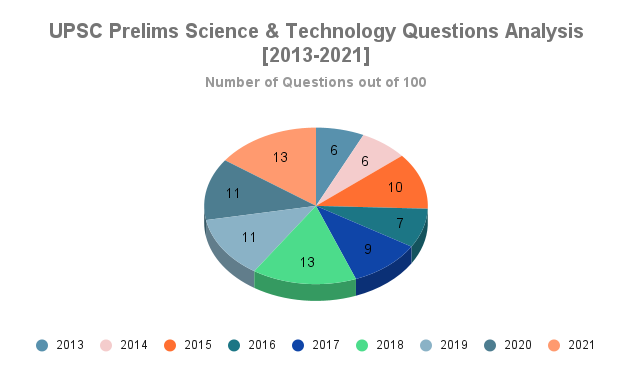
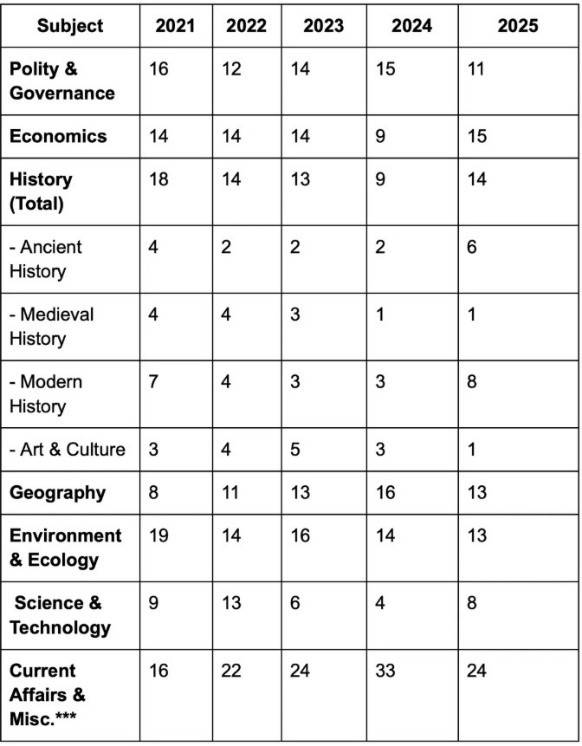
Science and Technology is a high-weightage, scoring area in the UPSC Prelims GS Paper 1, with repeated themes and most-asked topics appearing almost every year. In the UPSC Civil Services Prelims 2025, the Science & Technology (S&T) section continued its strong presence, contributing around 13–15 questions to General Studies Paper 1. This consistent trend makes UPSC Prelims Science and Technology one of the most crucial subjects for prelims-focused preparation, especially for aspirants aiming to capitalise on predictable, frequently repeated S&T themes.
UPSC Prelims Science Questions: Subject-Wise Trend Analysis (2021–2025)
Over the last decade, questions have consistently tested not just factual recall, but conceptual understanding and application of scientific principles in real-world contexts.
Understanding these repeated themes helps aspirants achieve two objectives:
This article analyses these themes and provides clarity on why they matter, how they map to PYQs and how best to prepare.
UPSC Prelims Science and Technology: Repeated Topics, PYQ Analysis
The biotechnology theme consistently appears in UPSC Prelims. Over the years, candidates have been asked about microorganisms, viruses, immunology, biofilms, probiotics and genetic technologies. Questions range from basic biological phenomena to cutting-edge biological innovations:
These questions test a range of understanding — from cellular biology and microbiology basics (like roles of viruses and bacteria) to applications (like vaccines and probiotics). Static NCERT biology forms the foundation, but current developments in health technologies form the application layer that UPSC loves.
Why this theme repeats:
Biotechnology is central to modern governance — from public health infrastructure (vaccination strategies) to agriculture (Bt crops) and biodiversity research. This makes it relevant for both static science and current policy frames.
Examples:
2023
How many of the above statements are correct?
(a) Only one
(b) Only two
(c) All three
(d) None
2022
Which of the statements given above is/are correct?
(a) 1 only
(b) 2 only
(c) 1 and 3
(d) 2 and 3
2021 Question
Which of the statements given above is/are correct?
(a) 1 only
(b) 2 only
(c) Both 1 and 2
(d) Neither 1 nor 2
2022 Question
Which of the statements given above are correct?
(a) 1 and 2 only
(b) 2 and 3 only
(c) 1 and 3 only
(d) 1, 2 and 3
Preparation strategy:
Space technology is a staple subject repeating across years, focusing on both astronomy and recent space missions:
UPSC uses space science questions to test basic scientific knowledge (like stellar classification, celestial phenomena) and to link them with India’s space policy and missions.
Examples:
2025:
How many of the space missions given above encourage and support microgravity research?
(a) Only one
(b) Only two
(c) All three
(d) None
2016
The Mangalyaan launched by ISRO
Which of the statement(s) given above is/are correct?
(a) 1 only
(b) 2 and 3 only
(c) 1 and 3 only
(d) 1, 2 and 3
Preparation strategy:
Questions in this category blend IT fundamentals with real applications:
What we see repeatedly is UPSC’s effort to test not only the meaning of terms but also their relevance and implications for public systems and governance. For example, SaaS and Web 3.0 question framing often ties into digital governance platforms and citizen data control paradigms.
Why this theme repeats:
ICT is no longer peripheral — it directly contributes to digital governance, cybersecurity and economic transformation (Digital India initiatives). It’s central to GS syllabus themes like e-governance and digital public infrastructure.
Examples
2022
(a) Cloud Services
(b) Quantum Computing
(c) Visible Light Communication Technologies
(d) Wireless Communication Technologies
Why this theme repeats:
Space exploration illustrates scientific progress and national capability. Its relevance to science and governance (in areas like communications, navigation and national security) makes it perennial.
2022
Which of the statements given above are correct?
(a) 1 and 2 only
(b) 2 and 3 only
(c) 1 and 3 only
(d) 1, 2 and 3
Preparation strategy:
The Defence Technology theme has grown stronger, with questions on:
UPSC asks such questions to gauge whether aspirants can distinguish between different defense technologies, their principles and missions. Questions are rarely about technical depth; rather, they focus on operational principle and policy implication.
Why this theme repeats:
Defense technologies sit at the intersection of science and national security — an area of perennial examination focus.
Examples:
2023
Which of the statements given above is/are correct?
(a) 1 only
(b) 2 only
(c) Both 1 and 2
(d) Neither 1 nor 2
2023
|
Aircraft Type |
Description |
|
I. Dornier-228 |
Maritime patrol aircraft |
|
II. IL-76 |
Supersonic combat aircraft |
|
III. C-17 Globemaster III |
Military transport aircraft |
How many of the pairs are correctly matched?
(a) Only one
(b) Only two
(c) All three
(d) None
Preparation strategy:
This theme comprises seemingly mundane but conceptually rich questions that often catch aspirants off-guard:
These questions highlight how foundational scientific concepts manifest in common technologies — from smartphones to sustainable products.
Examples
Which of the statements given above are correct?
(a) 1 and 3
(b) 2 and 4
(c) 1 and 4
(d) 2 and 3
2023
Select the correct answer using the code given below.
(a) 1 and 2 only
(b) 2 and 3 only
(c) 1 and 3 only
(d) 1, 2 and 3
2021
(a) Low-density polyethylene
(b) Polycarbonate
(c) Polyethylene terephthalate
(d) Polyvinyl chloride
Why this theme repeats:
Such questions evaluate applied science comprehension — not theoretical recall but understanding of how science manifests in daily life. They also reward logical reasoning skills.
Preparation strategy:
Science related to environment and energy intersects with biology, chemistry and technology:
UPSC presents such questions to test both scientific insight and environmental governance awareness.
2024
Which one of the following is synthesised in human body that dilate blood vessels and increases blood flow?
(a) Nitric oxide
(b) Nitrous oxide
(c) Nitrogen dioxide
(d) Nitrogen Pentoxide
2022
(a) Cotton
(b) Rice
(c) Sugarcane
(d) Wheat
Why this theme repeats:
Environmental science is part of both GS Paper 1 (Prelims) and GS Paper 3 (Mains), with high relevance due to climate change policies and sustainable development goals.
Preparation strategy:
Nanotech questions probe applications and implications:
While not the most frequent theme, these topics recur enough to demand focused preparation, especially because they bridge fundamental science and applied innovation.
2022
Which of the statements given above is/are correct?
(a) 1 only
(b) 3 only
(c) 1 and 2
(d) 2 and 3
2020
Which of the statements given above are correct?
(a) 1 and 2 only
(b) 2, 3 and 4 only
(c) 1, 3 and 4 only
(d) 1, 2, 3 and 4
2021
(a) genes introduced in the genetically modified plants
(b) development of India’s own satellite navigation system
(c) radio collars for wildlife tracking
(d) spread of viral diseases
Why this theme repeats:
Nanoscience sits at the frontier of modern science.. central to major research and innovation sectors.
Preparation strategy:
Questions in this category, though fewer, are conceptually significant:
These questions often test understanding of principles, not design details and their relevance to current energy shifts (electric vehicles, hydrogen economy).
Examples
2025
How many of the above are considered as alternative powertrain vehicles?
(a) Only one
(b) Only two
(c) All the three
(d) None
2024
(a) Hydrogen peroxide
(b) Hydronium
(c) Oxygen
(d) Water vapour
2024
(a) Hydrogen peroxide
(b) Hydronium
(c) Oxygen
(d) Water vapour
Why this theme repeats:
Energy transitions are central to global climate goals and national commitments to sustainable tech solutions.
Preparation strategy:
This recurring theme tests foundational aspects of physical science:
These concepts often appear in the context of space missions and celestial questions, but are rooted in basic physics and astronomy.
Examples
Statement-I : Giant stars live much longer than dwarf stars.
Statement-II : Compared to dwarf stars, giant stars have a greater rate of nuclear reactions.
Which one of the following is correct in respect of the above statements?
(a) Both Statement-I and Statement-II are correct and Statement-II explains Statement-I
(b) Both Statement-I and Statement-II are correct, but Statement-II does not explain Statement-I
(c) Statement-I is correct, but Statement-II is incorrect
(d) Statement-I is incorrect, but Statement II is correct
2023
|
Objects in space |
Description |
|
|
1. |
Cepheids |
Giant clouds of dust and gas in space |
|
2. |
Nebulae |
Stars which brighten and dim periodically |
|
3. |
Pulsars |
Neutron stars that are formed when massive stars run out of fuel and collapse |
How many of the above pairs are correctly matched?
(a) Only one
(b) Only two
(c) All three
(d) None
2020
(a) Some use uranium and others use thorium
(b) Some use imported uranium and others use domestic supplies
(c) Some are operated by foreign enterprises and others are operated by domestic enterprises
(d) Some are State-owned and others are privately-owned
Why this theme repeats:
Physics and astronomy provide the scientific basis for many advanced technological questions; UPSC uses them to assess conceptual grounding.
Preparation strategy:
This is a rapidly consolidating theme in UPSC Prelims, where questions are framed around conceptual understanding of emerging technologies, not coding or engineering depth.
UPSC increasingly tests:
• Core principles behind AI, Machine Learning, Deep Learning and automation
• Applications in governance, healthcare, finance and public systems
• Distinctions between closely related terms (AI vs ML, algorithm vs model)
Recent trends show that UPSC prefers definition-based conceptual traps, often mixed with governance relevance.
Key areas repeatedly touched upon:
2025
Which of the statements given above is/are correct?
(a) I only
(b) II only
(c) Both I and I
(d) Neither I nor II
2020
Select the correct answer using the code given below:
(a) 1, 2, 3 and 5 only
(b) 1, 3 and 4 only
(c) 2, 4 and 5 only
(d) 1, 2, 3, 4 and 5
2020
Which of the statements given above is/are correct?
(a) 1 only
(b) 1 and 2 only
(c) 2 only
(d) 1 and 3 only
Why this theme repeats:
AI and automation are now integral to digital governance, national missions and economic transformation. UPSC treats AI as an extension of ICT but increasingly tests it as a standalone scientific domain.
Summary of Repeated Science and Technology Themes in UPSC Prelims
To make this even clearer, here’s a recurring theme map based on PYQs and trend analysis across years:
|
Theme |
Why It Repeats |
|
Biotechnology & Life Sciences |
Relevance to health, governance, disease control policies |
|
Space Science & Astronomy |
Technological achievements and India’s space mission narratives |
|
ICT & Computing |
Digital governance, cybersecurity, modern tech lexicon |
|
Defence Technologies |
National security applications, DRDO innovations |
|
Everyday Technology |
Applied science in daily life, conceptual clarity |
|
Environment & Energy |
Climate change policy relevance |
|
Nanotechnology & Materials |
Frontier innovation and application |
|
Physics & Astronomy Fundamentals |
Conceptual science foundation |
|
Artificial Intelligence (AI), Automation & Emerging Digital Technologies |
Innovation ecosystem and governance |
How to Prepare Science and Technology for UPSC Prelims Using PYQ Trends
Conclusion: How Repeated Science & Technology Themes Can Be a Scoring Advantage
Science and Technology in UPSC Prelims is much more than a collection of random facts. It is an integrated domain where science principles, recent innovations and governance implications converge. Over the years, UPSC has consistently tested aspirants on conceptual clarity, application ability and awareness of real-world technological progress. By recognising the recurring themes outlined above and preparing with a strategic blend of static fundamentals and dynamic current affairs, aspirants can not only crack this section but also transform it into a scoring advantage.
© 2026 iasgyan. All right reserved