

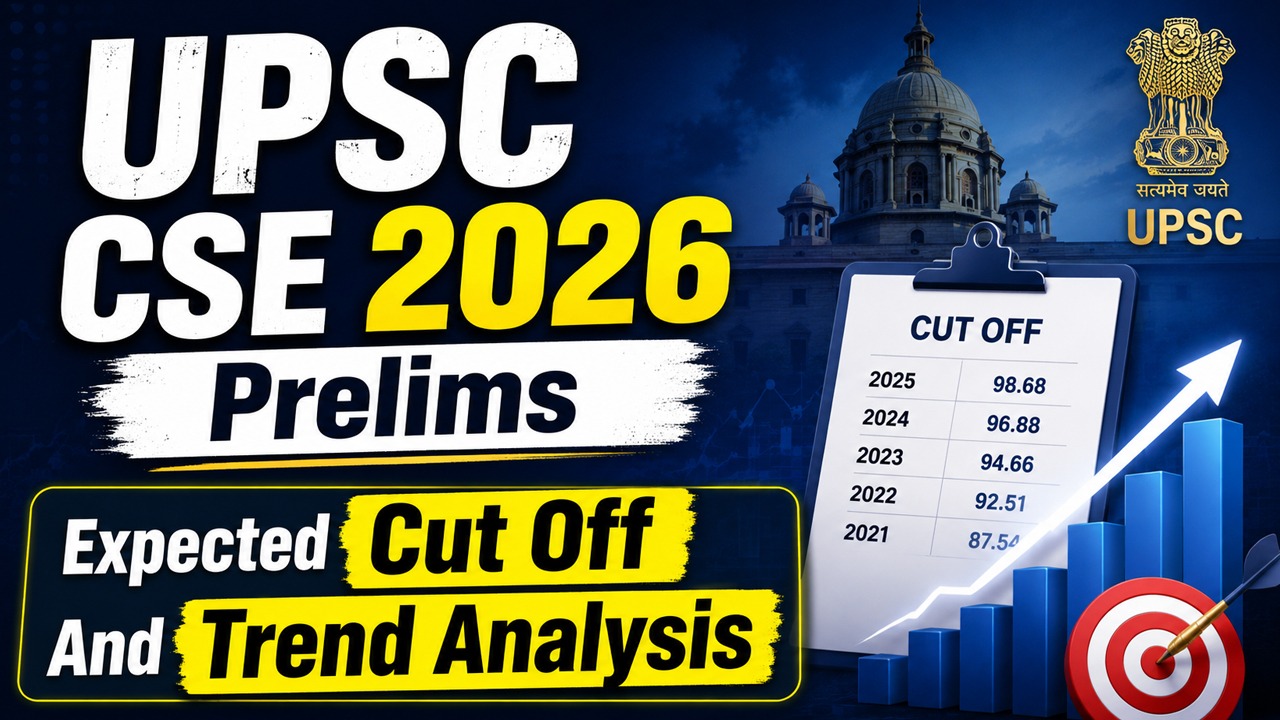
Every year, roughly 12 to 15 lakh aspirants appear for UPSC CSE Prelims, but only around 13,000 to 15,000 candidates clear the GS Paper I cut off, making it the most decisive filtering stage. Naturally, after the Prelims examination, one debate dominates the discussion - What will be the cutoff?
Right now, the UPSC CSE 2026 Prelims Cut Off is one of the most discussed benchmarks among aspirants.
Understanding expected cutoff trends, category-wise predictions and previous year patterns (2014–2025) is a strategic advantage. It helps aspirants set realistic score targets, refine preparation strategy and avoid last-minute surprises.
For a deeper understanding of preparation strategy, check UPSC Prelims Preparation Strategy 2026.
The UPSC Prelims Cut Off is the minimum score a candidate must secure to qualify for the UPSC Mains Examination conducted by the Union Public Service Commission.
It is determined based on factors such as the difficulty level of the paper, number of vacancies and overall candidate performance. The official cut off is released only after the final results are declared and helps candidates understand the level of competition in the exam.
The cut off marks are different for categories such as General, OBC, SC, ST and EWS.
Read more: UPSC Exam Pattern Explained
The UPSC Prelims Examination consists of two papers:
Related guide: 1 Year UPSC Preparation Strategy
Civil Services Aptitude Test (CSAT) – Paper II
Read More: Top 10 Scoring Areas for CSAT
Important Point
Even if a candidate scores above the cut off in GS Paper I, they will not qualify for Mains if they fail to clear the CSAT qualifying threshold. Therefore, qualifying both papers is mandatory for selection to the next stage of the examination conducted by the Union Public Service Commission.
The last 10 years UPSC Prelims Cut Off trends help aspirants understand the changing competition level in the Civil Services Examination conducted by the Union Public Service Commission. The year-wise and category-wise cut off marks provide a useful benchmark to analyse exam trends and estimate the score required to qualify for the UPSC Mains Examination.
|
Year |
General |
EWS |
OBC |
SC |
ST |
PwBD-1 |
PwBD-2 |
PwBD-3 |
PwBD-5 |
|
2025 |
92.66 |
89.34 |
92.00 |
84.00 |
82.66 |
76.66 |
54.66 |
40.66 |
40.66 |
|
2024 |
87.98 |
85.92 |
87.28 |
79.03 |
74.23 |
69.42 |
65.30 |
40.56 |
40.56 |
|
2023 |
75.41 |
68.02 |
74.75 |
59.25 |
47.82 |
40.40 |
47.13 |
40.40 |
33.68 |
|
2022 |
88.22 |
82.83 |
87.54 |
74.08 |
69.35 |
49.84 |
58.59 |
40.40 |
41.76 |
|
2021 |
87.54 |
80.14 |
84.85 |
75.41 |
70.71 |
68.02 |
67.33 |
43.09 |
45.80 |
|
2020 |
92.51 |
77.55 |
89.12 |
68.71 |
74.84 |
70.06 |
63.94 |
40.82 |
42.86 |
|
2019 |
98.00 |
90.00 |
95.34 |
82.00 |
77.34 |
53.34 |
44.66 |
40.66 |
61.34 |
|
2018 |
98.00 |
NA |
96.66 |
84.00 |
83.34 |
73.34 |
53.34 |
40.00 |
45.34 |
|
2017 |
105.34 |
NA |
102.66 |
88.66 |
84.66 |
85.34 |
61.34 |
40.00 |
47.34 |
|
2016 |
116.00 |
NA |
110.66 |
99.34 |
96.00 |
75.34 |
72.66 |
40.00 |
40.00 |
|
2015 |
107.34 |
NA |
106.00 |
94.00 |
91.34 |
90.66 |
76.66 |
40.00 |
68.34 |
|
2014* |
205.34 |
NA |
204.00 |
182.00 |
174.00 |
NA |
NA |
NA |
NA |
Figure: Table showing official UPSC CSE Prelims Cut Offs from 2015 to 2025
Note: In 2014, the cut off was calculated out of 400 marks because both GS Paper I and CSAT were counted in the merit list. From 2015 onwards, CSAT became a qualifying paper and only GS Paper I marks have been considered for the Prelims cut off.
Related Guide: UPSC Prelims Cut Off Trends: A Deep Dive
Based on the General category estimate: 87–92, and considering stable vacancies (933), moderate-to-high difficulty, and higher reasoning load, the likely cut-off ranges for other categories are as follows:
Expected Cut-off Range (2026)
|
Category |
Expected Cut-off (2026) |
|
General |
87 – 92 |
|
EWS |
84 – 89 |
|
OBC |
83 – 88 |
|
SC |
70 – 76 |
|
ST |
66 – 72 |
|
PwBD (Approx.) |
50 – 65 (varies by sub-category) |
The UPSC Prelims 2026 paper is no longer limited to factual recall. It focuses more on understanding, application and logical thinking.
The key shift is from remembering information to analyzing and connecting ideas under time pressure. In simple terms, UPSC is testing how you think, not just what you know.
Difficulty Level (2026)
|
Difficulty Level |
Number of Questions |
|
Medium |
38 |
|
Difficult |
40 |
|
Total Questions |
100 |
Nature of Questions (2026)
|
Category |
Number of Questions |
|
Static |
60 |
|
Pure Current Affairs |
28 |
|
Current + Static |
12 |
|
Total |
100 |
Current Affairs Distribution (2026)
|
Area |
Questions |
|
Science & Technology |
4 |
|
Art & Culture |
2 |
|
Economics |
6 |
|
Environment & Ecology |
2 |
|
Geography |
1 |
|
Internal Security |
2 |
|
International Relations |
2 |
|
Polity & Governance |
3 |
|
Social Issues |
2 |
|
Total |
32 |
Candidates & Participation (2026)
|
Category |
Number |
|
Candidates Applied |
8,19,372 |
|
Expected Appeared (Prelims) |
4.1 lakh – 4.9 lakh |
Vacancies & Competition (2026)
|
Category |
Number |
|
General Vacancies |
933 |
|
Cut-off |
Not provided |
Key Summary (2026)
|
Indicator |
Value |
|
Candidates Applied |
8.19 lakh |
|
Expected Appeared |
4.1 – 4.9 lakh |
|
Vacancies |
933 |
|
Total Questions |
100 |
|
Static Share |
60% |
|
Current Affairs Share |
~28–32% |
Difficulty Level: What Changed?
The paper is moderately difficult, but the real challenge is not content. It is comprehension and time management.
The difficulty comes from:
So, the paper is not harder in knowledge, but harder in reading and processing speed.
UPSC CSE Prelims 2026 reflects a clear evolution in question design—from factual recall to analytical reasoning, policy interpretation, and ethical decision-making. Three distinct new formats dominate this shift:
The “Statement Relationship” Format
UPSC has moved beyond the traditional “Which statements are correct?” model. The focus now is on logical and causal relationships between statements, testing deeper conceptual clarity.
Instead of verifying correctness, candidates must now determine how statements interact with each other intellectually and analytically.
Key Characteristics
Examples
Q25 – Sagarmala Programme
Instead of a standard coding question, options are framed as:
Q31 – Climate Change
Analysis
This format forces candidates to go beyond memorisation and engage in policy logic analysis. One must understand:
UPSC is now testing analytical intelligence over static knowledge
Traditionally restricted to GS Paper IV (Ethics) and CSAT, UPSC has now introduced scenario-based ethical reasoning directly into Prelims GS Paper I.
These questions test administrative judgement, ethical clarity, and governance instincts.
Key Characteristics
Examples
Q76 – Public Health Administration Scenario
A senior officer (“Mr. X”) exposes a private provider during vaccination rollout despite external pressure.
Question: Identify principle demonstrated:
Q77 – Conflict Mediation Scenario
You act as a government official mediating between:
You must select the statements that contribute to conflict resolution.
Q78 – Ethical Dilemma in Governance
An officer discovers confidential corruption-related information.
Options include:
Analysis
This marks a structural shift in UPSC Prelims design:
UPSC is now screening for “mini civil servant thinking” at Prelims stage itself
The “Conditional Count” Format
While the traditional “How many statements are correct?” format still exists, UPSC has refined it into a more logic-layered conditional structure.
Key Characteristics
Examples
Q82–Q84 (Polity-based questions)
Options are framed as:
Analysis
This is a hybrid evolution of:
It rewards candidates who:
UPSC is increasing efficiency pressure under moderate structural guidance
History, Art & Culture (Analytical Static Evolution)
The section moves away from rote memory and focuses on interpretation and cultural reasoning.
Ancient & Medieval
Focus: Interpretation over identification
Modern History
Focus: Cause-effect in political developments
Art & Culture
Focus: Cultural synthesis and interlinkages
Economy & Digital Infrastructure (Tech-Driven Economy)
Economy section becomes highly contemporary and digital-first, shifting away from traditional macroeconomics.
Digital Economy
Focus: Fintech, digital transformation, decentralized systems
Core Finance
Focus: Policy-finance interface
Science, Technology & Defence (Frontier Knowledge Testing)
This section confirms UPSC’s expectation of cutting-edge scientific awareness (2025–26 level).
Emerging Technologies
Focus: Applied science + national projects
Defence & Aviation
Focus: Strategic-tech integration
Geography & Environment (Conceptual + Applied Mapping)
Geography
Focus: Applied spatial reasoning
Environment
Focus: Conservation + ecological function
International Relations & Global Governance
IR becomes institution + summit + treaty-heavy, strongly current-affairs driven.
Key Themes
Focus: Institutional diplomacy + global governance frameworks
However, UPSC compensates by introducing:
Net effect:
Less trick-based difficulty, more intellectual processing burden
Final Insight
UPSC CSE Prelims 2026 is no longer just a test of:
It is now a test of:
The exam is evolving into a mini simulation of civil service thinking itself
Why Our UPSC CSE 2026 Cut-Off Prediction Is Most Reliable
Our 2026 cut-off prediction is based on a structured, data-driven model using UPSC official trends (2014–2025), category behaviour patterns, and exam difficulty cycles - not speculation or single-year averages.
Importantly, our prediction framework has a proven track record.
In our last year, expected UPSC Prelims Cutoff 2025 (pre-result prediction), we had clearly projected the General category expected cut-off in the range of 90–95. The official cut-off, released subsequently, landed precisely at 92.66. Our projections closely aligned with the actual UPSC Prelims 2025 cut-off trend pattern, making our model more trustworthy and accurate.
A data-driven framework combining historical trends, difficulty cycles, category behaviour, and exam-scale factors forms the foundation of our projections.
Long-Term UPSC Data Analysis (10+ Years)
We analyze a full decade of UPSC Prelims cut-offs to identify structural patterns:
Difficulty Cycle Mapping
UPSC Prelims follows recurring difficulty cycles rather than linear trends:
Inter-Category Behaviour Analysis
We study relational patterns between categories instead of isolated movement:
Vacancy & Competition Framework
Our model incorporates real examination scale factors:
Real-Time Model Calibration
Projections are continuously refined using:
The 2026 UPSC Prelims cut-off projection is based on observable historical patterns rather than isolated yearly fluctuations, which are often driven by paper difficulty and normalization effects. When the last decade of data is examined collectively, the movement across categories shows recurring structural behaviour that helps explain the expected ranges.
General Category Stabilisation
The General category shows a clear long-term stabilisation trend. The 2023 dip (75.41) is treated as a difficulty-driven anomaly, while 2024–2025 recovery (88–92 range) indicates a return toward a mid-90s equilibrium zone under moderate difficulty conditions.
EWS Convergence with General
EWS cut-offs remain closely aligned with General, typically 2–5 marks lower. This gap has narrowed in recent cycles, indicating stronger convergence. The 2026 projection continues this trend-based alignment.
OBC Consistency Band
OBC remains the most stable category, consistently tracking General within a narrow margin. This structural stability keeps the expected range tightly predictable (92–95 under moderate difficulty conditions).
SC/ST Gradual Drift with Ceiling Effect
SC and ST categories show slow upward movement over time, influenced by normalization and competition changes. However, this growth remains capped, maintaining a consistent gap below OBC and EWS.
PwBD Volatility Range
PwBD categories exhibit the highest variability due to sensitivity to exam difficulty and normalization effects. While PwBD-2/3/5 remain anchored in the lower band, PwBD-1 shows wider fluctuation, making precise prediction less stable.
Final Expert Insight
If UPSC 2026 follows:
Must Read Article: Detailed Analysis of UPSC Paper 1, GS Prelims 2025
Analyzing the UPSC Civil Services Examination (CSE) Preliminary Exam cut-off trends provide crucial perspective for mapping out a realistic target score.
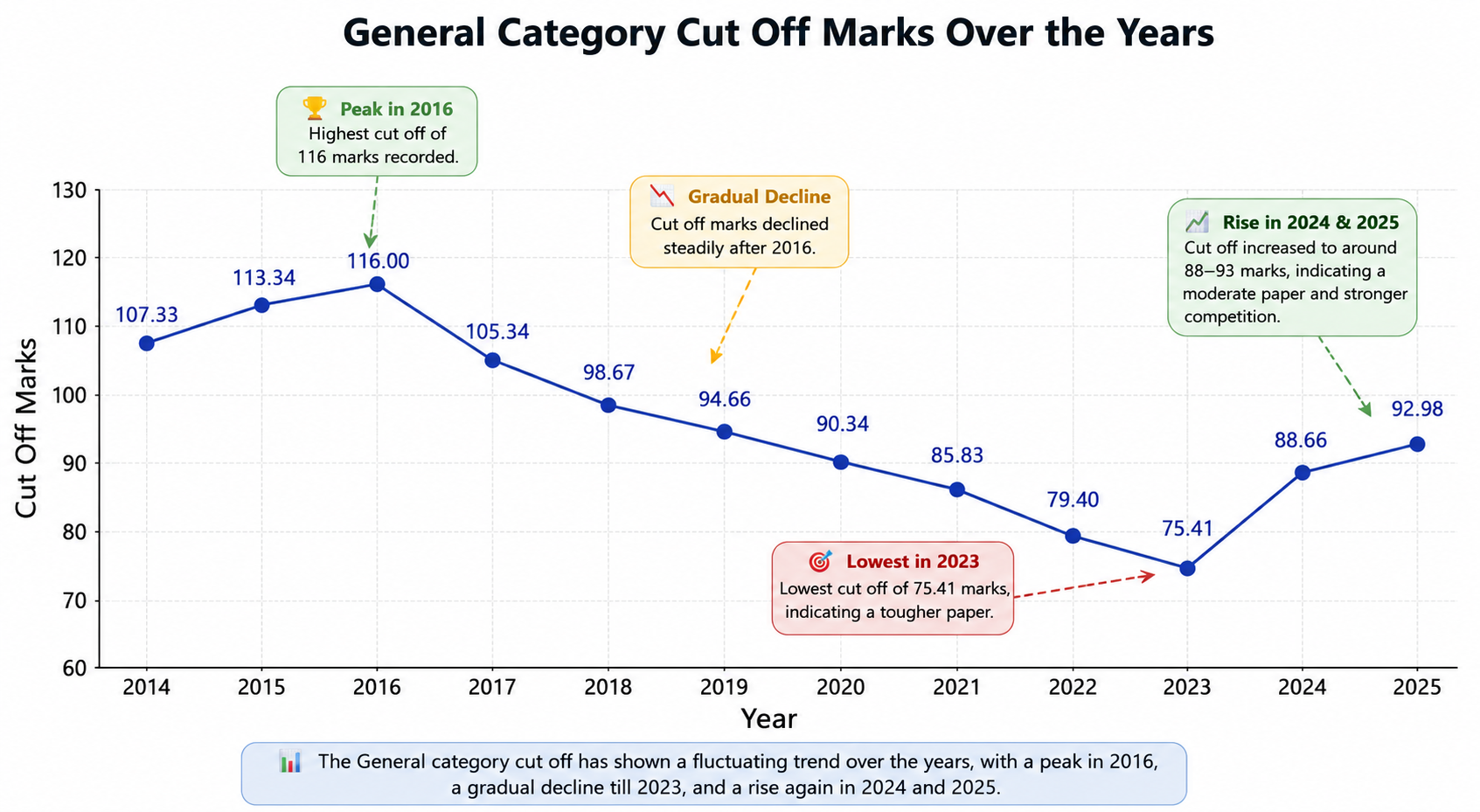
Overall Trend in General Category Cut Off:
The General category cut off has shown a fluctuating trend over the years. After reaching a high of 116 marks in 2016, it gradually declined in subsequent years. The lowest cut off was recorded in 2023 (75.41 marks), indicating a tougher paper. However, in 2024 and 2025, the cut off rose again to around 88–93 marks, suggesting a moderate paper and increased competition among aspirants.
OBC Category Trend
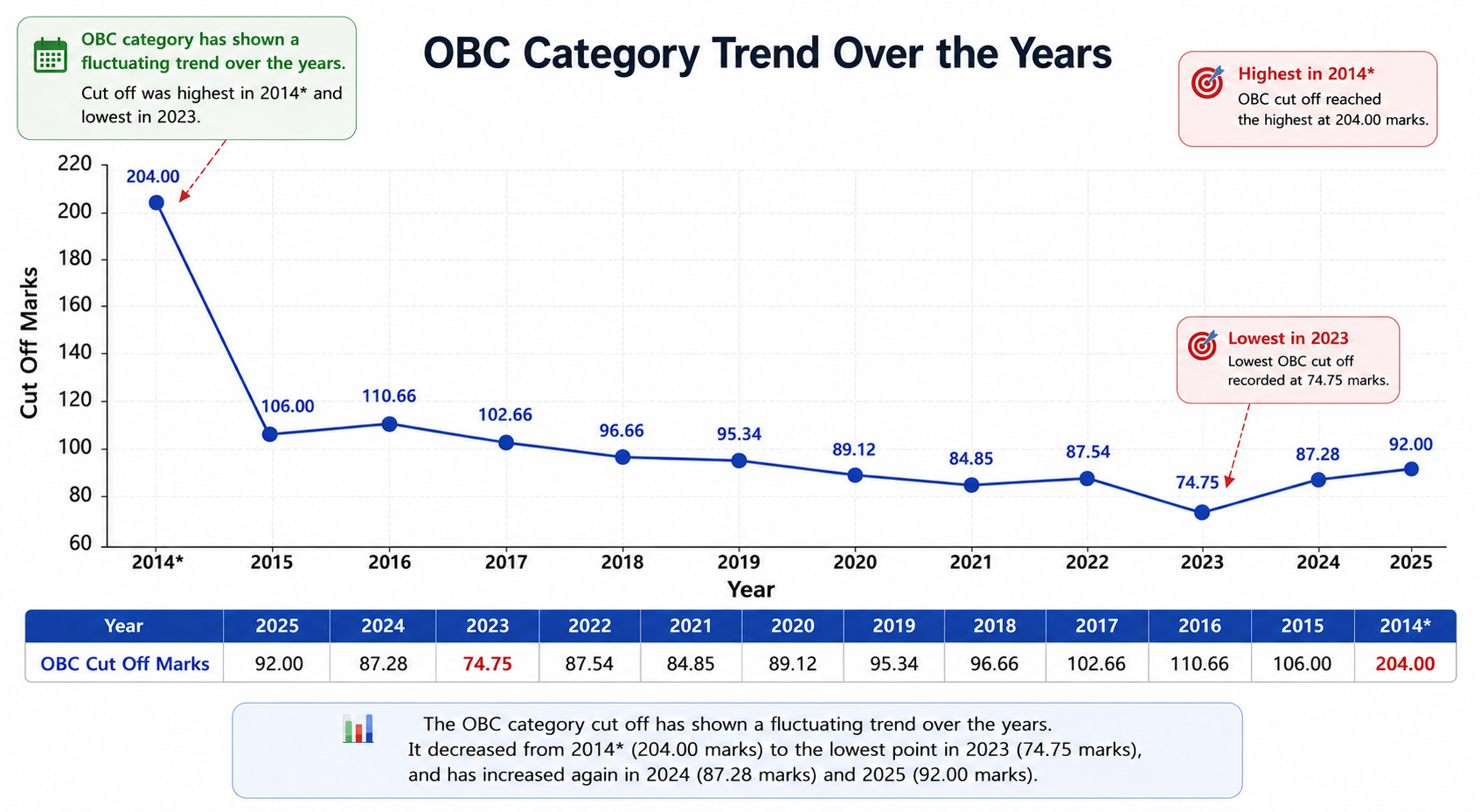
The OBC category cut off has consistently remained very close to the General category cut off, with the gap generally staying within 1–5 marks. Similar to the General category trend, the OBC cut off witnessed a sharp decline in 2023, followed by a recovery in 2024 and 2025, indicating improving score trends and moderate exam difficulty.
SC and ST Category Trends
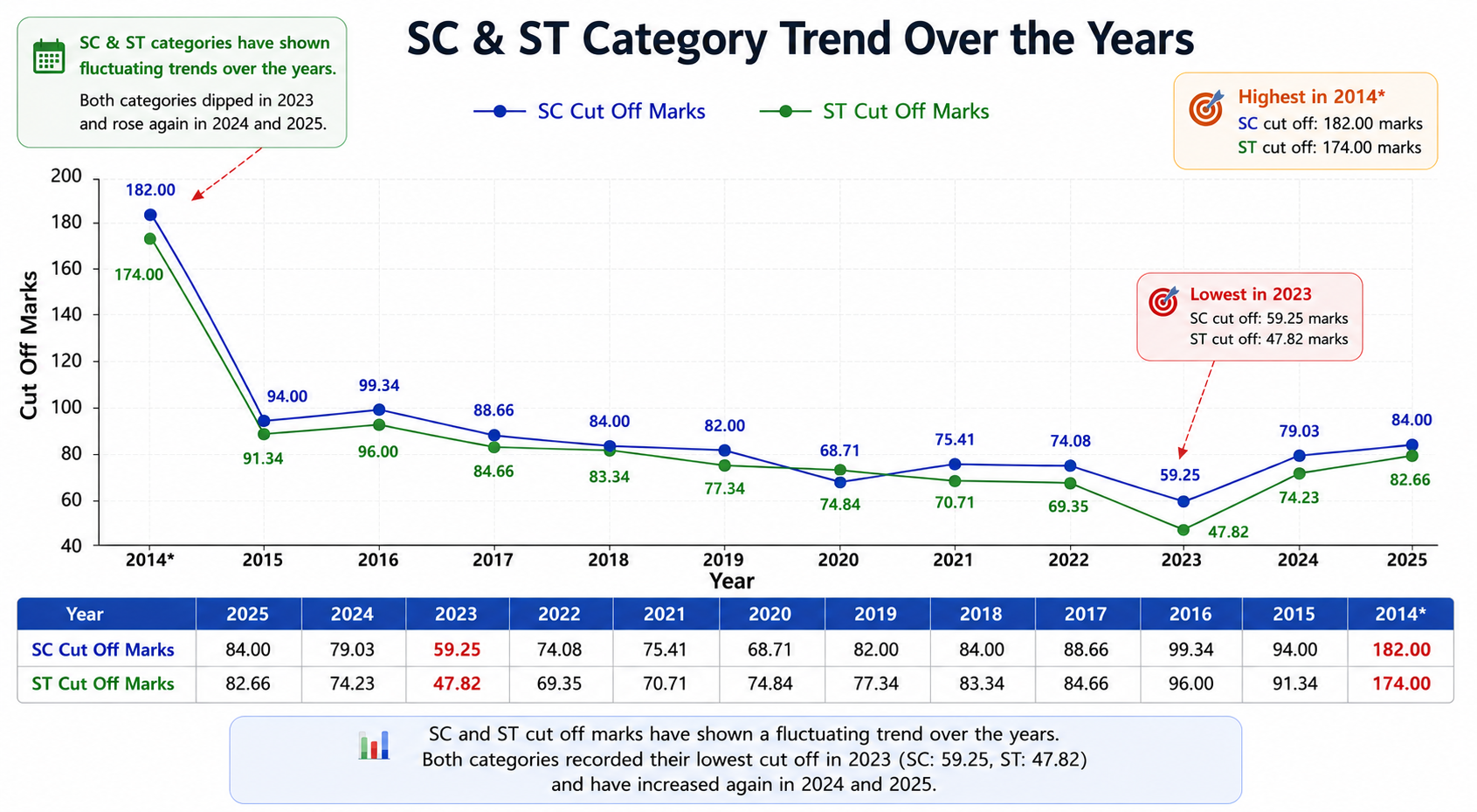
The SC and ST category cut offs have consistently remained significantly lower than the General and OBC categories. A major decline was observed in 2023, particularly in the ST category, where the cut off dropped to 47.82 marks, indicating a highly difficult paper. However, the cut offs recovered strongly in 2024 and 2025, reflecting a return to moderate exam difficulty and improved scoring patterns.
EWS Category Trend
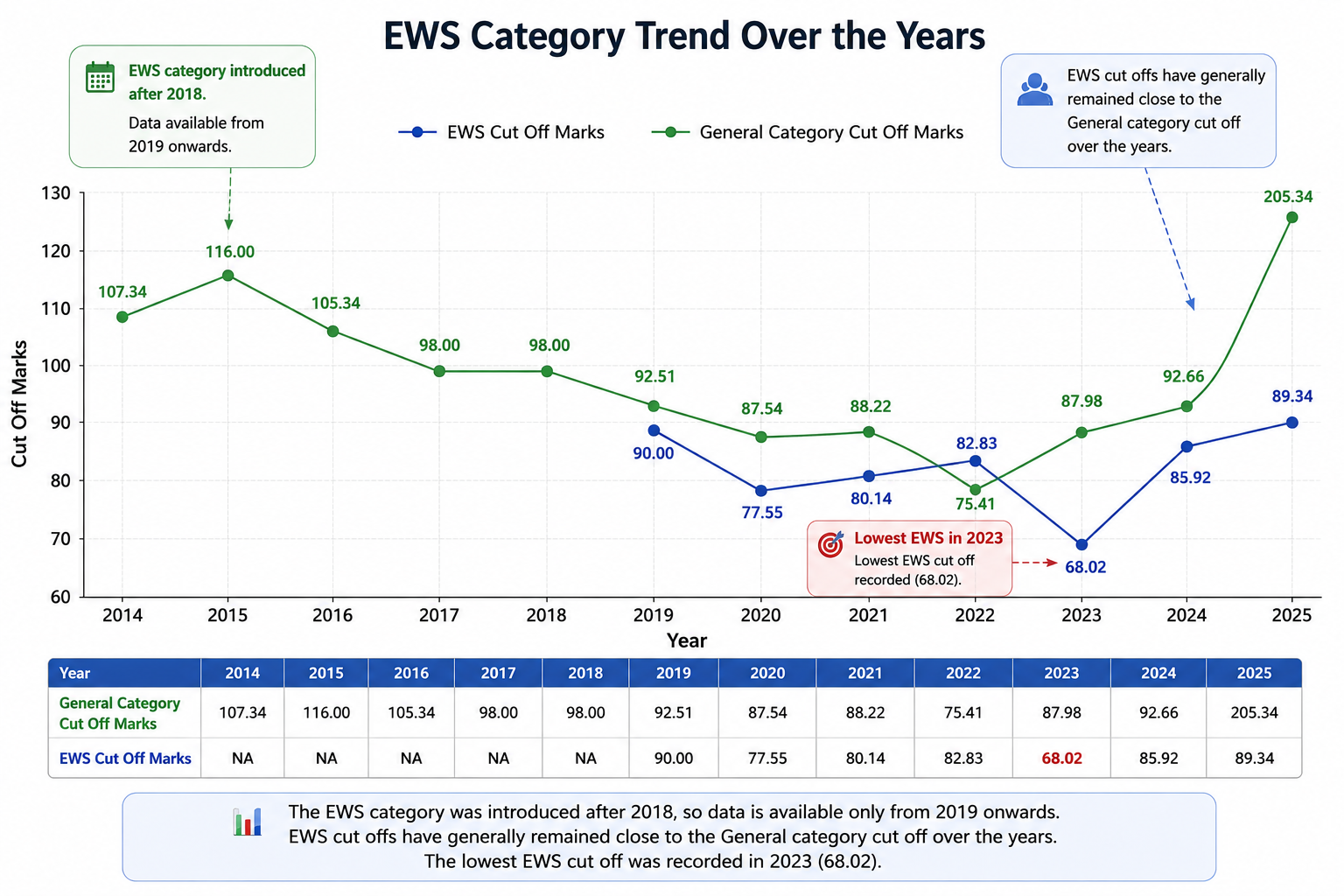
The EWS category cut off, introduced after 2018, has data available only from 2019 onwards. The EWS cut offs have generally remained close to the General category cut off, reflecting similar competition levels. The lowest EWS cut off was recorded in 2023 (68.02 marks), indicating a comparatively tough examination year.
PwBD Category Trends
The PwBD category cut offs have shown varied trends across different sub-categories. PwBD-1 and PwBD-2 witnessed higher fluctuations compared to other categories over the years. In contrast, PwBD-3 remained relatively stable around the 40-mark range in most years. Meanwhile, PwBD-5 displayed significant variation, with its highest cut off recorded in 2015 (68.34 marks).
Figure: Graph showing PwBD cut-off trends with fluctuating PwBD-1 and PwBD-2, stable PwBD-3 and variable PwBD-5.
Key Observations from the Trend Analysis
The trends from 2014–2025 clearly show that cut offs fluctuate significantly, making strategic preparation more important than prediction.
For UPSC CSE 2026, the expected General category cut off is likely to remain around 90–100 marks as per expert led interpretation. However, aspirants should aim well above the expected range to stay on the safer side.
The key takeaway is simple - focus on maximizing GS Paper-I marks, comfortably qualifying CSAT and maintaining consistency, accuracy and revision. In the end, success in Prelims depends less on cutoff speculation and more on smart preparation and exam temperament.
Complete UPSC Mains Answer Writing, Test Series & Mentorship Programme
Start Your UPSC 2027 Preparation Early with India’s Top Faculty at APTI PLUS
Explore our UPSC Courses | Book Free Demo Class Now
Generally, yes. More vacancies mean UPSC will select a larger pool of candidates for the Mains exam (usually 12–13 times the number of seats), which can pull the cutoff down. However, if the paper happens to be very easy that year, the cutoff might still rise despite more vacancies.
If there is a tie in the final stage, UPSC breaks it by prioritizing the candidate with higher total marks in the Main written papers plus the Interview. If a tie still persists, the candidate who is senior in age is ranked higher.
Given that recent cutoffs have climbed back into the 88–93 range, aiming for a consistent buffer score of 105+ in mock tests is considered the ideal safety benchmark for General/OBC candidates to offset unpredictable exam conditions.
As per the official notification released by the Union Public Service Commission, there are approximately 933 vacancies for the 2026 exam cycle, which includes 33 seats horizontally reserved for Persons with Benchmark Disabilities (PwBD).
UPSC typically qualifies candidates for the Mains written stage at a ratio of 12 to 13 times the number of vacancies. For 933 posts, expect roughly 11,200 to 12,100 candidates to clear the Prelims boundary line.
While service-wise allocations can adjust slightly based on final cadre confirmation, the Indian Administrative Service (IAS) intake is maintained at its steady cap of 180 seats. The Indian Police Service (IPS) is allocated 150 seats for the 2026 batch.
The 2026 count of 933 indicates a contraction in intake after a brief upward trend. It is a slight drop from 2025 (979 seats) and a more noticeable decline from the peak recruitment year of 2023, which saw 1,105 vacancies.
The 33 reserved posts are categorized into: 11 seats for Deaf and Hard of Hearing, 8 seats for Locomotor Disability, 7 seats for Blindness and Low Vision and 7 seats for Multiple Disabilities.
UPSC has actively modified its question architecture, moving away from classic "1, 2 and 3 only" options to "Only one pair," "Only two pairs," or tough statement-reasoning formats. This effectively demands precise, fundamental knowledge rather than smart guessing.
© 2026 iasgyan. All right reserved