THE ECONOMICS OF HAPPINESS
Introduction
- According to Researchers there is a strong correlation between wealth and happiness. They say:
“Rich people and nations are happier than their poor counterparts.”
- But they also note that money’s impact on happiness isn’t as large as we might think.
- Economists and national leaders are increasingly talking about measuring a country’s status with other metrics and even with “Happiness.”
- This is clearly a paradox as most people want more income and strive for it. In this article we shall be decoding the curious relationship between Money and Happiness.

The case for money = happiness
World Happiness Report 2020 International Monetary Fund 2017 Report
|
S.No.
|
The least happy African countries are
|
Poorest Countries are (2017)
|
|
1
|
Bangui/Central African Republic (178th)
|
Central African Republic: GNI per capita: $663 &GDP: $3.1 billion
|
|
2
|
Kigali/Rwanda (176th)
|
Rwanda: GNI per capita: $1,814 &GDP: $22.7 billion
|
|
3
|
Antananarivo/Madagascar (172nd)
|
Madagascar: GNI per capita: $1,339 &GDP: $36.2 billion
|
|
4
|
Harare/Zimbabwe (171st)
|
Zimbabwe: GNI per capita: $1,990 & GDP: $36.6 billion
|
So, there is a clear correlation between Happiness and Income of a country.
- Harvard Business School Report
A 2003 research paper “The Macroeconomics of Happiness” by Harvard Business showed that reported happiness monotonically increases with income, and decreases during economic shocks such as a recession. The paper showed that reported happiness is strongly correlated to GDP across countries.
The case for why money ≠ happiness
- Gallop World Poll: It shows that the relationship between subjective well-being and income is often weak. Low-income countries in Africa and South Asia are the exceptions though.
- Daniel Kahneman‘s Research: It reported that the correlation between household income and reported life satisfaction or happiness with life typically ranges from 0.15 to 0.30.
- Richard Layard’s Research: Professor Richard Layard in his book, “Happiness: Lessons from a New Science” writes that people are no happier today than they were 50 years ago. This is despite incomes more than doubling in that time period. This paradox is equally true for the UK, US and Japan.
Professor Layard’s research says that money has far greater impact in only those nations which are below the poverty line.
- 'Easterlin Paradox’: The 'Easterlin Paradox' states that at a point in time happiness varies directly with income both among and within nations. But over time happiness does not trend upward as income continues to grow. In the mid-70s, economist Richard Easterlin showed that despite a steadily growing American economy over the previous decades, the average happiness had remained almost unaltered.
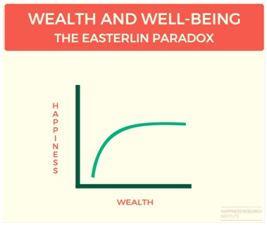
According to Researchers, as the income increases, the lifestyle grows with it. As our lifestyle becomes more expensive so we have to work harder to earn more. We think that if only we got another raise, then we would have “Enough” and we would be happy. But in all likelihood, we just repeat the process by spending even more. Psychologists call this vicious cycle the hedonic treadmill.
People on the hedonic treadmill think they’d be happy if they just had a little more money. But when they get more money, they discover something else they want. Because they’re never content with what they have, they can never have “Enough”.
- London School of Economics Report: London School of Economics suggests mental health has greater impact on reported life satisfaction than income. To put it in numbers, income gaps explain only 1%of the variation in happiness in the community whereas differences in emotional well-being explain over 4%. There is very little evidence that income drives happiness.
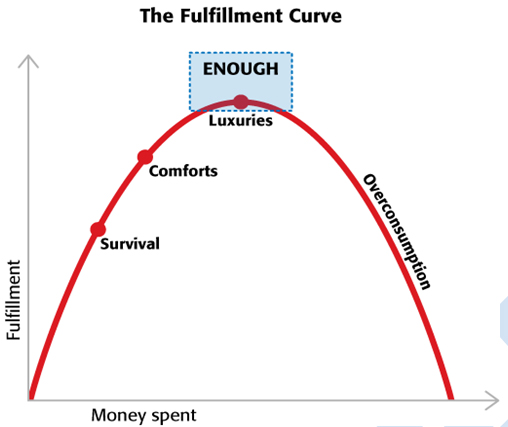
This curve suggests that the relationship between spending and happiness is non-linear. More spending does lead to more fulfillments—up to a point. But spending too much can actually have a negative impact on the quality of life.
- Abraham Maslow’s Theory on the “Hierarchy of Needs”: Abraham Maslow did a comprehensive study which involved interviewing exemplary personalities like Albert Einstein and Eleonor Roosevelt.
Then he made a list of key human needs (ingredients) that he found were necessary for optimum psychological health and happiness.
He came to categories a hierarchical list of needs that need to be fulfilled for increased life satisfaction.
5.png) SELF — ACTUALIZATION (the “highest” need)
SELF — ACTUALIZATION (the “highest” need)
This is where Maslow had seen the most successful people had reached.
- Where one is acting in true accordance with oneself
- Fulfilling one’s true, maximum potential
- Such people are found to experience a strong, grounded sense of well-being and satisfaction with their lives
- They are independent thinkers, not overly influenced by general culture
Maslow termed the bottom 4 needs as the “deficiency needs” — these are the fundamentals that humans cannot do without.
Once these are satisfied and one is a ‘healthy person’, and becomes motivated by the pursuit of self-actualization.
From Abraham Maslow’s Research it can be concluded that beyond ‘physiological’ and ‘safety’ needs, income has no role.
Happiness as the new measure of well being
There is a lot of discontent over the conventional measures of well-being, including measures such as per capita incomes and gross domestic product (GDP). Thus, there are talks of considering “Happiness as the new GDP"
|
Issues with GDP
“The gross national product does not allow for the health of our children, the quality of their education, or the joy of their play. It does not include the beauty of our poetry or the strength of our marriages; the intelligence of our public debate or the integrity of our public officials. It measures neither our wit nor our courage; neither our wisdom nor our learning; neither our compassion nor our devotion to our country; it measures everything, in short, except that which makes life worthwhile.” ― Robert F. Kennedy
GDP can’t distinguish between economic activities that increase a nation’s wealth and ones that eat into its natural disasters, curbing pollution etc--- Basically Negative Externalities.
Many things of value in life cannot be fully captured by GDP, but they can be measured by metrics of health, education, political freedom, and the like. In the 1980s Amartya Sen began to distinguish between “commodities,” which show up in GDP, and “capabilities,” which do not.
Sen’s and Mehbub Ul Haq’s efforts helped in supplanting GDP with HDI (” Human Development Index”).
Compiling GDP involves making a lot of choices, and even reasonable choices can lead to skewed results. Example: unpaid household work, although clearly of great economic importance, are left out of the calculations. And the value of government programs, including health care provision, is generally underrepresented.
Instance of 1990s Globalization
Developing nations with lots of foreign direct investment saw GDP grow much faster than GNP would have—but didn’t necessarily reap the benefits, because the investments’ profits went mostly to multinational corporations only.
|
Various Efforts made
- Since the 1970s, Bhutan has been using an index of Gross National Happiness instead of GDP to measure success.
- Many other countries have been trying to replicate the Bhutan model of happiness maximization.
- In the US, for instance, the state of Maryland officially reports a measure called Genuine Progress Indicator which accounts for inequality, environmental degradation, health, and leisure.
- In 2016, Madhya Pradesh became the first Indian state to set up a “Department of Happiness”.
1.png)
|
"Gross National Happiness"
The term "Gross National Happiness" was coined in 1972 by Sicco Mansholt, one of the Founding Fathers of the European Union. Bhutan's fourth King, Jigme Singye Wangchuck popularized the concept in the late 1990s.
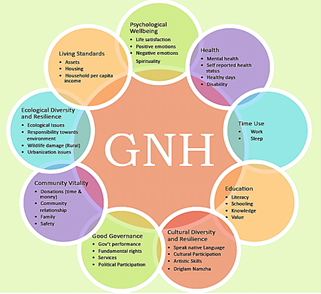
Gross National Happiness is a philosophy that guides the government of Bhutan. It includes an index which is used to measure the collective happiness and well-being of a population. 20th March has been declared as the International Day of Happiness by the UN in 2012.
4.png)
The Gross National Happiness Index is a single number index developed from 33 indicators categorized under nine domains. The GNH Index is constructed based upon a robust multidimensional methodology known as the Alkire-Foster method. The GNH Index is designed to create policy incentives for the government, NGOs and businesses of Bhutan to increase GNH. The 33 indicators under the nine domains aim to emphasize different aspects of wellbeing and different ways of meeting these underlying human needs.
 1.png)
Better Life Index
The Organization for Economic Cooperation and Development (OECD) through its Better Life Index, it is conducting an impressive work programme to analyse quality of life in the 34 developed countries that constitute its membership. The OECD index provides a broad overview of quality life, measuring the performance of countries on various important issues, from housing to environment and from civic engagement to life satisfaction. Like the Gross National Happiness (GNH) concept, the Better Life Index indicates what the good places to live are in a much broader sense than the mere economic data of GDP could do. Wealth’s correlation with happiness is limited at best, scientists have shown time and again.
But there remains a problem with this kind of national indices: they provide national averages – and do not say anything about the extremes and the equality of the data.
World Happiness Report
The World Happiness Report is a publication of the United Nations Sustainable Development Solutions Network. It contains articles and rankings of national happiness, based on respondent ratings of their own lives, which the report also correlates with various (quality of) life factors. The report primarily uses data from the Gallup World Poll.
|
India and Happiness
- India was ranked at a dismal 144 out of 156 nations at World Happiness Report 2020.
- India scored 3.573 points, ranking lower than Pakistan which secured 5.693 points.
- The World Happiness Report 2020 for the first time ranked cities around the world by their subjective well-being and digs more deeply into how the social, urban and natural environments combine to affect our happiness.
Delhi’s ‘happiness curriculum’
- The curriculum calls for schools in India to promote development in cognition, language, literacy, numeracy and the arts along with addressing the well-being and happiness of students.
- It further says that future citizens need to be “mindful, aware, awakened, empathetic, firmly rooted in their identity.
- It is based on the premise that education has a larger purpose, which cannot be in isolation from the “dire needs” of today’s society.
So, if making people happy is so important, why are policymakers not making it their primary target?
Replacing GDP with Happiness Index
Will we truly be better off with a happiness index replacing the GDP (and the related measure of per-capita income)?
- The answer suggested by a wide body of research is a big “NO”. And the reason is simple: measuring Happiness is really difficult.
For instance,
- The 2016 World Happiness Report. The report is based on responses to questions such as “how people see their lives", where people are asked to evaluate their current lives on a scale of 0 to 10.
- The other popular survey, by Gallup, asks people about their experiences and feelings— “smiling, stress, pain, enjoyment"—responses to which are then combined to create an index.
- The problem with such methodologies is that the data, or the answers to the questions, are not independent of space and time.
- In some countries, people might shy away from responding positively even when they are actually “happy".
- On the other hand, some people may be compelled to respond that they are satisfied with their lives because of Societal and Political pressures.
- This makes the cross-country comparison of happiness deeply problematic.
- The reliability of surveys in tracking happiness over time is extremely dodgy.
- So, the mission to replace GDP with a happiness index is doomed to fail.
GDP: The more reliable measure
- Despite its fair share of problems, the measurement of GDP is a fairly robust exercise.
- The GDP measures the total output of all goods and services produced using prices as a common metric of value.
- Although it often excludes the informal economy or unpaid labour, the fixity of its definition across countries and over time makes it a reliable yardstick.
Opinion of the Economists
- Economists and economic policy-makers do not wish to accord primacy to the pursuit of happiness.
- They believe that it is inextricably linked to the pursuit of money and material well-being.
- Many economists think that money does buy happiness, at least till a certain level of income.
- In a 2010 study the Nobel Prize-winning economist Angus Deaton and the psychologist Daniel Kahneman took the Gallup poll data for about 500,000 residents in the US. It showed that happiness increases with income although there is an upper bound beyond which the income effect dissipates.
- Deaton and Kahneman also put a number to it: $75,000.
- Anything that goes beyond $75,000 doesn’t add anything to emotional well-being.
Conclusion and Way Ahead
- Various World Happiness Reports indicate that the variation in well-being as measured by happiness indices is well explained by economic variables like GDP.
- The pursuit of happiness, at least for the developing world, lies in the pursuit of wealth and material well-being.
- So, for a long time, developing nations have rightly looked up to economically thriving nations. GNP and GDP were major goals for these nations.
1.png)
- However, now more and more developing nations such as Bhutan are looking for a model of nations that promote citizens’ subjective well-being.
- Just as many developing nations used to look up to the United States and other economic powerhouses, many nations, including economically developed nations (e.g., Japan, South Korea), are now looking up to Denmark and other happy societies.
- In conclusion it can be said that an ideal society is a society where citizens feel happy, feel satisfied, and find their lives to be meaningful.
- Self-reported well-being helps to evaluate the effectiveness of certain public policies.
- It also helps in monitoring citizens’ subjective perspective on how well they are doing and how well a society as a whole is doing.
- Citizens’ well-being should be assessed periodically using various measures, ranging from
- global life satisfaction and happiness to
- domain-specific satisfaction to
- stress and pain.
- The periodical recording (e.g., monthly, quarterly) of citizens’ well-being will allow policy makers and researchers to test empirically whether a certain policy had an intended effect.
- It will also help in gauging whether a society is making progress toward its ideal.