Description
Disclaimer: Copyright infringement not intended.
Context
The occurrence and implications of the "Fujiwhara effect."
Details
- The United States West Coast has experienced unusual weather phenomena recently, including Hurricane Hilary.
- The National Hurricane Centre issued its first tropical storm watch for parts of Southern California due to this sub-tropical storm. Unusual weather events, like the "Fujiwhara effect," have been observed in the region.
Atmospheric Rivers and Fujiwhara Effect
- California witnessed an unusually wet winter with "atmospheric river" storms, carrying dense moisture in the atmosphere.
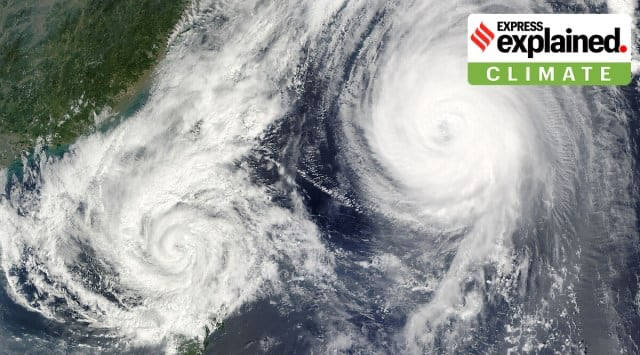
- The "Fujiwhara effect" occurs when two hurricanes or cyclones spin in the same direction and interact closely.
- These cyclones engage in an intense dance around a common center, with outcomes depending on their relative strengths.
- If one cyclone is stronger, it absorbs the weaker one. Similar-strength cyclones may merge or spin around each other before separating.
- Rarely, intense cyclones merging can form a mega cyclone with destructive potential.
- The phenomenon was first identified by Japanese meteorologist Sakuhei Fujiwhara in 1921 and observed in 1964 over the Pacific Ocean.

Outcomes Based on Cyclone Strength
Weaker Cyclone Absorption
- If one cyclone is significantly weaker than the other, it can get drawn into the circulation of the stronger cyclone.
- Eventually, the weaker cyclone is absorbed, and their individual identities are lost.
Similar-Strength Cyclones
- Cyclones of comparable strengths may either merge to form a larger cyclone or engage in a complex rotational dance.
- Their interaction results in unpredictable movements as they gravitate towards each other and exchange energy.
Intense Cyclone Merging
- In rare cases, two intense cyclones can merge, leading to the formation of a mega cyclone with heightened destructive potential.
- This merging amplifies their combined energy and can have severe consequences for coastal regions.
Historical Context and Discovery
- Identified by Japanese meteorologist Sakuhei Fujiwhara in 1921.
- The effect was first mentioned in Fujiwhara's 1921 paper.
- The phenomenon was observed over the western Pacific Ocean when Typhoons Marie and Kathy merged in 1964.
Impact and Observations
- In March 2023, the Bay Area and Southern California faced powerful winds and damage due to the Fujiwhara effect.
- Typhoon Hinnamnor and tropical storm Gardo exhibited the Fujiwhara effect, leading to casualties in South Korea.
- Hurricane scientist David Longshore noted that the effect might intensify the primary circulation of a system and make cyclonic systems harder to predict.
Relation to Climate Change
- Experts link the increasing frequency of the Fujiwhara effect to global warming and rising ocean temperatures.
- Ravi Shankar Pandey's research shows a 35% increase in typhoon strength in Taiwan between 1977 and 2016 due to rising sea surface temperatures.
|
PRACTICE QUESTION
Q) Discuss the 'Fujiwhara Effect' in the context of cyclonic interactions and its implications for weather patterns and climate change. (150 words)
|

https://indianexpress.com/article/explained/explained-climate/fujiwhara-effect-cyclones-dance-8905398/